HelloGrowthCRM software
Built for real small-business sales teams
HelloGrowthCRM helps reps qualify faster, follow up on time, and close more deals—with practical automation in one place.
- AI lead scoring and pipeline visibility
- Built-in dialer, WhatsApp, and email automation
- Sales forecasting and RevOps-ready reporting
Activity sales metrics are measurements of the actions your sales team performs daily to move prospects through the sales pipeline. These include calls made, emails sent, meetings booked, follow-ups completed, and proposals sent. Monitoring these metrics gives you insight into your team's productivity and highlights where improvements are needed to close more deals efficiently.
Why this comes up / what goes wrong
Many small business owners in the UK manage sales activities through informal methods such as WhatsApp, email, or spreadsheets. While these tools are familiar, they often lead to lost leads, missed follow-ups, and unclear visibility of sales efforts. Without clear activity sales metrics, it is difficult to understand if your team is working at full capacity or where sales processes stall. You might see good revenue numbers but lack the information to sustain growth or coach your team effectively.
Sales leaders may find it hard to pinpoint why deals are delayed or lost because they cannot track the exact sales actions taken. This lack of data leads to reactive management rather than proactive coaching and improvement.
Step-by-step
- Identify key sales activities to track: Decide which actions directly impact your sales process. Common metrics include calls made, emails sent, meetings booked, follow-ups completed, and proposals sent. These activities represent the daily effort that drives deals forward.
- Set measurable targets for each activity: For example, target 20 calls per day per salesperson or 10 follow-ups per week. Clear targets motivate your team and provide benchmarks to measure progress. Ensure targets are realistic and aligned with your sales cycle.
- Implement a system to record activities consistently: Ensure every call, email, meeting, and follow-up is logged with dates, times, and outcomes. This eliminates reliance on memory and provides accurate data for analysis. Using a CRM with task boards helps keep this organised.
- Regularly review activity data: Analyse daily or weekly reports to check if targets are met, which activities lead to deals, and where delays occur. Look for patterns such as follow-ups being skipped or calls not converting.
- Adjust sales tactics based on insights: If follow-ups are low, coach your team on discipline and prioritisation. If calls generate few meetings, improve call scripts or lead targeting. Use activity data to focus training where it matters most.
- Link sales activities to deal stages in your pipeline: Track how activities move leads through sales stages to forecast revenue more accurately and prioritise efforts. This connection helps you understand which activities have the highest impact.
Example (fictional figures)
An accountancy practice in Birmingham is tracking calls and follow-ups for April 2024.
- On 01/04/2024, a sales rep makes 15 calls.
- Each call takes about 10 minutes, so total calling time is 15 × 10 = 150 minutes.
- From those calls, 3 meetings are booked.
- By 05/04/2024, 10 follow-ups are completed.
- By 10/04/2024, 2 proposals are sent following meetings and follow-ups.
- One proposal converts to a £12,000 contract.
This tracking reveals the conversion path and where to focus sales efforts for better results. For example, if calls lead to few meetings, the rep can refine their approach. If follow-ups are low, increasing them may improve deal closure.
Common mistakes
- Not tracking sales activities at all: Leads to missed follow-ups and lost sales. Prevent this by using task boards to log every action and ensure nothing is forgotten.
- Relying on memory or informal notes: Causes inaccurate or incomplete data. Prevent with a CRM that records calls and tasks automatically, reducing human error.
- Setting unrealistic activity targets: Demotivates the team and leads to burnout. Set achievable goals based on past performance data and adjust as needed.
- Ignoring activity data when making decisions: Misses opportunities to coach and improve. Schedule regular reviews of activity reports to inform management actions.
- Separating activity tracking from deal management: Makes sales forecasting unreliable and follow-ups inconsistent. Use integrated pipelines that link activities to deals for a full picture.
- Failing to communicate the importance of activity metrics: If the team doesn’t understand why tracking matters, they may not comply. Explain how metrics help everyone succeed.
Doing this in HelloGrowthCRM
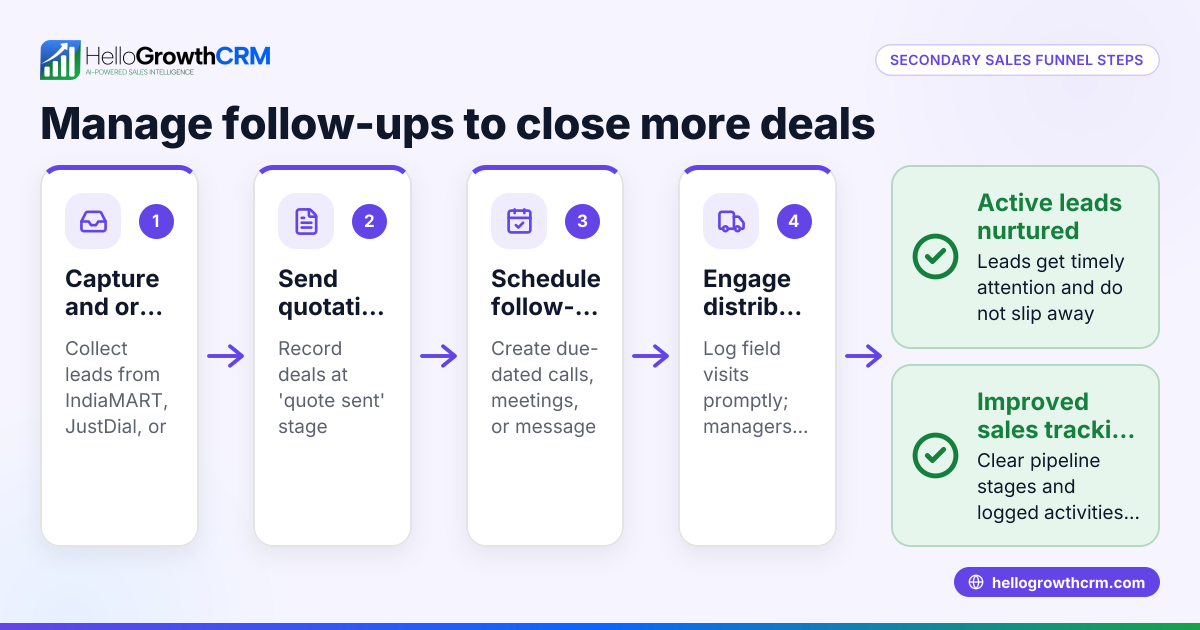
HelloGrowthCRM helps you manage activity sales metrics effectively. Its Activities and task boards turn every follow-up into a task with a due date, so the day's calls form a clear list rather than a memory test. The Deals (pipeline) feature shows quotations and deals at every stage with follow-up dates, ensuring no opportunity is forgotten. For businesses with field sales, Territories, field operations and commissions let reps log visits from their phones, and managers can see the day's beat. Learn more about HelloGrowthCRM for the United Kingdom, the built-in CRM dialer, and the WhatsApp and SMS CRM.
Frequently asked questions
What are the most important activity sales metrics to track? Focus on calls made, emails sent, meetings booked, follow-ups completed, and proposals sent. These reflect the core efforts that move leads through your sales pipeline.
How often should I review activity sales metrics? Reviewing daily or weekly provides timely insights. Daily reviews help reps stay on track, while weekly reviews allow managers to spot trends and coach the team effectively.
Can activity sales metrics predict revenue? Yes, when linked to deal stages, activity metrics help forecast sales by showing how many actions typically lead to closed deals.
How do I motivate my team to log activities consistently? Make logging easy with task boards and reminders. Set clear targets and share activity data transparently to encourage accountability.
What tools can help track activity sales metrics? CRMs with task boards, pipelines, and integrated calling features simplify tracking. HelloGrowthCRM offers these capabilities tailored for small and mid-sized UK businesses.
How do activity sales metrics improve sales forecasting? By linking activities to deal stages, you can see which actions typically result in sales. This data helps predict future revenue and allocate resources more effectively.
Key takeaways
- Activity sales metrics measure sales actions like calls, emails, meetings, and follow-ups.
- Tracking these metrics helps identify bottlenecks and improve sales efficiency.
- Use a consistent system to log activities and link them to deals.
- Regularly review activity data to coach your team and adjust tactics.
- Avoid common mistakes such as poor tracking and ignoring activity data.
- HelloGrowthCRM supports activity tracking with task boards, pipelines, and field sales tools.
Improve your sales activity tracking today. Start on the Free Forever plan (200 leads, no credit card).
Ready to put this into practice?
Set up your pipeline, WhatsApp follow-ups, and AI lead scoring in minutes — free, no credit card.
Try HelloGrowthCRM freeGet CRM tips in your inbox
Join thousands of sales professionals who get weekly insights on CRM strategy, AI automation, and pipeline optimization.

The HelloGrowthCRM team publishes guides on CRM strategy, AI sales tools, and revenue operations for small business sales teams.