HelloGrowthCRM software
Built for real small-business sales teams
HelloGrowthCRM helps reps qualify faster, follow up on time, and close more deals—with practical automation in one place.
- AI lead scoring and pipeline visibility
- Built-in dialer, WhatsApp, and email automation
- Sales forecasting and RevOps-ready reporting
AI-enhanced follow-up strategies are transforming sales processes, facilitating personal engagement with prospective customers and significantly increasing lead conversion rates. In an increasingly competitive market, the use of advanced analytics, automated systems, and intelligence-driven methodologies empowers businesses to optimize their lead follow-up approaches, driving sales success and customer loyalty. HelloGrowthCRM leverages these AI technologies to create effective and efficient follow-up strategies, ensuring sales teams can engage leads meaningfully, ultimately doubling their conversion rates.
Understanding AI Lead Follow-Up Strategies
AI lead follow-up strategies utilize advanced algorithms and machine learning techniques to analyze interactions between businesses and leads. It's a blend of data sophistication and human-like intelligence designed to enhance the way sales teams approach lead engagement. By automating mundane tasks while focusing on personalized communications, AI CRM solutions enable sales professionals to optimize their follow-up efforts significantly. HelloGrowthCRM stands at the forefront of this evolution, providing businesses with innovative tools to harness the power of AI effortlessly.
Why Follow-Up Matters in Sales
The follow-up process is a critical aspect of converting leads into customers. Statistics suggest that most sales require several interactions before a decision is made. In fact, following up consistently can increase the chances of conversion by over 70%. Here’s why effective follow-ups are indispensable:
- Nurtures Relationships: Building rapport with leads requires ongoing communication.
- Addresses Concerns: Follow-ups provide opportunities to resolve any objections or questions.
- Keeps Your Brand Top-of-Mind: Regular contact helps maintain visibility in crowded marketplaces.
- Improves Lead Understanding: Tailored follow-ups based on previous interactions can enhance your knowledge of lead interests and needs.
Incorporating AI Lead Scoring alongside traditional follow-up techniques can supercharge this process.
Key Components of AI-Enhanced Follow-Up Strategies
When implementing AI-enhanced follow-up strategies, several essential components can elevate your approach:
1. Automation of Follow-Up Tasks
Leveraging automation minimizes the time spent on repetitive follow-up actions, allowing sales representatives to focus on high-value interactions. HelloGrowthCRM offers powerful Email Automation features that ensure timely follow-ups are sent based on predetermined triggers, such as lead behavior or sales cycle milestones.
2. Smart Scheduling
AI technology helps in predicting the best times for follow-up interactions. By analyzing past interactions and lead response patterns, HelloGrowthCRM can suggest optimal times to reach out. This personalization increases the likelihood of leads engaging with follow-up messages.
3. Tailored Content Delivery
AI-driven insights enable sales teams to customize their follow-up content. Using data-driven analysis, HelloGrowthCRM helps determine what type of content resonates with specific leads, whether they prefer case studies, product demonstrations, or more general informative materials.
4. Multi-Channel Follow-Up
In today’s digital landscape, effective follow-ups extend beyond email. Utilizing various channels—such as social media, SMS, and direct calls—ensures you connect with leads on platforms they prefer. An integrated approach can improve conversion rates significantly.
5. Performance Tracking and Analytics
Continuous measurement of follow-up effectiveness is vital. Through in-depth analytical dashboards within HelloGrowthCRM, sales teams can track response rates, engagement metrics, and the overall success of their follow-up strategies, leading to data-driven decision-making.
Implementing AI-Enhanced Follow-Up Strategies
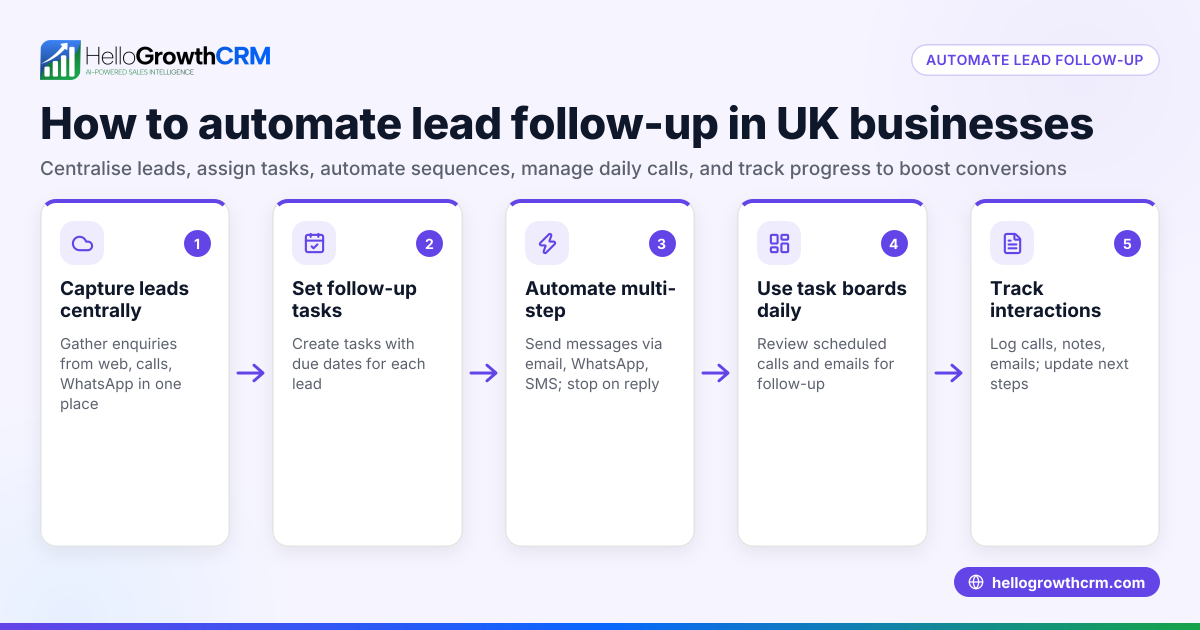
To implement AI-enhanced follow-up strategies effectively, businesses should consider the following steps:
Step 1: Analyze Your Current Processes
Start by assessing your existing follow-up processes. Identify gaps and areas for improvement. Understand how current strategies affect your conversion rates and gather data on lead behavior to inform future actions.
Step 2: Define Lead Segmentation Criteria
Develop criteria for segmenting leads based on behavior, industry, or stage in the sales funnel. Personalized follow-ups based on segmentation can lead to higher engagement rates and act as a guide for tailored content delivery.
Step 3: Leverage AI Tools
Utilize tools offered by HelloGrowthCRM to automate follow-up communications and analyze lead engagement effectively. Features like Sales Forecasting help visualize future opportunities based on previous behaviors and interactions.
Step 4: Train Your Sales Team
Invest in training your sales team on best practices for using AI tools. Ensure they understand how to interpret data generated by the system and leverage insights for personalized engagement.
Step 5: Continuously Optimize
Regularly evaluate and optimize your follow-up strategies based on performance metrics and feedback from leads. Continuous improvement will ensure you stay ahead in a dynamic marketplace.
Real-World Examples of Successful Implementation
Numerous businesses have seen tangible results from implementing AI-enhanced follow-up strategies:
- Tech Startup: After integrating HelloGrowthCRM’s AI CRM, the startup saw a 60% increase in lead engagement by implementing automated follow-ups based on website interactions.
- E-commerce Retailer: By using smart scheduling tools, the retailer improved open rates for follow-up emails by 40%, contributing to a notable increase in sales conversion.
- Professional Services Firm: Implementing multi-channel follow-up tactics through HelloGrowthCRM allowed the firm to engage leads across email, LinkedIn, and SMS, resulting in a 50% uplift in client acquisition.
These case studies highlight the profound impact that AI-enhanced follow-up strategies can have on lead conversion rates.
Common Challenges in AI-Enhanced Follow-Up Strategies
While adopting AI-enhanced follow-up strategies can provide significant benefits, organizations may encounter challenges, including:
- Data Quality: The effectiveness of AI depends heavily on the quality of the data fed into the systems. Regular audits and clean-ups are necessary for consistent performance.
- Resistance to Change: Team members may feel apprehensive about adopting new tools. Implementing a structured change management plan can mitigate this.
- Integration Difficulties: Ensuring that your existing systems integrate seamlessly with new AI tools can be a hurdle. HelloGrowthCRM's numerous Integrations help bridge connectivity gaps.
Addressing the Challenges
To tackle these challenges, consider the following actions:
- Conduct Data Audits: Regularly evaluate the integrity of your leads' data.
- Implement Change Management Programs: Support your team throughout the transition to new tools.
- Utilize Dedicated Support: Leverage HelloGrowthCRM’s customer support services for integration and training assistance.
Frequently Asked Questions (FAQ)
1. What are AI lead follow-up strategies?
AI lead follow-up strategies involve using artificial intelligence and data analytics to enhance the process of engaging leads after initial contact, with the goal of converting them into customers.
2. How can AI improve my follow-up process?
AI improves your follow-up process by automating repetitive tasks, analyzing data for optimal engagement strategies, and personalizing communications based on lead behavior.
3. What type of AI tools does HelloGrowthCRM offer?
HelloGrowthCRM provides various AI tools, including AI Lead Scoring, Email Automation, Sales Forecasting, and insights into performance analytics.
4. Can AI follow-up strategies increase conversion rates?
Yes, AI lead follow-up strategies can significantly enhance conversion rates by personalizing engagement and optimizing communication timings based on predictive analytics.
5. How do I get started with AI lead follow-up strategies?
Begin by analyzing your current follow-up processes, segmenting your leads effectively, and integrating HelloGrowthCRM's AI tools to automate and optimize your strategies.
Conclusion
In a digital age where personalization and rapid response are critical, AI-enhanced follow-up strategies can make a remarkable difference in your sales outcomes. Embracing AI tools can streamline your sales processes, improve lead engagement, and ultimately double your conversion rates.
Discover how HelloGrowthCRM can transform your lead follow-up strategies today. Start with our Free Trial or request a Demo to see the benefits firsthand! Let us help you elevate your sales strategy and achieve unparalleled success.
Implementation Checklist for How AI-Enhanced Follow-Up Strategies Can Double Your Lead Conversion Rate
Teams researching ai lead follow-up strategies usually need more than a high-level definition. They need a repeatable process, clear ownership, and a way to connect day-to-day execution back to pipeline quality and revenue outcomes. That is why the most useful version of this topic is practical: it should help a team decide what to standardize, what to automate, and what to measure first.
Start by deciding where ai lead follow-up strategies fits in the revenue workflow. For some teams it belongs near lead qualification, because better prioritization affects who gets attention first. For others it belongs in pipeline management, because the real problem is inconsistent stage movement, poor follow-up discipline, or weak forecast confidence. The exact placement matters because it determines which records, fields, and manager reviews should change after the process is introduced.
Step-by-step rollout model
- Define the business outcome the team wants from ai lead follow-up strategies. That could be faster speed-to-lead, better conversion from demo to opportunity, cleaner qualification, or fewer stalled deals.
- Identify which team owns the process day to day. A workflow with no owner usually becomes a dashboard topic instead of an execution habit.
- Decide which fields or signals are required. Keep the list narrow enough that reps can maintain it without turning the CRM into admin overhead.
- Add automations only after the workflow is clear. Good automation reduces repetitive work, but bad automation hides process problems and makes reporting less trustworthy.
- Review performance weekly. Teams improve faster when they inspect real records, not just summary charts.
What strong teams usually standardize
- A clear definition of when a lead, account, or deal qualifies for the next step
- Required fields that support follow-up, segmentation, and reporting
- Ownership rules for handoffs, reminders, and stage progression
- Manager review checkpoints for aging, conversion, and execution quality
- An escalation path for records that are blocked, stale, or missing context
Metrics to watch after rollout
When a team implements ai lead follow-up strategies well, performance should change in ways that are visible. Look at conversion rate between stages, response time, meeting creation, pipeline age, follow-up completion, and forecast confidence. If those numbers do not move after implementation, the process may be too theoretical, too hard to use, or not connected tightly enough to how reps actually work inside the CRM.
It is also useful to separate activity metrics from quality metrics. A team can appear busy while still failing to improve outcomes. Measuring both helps leadership understand whether ai lead follow-up strategies is increasing output only, or improving the quality of decisions and follow-through as well.
How HelloGrowthCRM supports this workflow
HelloGrowthCRM is most effective when the team uses it as an operating system rather than a contact database. The platform helps centralize lead records, activity history, communication, automation triggers, reporting, and follow-up actions in one place. That matters for ai lead follow-up strategies because it reduces the gap between strategy and execution. Reps can see the context, managers can inspect progress, and leaders can connect the process back to revenue performance.
For example, a team may start with a simple scoring or qualification framework, then connect it to follow-up tasks, reporting views, internal alerts, and manager dashboards. Another team may apply the same principle to messaging, meeting scheduling, outbound sequencing, or account prioritization. In each case, the system works best when the workflow is inspectable and the next step is obvious.
Common mistakes that reduce content quality and execution quality
One common mistake is treating ai lead follow-up strategies as a one-time setup instead of an ongoing operating discipline. Teams launch the framework, create a dashboard, and assume the problem is solved. In reality, the process needs feedback loops. Inputs drift, rep behavior changes, and the market evolves. Without review, even a good workflow loses accuracy.
Another mistake is overcomplicating the first version. Teams sometimes try to capture too many fields, too many exceptions, or too many automations before the basic operating model is stable. That creates resistance and lowers adoption. A better approach is to launch the smallest version that still produces measurable decisions, then add sophistication after the team trusts the workflow.
Practical FAQ extension
How long should a team give this process before judging results?
Most teams need a few weeks of consistent use before they can evaluate whether ai lead follow-up strategies is improving execution. The exact timing depends on deal cycle length and lead volume, but a workflow should usually be reviewed across multiple reporting intervals before large conclusions are drawn.
Does ai lead follow-up strategies matter only for large sales teams?
No. Smaller teams often benefit even more because a clear workflow prevents follow-up gaps and makes performance easier to inspect without adding management layers. The key is to keep the process proportional to team size.
What is the best first improvement to make?
Usually the best first improvement is clarity. Define the next step, the owner, and the required information. Once those are stable, automation and reporting become much more valuable.
Final execution notes for How AI-Enhanced Follow-Up Strategies Can Double Your Lead Conversion Rate
ai lead follow-up strategies becomes commercially valuable when it helps a team move faster with more confidence, not when it just adds vocabulary. The teams that get the best results usually connect workflow design, data hygiene, automation, and manager inspection into one rhythm. That is the lens readers should use when evaluating any approach connected to HelloGrowthCRM.
Frequently Asked Questions
Ready to put this into practice?
Set up your pipeline, WhatsApp follow-ups, and AI lead scoring in minutes — free, no credit card.
Try HelloGrowthCRM freeGet CRM tips in your inbox
Join thousands of sales professionals who get weekly insights on CRM strategy, AI automation, and pipeline optimization.

The HelloGrowthCRM team publishes guides on CRM strategy, AI sales tools, and revenue operations for small business sales teams.