HelloGrowthCRM software
Built for real small-business sales teams
HelloGrowthCRM helps reps qualify faster, follow up on time, and close more deals—with practical automation in one place.
- AI lead scoring and pipeline visibility
- Built-in dialer, WhatsApp, and email automation
- Sales forecasting and RevOps-ready reporting
A strategy call is a structured sales conversation with a high-intent lead who wants to understand fit, timing, and next steps before buying. For US B2B teams, the goal is simple: qualify quickly, route to the right rep, and leave the call with a clear follow-up plan that moves the deal forward.
Key takeaways
- A strategy call should confirm pain, urgency, authority, budget range, and buying process.
- High-intent leads need fast routing, clean CRM ownership, and a defined follow-up sequence.
- US sales teams should document consent, email outreach rules, and call outcomes clearly.
- A good framework keeps calls consistent across founders, AEs, SDRs, and RevOps.
- AI can help score leads, suggest next steps, and reduce admin after each call.
What is a strategy call in B2B sales?
A strategy call is a scheduled conversation with a prospect who has shown real buying intent. They may have filled out a demo form, replied to outreach, asked for pricing, or requested a deeper discussion with sales.
This is not a cold call. It is also not just a generic product demo.
A strong strategy call sits between discovery and solution design. You are trying to learn whether the account is a fit, whether the timing is real, and what should happen next. In many US B2B teams, this call is where pipeline quality either improves or falls apart.
If the rep asks vague questions, the CRM fills with weak opportunities. If the rep follows a clear framework, the team can forecast better, hand off cleaner, and spend time on deals that can actually close.
For a founder-led sales team in Chicago or a RevOps-led team in Houston, the basics are the same. You need a standard process that helps every rep gather the right details without making the call feel robotic.
Why do strategy calls matter for US B2B sales teams?
They matter because high-intent leads are expensive to generate and easy to waste. If your team responds slowly, asks inconsistent questions, or forgets follow-up, your best leads go cold.
A strategy call gives your team a checkpoint. It answers five practical questions:
- Is this a real sales opportunity?
- Is this the right contact?
- Is there a problem worth solving now?
- Does your team have a realistic path to win?
- What is the next step, by date, with owner assigned?
For US B2B businesses, this structure also supports cleaner operations. Your team can tie lead source to revenue, keep call notes in one system, and avoid scattered follow-up across inboxes, spreadsheets, and personal phones.
When strategy calls are handled well, several things improve:
- Conversion from inbound lead to qualified opportunity
- Rep response time
- Forecast accuracy
- Handoff from SDR to AE
- Follow-up consistency
- CRM data quality
That is why many growing teams treat the strategy call as an operational workflow, not just a rep skill.
What should happen on a strategy call?
A good strategy call should confirm fit, uncover urgency, identify decision-makers, and secure a clear next step. By the end, the rep should know whether to advance, nurture, disqualify, or route the lead elsewhere.
Under the hood, the call should gather enough detail for sales, RevOps, and leadership to act on the opportunity. That means the rep needs a repeatable structure.
1. Open with context and intent
Start by explaining the purpose of the call in plain language. Keep it short.
For example:
“Thanks for making time. I want to understand your goals, how you handle this today, and whether it makes sense to go deeper. If it does, we can agree on next steps before we wrap up.”
This lowers pressure. It also gives the buyer a simple roadmap.
2. Confirm why they booked
Ask what triggered the meeting. Do not assume the form fill tells the whole story.
Useful questions include:
- What made you book the call now?
- What changed in the last 30 to 90 days?
- What are you hoping to get out of this conversation?
This helps you separate casual curiosity from active buying intent.
3. Understand the business problem
Now move into the current state. Focus on pain, process, and impact.
Ask about:
- The current workflow
- What is breaking or slowing down
- Who feels the pain most
- How the problem affects revenue, margin, speed, or visibility
In US B2B sales, buyers often care about practical outcomes. They may want fewer manual tasks, better handoffs, stronger reporting, or faster rep follow-up. Tie your questions to business results.
4. Qualify the account
You do not need a rigid script, but you do need consistent data.
At minimum, capture:
- Company size
- Industry
- Team structure
- Existing tools
- Budget range
- Buying timeline
- Decision-makers
- Technical or security requirements
For example, if the buyer mentions procurement, legal review, or SOC 2 expectations, that may affect timeline. If they use QuickBooks, Stripe, or a manufacturing ERP, that may affect integration needs and rollout scope.
5. Agree on the next step live
Never end with “I’ll follow up sometime next week.”
Instead, lock in one next action:
- Schedule a tailored demo
- Invite additional stakeholders
- Send a specific proposal
- Start a pilot discussion
- Move to nurture if timing is not right
- Disqualify respectfully if there is no fit
Put the date and owner in the CRM before the rep moves on.
How do you qualify high-intent leads without making the call feel scripted?
Use a fixed checklist, not a fixed script. Ask the same categories each time, but in natural language. That gives reps consistency while keeping the conversation human.
The best reps sound flexible because they know what must be learned, not because they improvise everything.
Use a qualification scorecard
A simple scorecard helps your team compare opportunities fairly. You can score each area as strong, medium, or weak.
Core categories:
- Pain severity
- Urgency
- Authority
- Budget reality
- Fit with your solution
- Implementation readiness
- Clear next step
This is where an AI lead scoring workflow can help. It can flag leads that match your ideal profile, surface missing fields, and help the team prioritize who needs immediate attention.
Listen for signal, not just answers
A prospect may say they are “exploring options.” That alone tells you very little. Listen for proof of motion.
Higher-intent signals include:
- A current system is failing
- Leadership asked for a solution this quarter
- Budget has been discussed
- A cross-functional buying group is forming
- The buyer wants security or implementation details
- A deadline is attached to a business event
Lower-intent signals include:
- No defined problem
- No owner
- No urgency
- No timeline
- No willingness to involve others
Capture disqualification reasons clearly
Disqualification is useful when documented well. It keeps the pipeline honest and improves future routing.
Common reasons include:
- No real business pain
- Budget mismatch
- Wrong contact
- Timing pushed far out
- Missing required functionality
- Not ready for internal change
Do not leave these as free-text notes only. Standardize them in your CRM.
How should leads be routed after a strategy call?
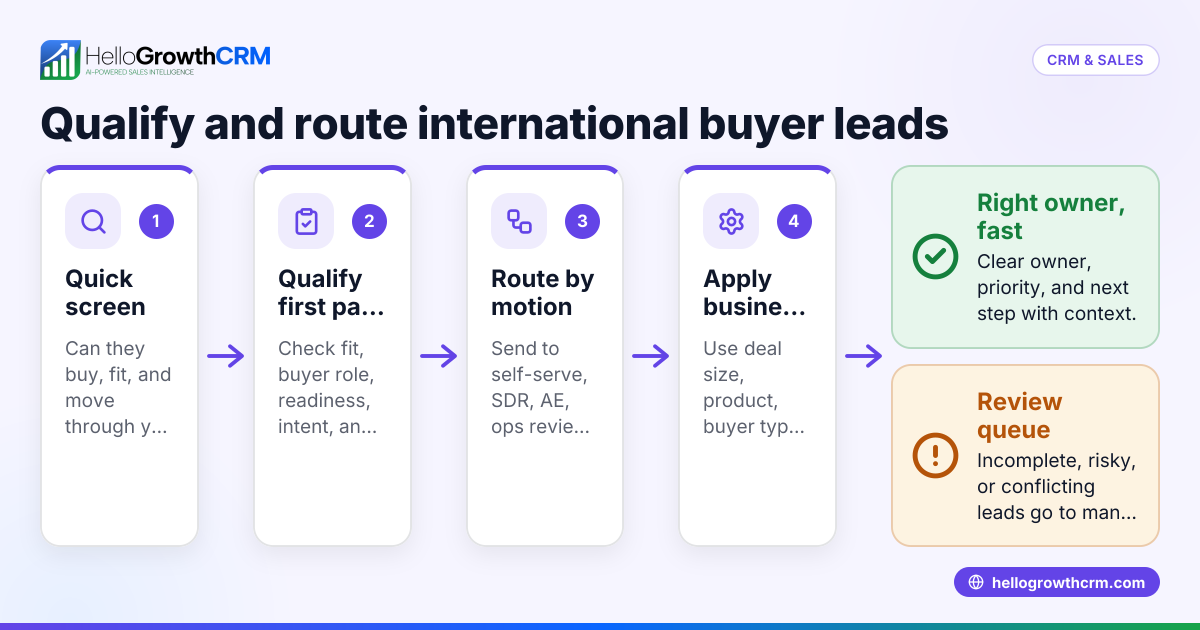
Route leads based on fit, urgency, territory, and sales motion. The faster your team assigns ownership, the lower the chance of dropped follow-up and duplicate outreach.
Routing should be rules-based whenever possible.
Build a simple routing model
Most US B2B teams can start with four paths:
- Advance to AE
Good fit, real urgency, clear next step. - Keep with SDR or founder
Early-stage interest, but needs more qualification. - Send to nurture
Fit is decent, but timeline is later. - Disqualify and close
No meaningful path to revenue.
Routing rules should consider:
- Company size
- Industry
- Inbound source
- Product interest
- Geography if your team uses territories
- Deal size potential
- Implementation complexity
A lead from a manufacturing company in Detroit with ERP integration needs may require a different owner than a simple SMB buyer asking for fast deployment.
Avoid common routing mistakes
The most common problems are not strategic. They are operational.
Watch for:
- Leads sitting unassigned for hours
- Two reps contacting the same account
- Strategy call notes stored outside the CRM
- No owner for next action
- Handovers with no summary
- Nurture leads left untouched
An AI CRM can help by assigning records, tracking ownership, and keeping notes, tasks, and activity in one place. The point is not more software. The point is fewer dropped balls.
What should the follow-up look like after a strategy call?
Send a short recap the same day, restate the business problem, confirm next steps, and assign dates. Good follow-up reduces confusion and keeps momentum while the conversation is still fresh.
That first message should be useful, not generic.
Use a same-day follow-up template
Your follow-up should include:
- Thanks for the conversation
- The main problem you heard
- The desired outcome
- Agreed next step
- Date and attendees
- Any documents or answers promised
A practical example:
“Thanks for the call today. You shared that your team is losing inbound leads because follow-up is split across inboxes and spreadsheets. Your goal is to improve speed-to-lead and reporting before Q4 planning. Next step: a 45-minute demo on 10/16/2026 with sales and ops. I’ll send the calendar invite today.”
This is short, clear, and easy to forward internally.
Build a follow-up sequence, not a one-off email
If the lead is active, create a sequence with tasks across email and phone. For US teams, email and phone remain the default business channels. If you use text or WhatsApp, make sure your process reflects consent and your legal review, especially where outreach rules may apply under CAN-SPAM or TCPA depending on channel and use case.
A simple post-call sequence might include:
- Same-day recap email
- Calendar invite for next meeting
- Reminder one business day before
- Follow-up call if the buyer goes silent
- Re-engagement email with a specific question
- Close-lost or nurture update if timing slips
Tools like email automation help standardize this without making messages sound robotic.
Update the CRM before the day ends
This is non-negotiable. If the rep waits, details get lost.
Required fields should include:
- Call outcome
- Qualification status
- Next step
- Next meeting date
- Stakeholders
- Pain points
- Timeline
- Budget notes
- Routing path
If your team needs help maintaining that discipline, managed RevOps can support process design, field standards, and reporting.
A practical strategy call framework your team can use
Here is a simple framework that works well for small and mid-sized B2B teams in the United States.
Step 1: Pre-call review
Spend two to three minutes reviewing:
- Form details
- Source campaign
- Website behavior if available
- Prior emails
- Company size and industry
- Existing account owner
- Duplicate records
The goal is not deep research. The goal is context.
Step 2: Set the agenda
Use a short opener:
- Why they booked
- Current situation
- Desired outcome
- Next steps if there is a fit
This keeps the conversation focused.
Step 3: Diagnose the problem
Ask open questions first. Then narrow.
Examples:
- What is happening today?
- Where is the process breaking?
- What is the cost of staying with the current approach?
- Why solve this now?
Step 4: Qualify buying readiness
Ask about:
- Who is involved
- What budget process looks like
- Whether timing is tied to a quarter, launch, or operational issue
- What systems are already in place
- What approval steps exist
Step 5: Position only what matters
Do not give a full product tour. Match your solution to the problem you heard.
If the buyer cares about lead routing, show that. If they care about forecasting, focus there. If they care about tool connections, point them to relevant integrations.
Step 6: Confirm the next commitment
This should be calendar-based and mutual.
Examples:
- “Let’s schedule a technical review with your ops lead.”
- “Let’s bring in your VP of Sales for the next conversation.”
- “Let’s pause here and reconnect in January.”
Step 7: Document and trigger follow-up
Log the outcome, assign tasks, and launch the correct sequence.
This is where an ai strategy call workflow becomes useful. It can summarize the meeting, suggest follow-up tasks, and prompt the rep to fill missing fields before the record moves forward.
Where does AI actually help with strategy calls?
AI helps before, during, and after the call by reducing admin and improving consistency. It should support rep judgment, not replace it.
The biggest value usually comes from structure.
Before the call
AI can help with:
- Lead enrichment
- Duplicate detection
- Pre-call summaries
- Lead scoring
- Suggested talking points
This helps reps walk in prepared without spending 20 minutes on manual research.
During the call
Real-time help should be used carefully. The best use cases are:
- Note capture
- Question prompts
- Objection tagging
- Stakeholder detection
- Next-step reminders
The rep still needs to listen well. AI should not turn a live conversation into a checklist recital.
After the call
This is where AI often saves the most time.
Useful post-call actions include:
- Drafting recap emails
- Updating fields
- Assigning tasks
- Recommending routing
- Flagging stalled deals
- Feeding forecast data
If your team wants that support in one place, review the platform features and decide whether it fits your process.
Common mistakes that weaken strategy calls
Even strong sales teams make the same avoidable errors.
Talking too much
A strategy call is not a pitch contest. If the rep speaks most of the time, qualification usually suffers.
Asking surface-level questions
“Tell me about your business” is too broad. Ask about current process, impact, and urgency.
Skipping buying process questions
You can have pain and fit but still lose the deal if procurement, security review, or stakeholder alignment is ignored.
Ending without a real next step
A vague promise to “circle back” is not a next step.
Failing to log clean data
Bad CRM hygiene breaks routing, automation, and forecasting.
For teams that need tighter visibility, a connected sales forecasting process depends on accurate opportunity updates after each call.
How can sales leaders make strategy calls consistent across the team?
Create one framework, one scorecard, and one follow-up standard. Then coach to the process weekly using real call reviews and CRM data.
Consistency does not mean every rep sounds the same. It means every lead gets the same quality of qualification and next-step control.
Set minimum call standards
Define what must happen on every strategy call:
- Agenda set
- Pain identified
- Buying process explored
- Qualification fields completed
- Next step scheduled or reason documented
- Follow-up sent same day
Review calls with operations in mind
Do not coach only on tone and objections. Also coach on data capture and handoff quality.
Good review questions:
- Was the opportunity truly qualified?
- Were stakeholders identified?
- Was urgency proven or assumed?
- Did the rep earn a real commitment?
- Is the CRM record usable for the next person?
Read next
This article covers one part of a bigger topic. For the complete picture, read our guide to strategy call.
Ready to put this into practice?
Set up your pipeline, WhatsApp follow-ups, and AI lead scoring in minutes — free, no credit card.
Try HelloGrowthCRM freeGet CRM tips in your inbox
Join thousands of sales professionals who get weekly insights on CRM strategy, AI automation, and pipeline optimization.

The HelloGrowthCRM team publishes guides on CRM strategy, AI sales tools, and revenue operations for small business sales teams.