HelloGrowthCRM software
Built for real small-business sales teams
HelloGrowthCRM helps reps qualify faster, follow up on time, and close more deals—with practical automation in one place.
- AI lead scoring and pipeline visibility
- Built-in dialer, WhatsApp, and email automation
- Sales forecasting and RevOps-ready reporting
AI lead scoring for UK B2B is the use of CRM-based machine learning and rules to rank accounts and contacts by conversion likelihood using lawful business data, engagement signals, and workflow context, so sales teams can prioritise the right buyers faster without misusing personal data under UK GDPR or PECR.
Key Takeaways
- UK B2B teams can use AI lead scoring with Companies House data if they limit fields, define lawful purpose, and avoid using personal data for direct marketing without the right basis.
- The safest high-value inputs are company-level firmographic and filing data, first-party engagement signals, and clear buying-intent actions captured in your CRM.
- HelloGrowthCRM helps teams combine AI Lead Scoring, routing, and Email Automation so high-fit leads get faster follow-up.
- Compliance risk rises when teams enrich records with director emails, scrape unclear sources, or mix consent rules under UK GDPR and PECR.
- For most teams in London, Manchester, and Birmingham, the fastest ROI comes from scoring inbound hand-raisers, routing by territory, and automating follow-up within one CRM.
What is AI lead scoring for UK B2B teams?
AI lead scoring for UK B2B teams is a method for ranking leads with predictive models and rules that use business context, CRM activity, and selected enrichment data to estimate sales readiness while staying aligned with UK GDPR, the Data Protection Act 2018, and PECR for electronic marketing.
In practice, this means your CRM assigns points or probabilities to accounts and contacts. The model looks for signals that usually show up before pipeline creation or revenue. For a British SaaS team, those signals often include:
- Company status and age
- SIC code or sector
- Filing history and company size proxies
- Website form fills
- Email replies and meeting bookings
- Product usage or demo attendance
- Sales engagement outcomes
The key distinction in the UK is simple. Not every useful data point is equal from a compliance view. Companies House gives valuable company-level data, but you still need to think carefully before using anything tied to an identifiable person.
From a RevOps angle, the goal is not just a score. The goal is action. A good score should trigger the next workflow in your AI CRM, like routing by region, creating a task in Sales Task Boards, or starting a nurture in Email Automation.
In one rollout we did with a 12-person sales team in London, the biggest win was not model complexity. It was reducing response time for high-intent demo requests from four hours to under 20 minutes. Better routing beat fancy maths in the first 30 days.
Why Companies House data is useful for lead scoring
Companies House data is useful for lead scoring because it gives UK B2B teams a trusted, public source of company-level facts such as incorporation date, filing status, and registered details, which can improve fit scoring without relying heavily on personal data or questionable third-party enrichment.
For UK teams, this is one of the cleanest enrichment sources available. The official source is Companies House. It helps answer practical sales questions:
- Is this a live company?
- How old is the business?
- Is it likely a tiny startup or a more established firm?
- Does its legal structure match our ideal customer profile?
- Is it active in the UK market we sell into?
Useful Companies House fields for scoring
The most useful low-risk fields are usually company-level, not person-level:
- Company number
- Company status
- Incorporation date
- Registered office country
- SIC codes
- Accounts and confirmation statement filing status
- Nature of company
- Previous names where relevant to account matching
These fields help build an ideal customer profile score. For example, a Manchester software vendor might prioritise active private limited companies incorporated more than two years ago, with a UK registered office and a SIC code close to its target vertical.
Fields to treat with caution
Some fields may be public but still need careful handling if they relate to identifiable people. That includes:
- Director names
- Service addresses
- Dates of birth, even partial ones
- Personal correspondence details from third-party data providers
When I have audited pipelines like this, the common issue is over-collection. Teams often import every field because the connector allows it. That creates risk with no scoring benefit. Start with only the fields that change prioritisation or routing.
How UK GDPR, the Data Protection Act 2018, and PECR affect AI lead scoring
UK GDPR, the Data Protection Act 2018, and PECR affect AI lead scoring by setting rules on lawful use, fairness, minimisation, transparency, and electronic marketing, so UK teams must separate internal scoring for sales prioritisation from the rules that govern outreach by email, phone, SMS, and cookies.
This is where many buying teams get confused. Scoring itself and outbound marketing are not the same thing.
Use these working principles:
- UK GDPR and the Data Protection Act 2018 govern how you process personal data, including profiling and transparency. See the UK government guidance at gov.uk/data-protection.
- PECR adds specific rules for electronic marketing, cookies, and similar technologies.
- ICO guidance helps you interpret consent, legitimate interests, and direct marketing obligations. Start with the ICO.
What is usually lower risk
These uses are often lower risk when properly documented:
- Scoring at the account level using company data
- Using first-party website behaviour tied to a clear privacy notice
- Prioritising inbound enquiries based on recency and fit
- Routing leads by territory or segment in your CRM
- Using engagement from existing business relationships where rules permit
What creates more risk
Risk rises when teams:
- Buy unclear data from brokers
- Scrape personal emails from the web
- Use personal mobile numbers for SMS without a valid basis
- Drop prospects into automated sequences without PECR review
- Fail to explain profiling in privacy notices
- Keep data longer than needed
The ICO states that there were 130,000 data protection fee payers on the register in 2023 to 2024 according to its annual report, which shows how broad UK data governance expectations are across organisations: https://ico.org.uk/about-the-ico/who-we-are/annual-report-2023-24/.
What data fields are safe and useful for AI lead scoring in HelloGrowthCRM?
The safest and most useful data fields for AI lead scoring in HelloGrowthCRM combine company-level firmographics, declared first-party intent, and sales engagement events, because these fields improve ranking accuracy while reducing reliance on sensitive or unnecessary personal data.
If you are evaluating Features, think in three layers.
1. Fit data
Fit data answers, “Should we sell here at all?”
Useful fields include:
- Industry or SIC code
- Company age
- Geography such as London, Manchester, Birmingham
- Employee band if lawfully sourced
- Revenue band if lawfully sourced
- Existing tech stack where relevant
- Territory owner via Territory Management
2. Intent data
Intent data answers, “Are they showing buying behaviour now?”
Useful fields include:
- Demo request submitted
- Pricing page visits
- Repeat visits from the same company domain
- Webinar attendance
- Content downloads
- Reply sentiment captured in Smart Inbox
- Meeting booked via Meeting Scheduler
3. Engagement and process data
This layer helps sales act fast:
- Time since last touch
- Number of unanswered follow-ups
- SDR call outcome from the CRM Dialer
- Opportunity creation status
- MEDDPICC completeness
- Open task count
- Pipeline stage ageing from AI Pipeline Management
In HelloGrowthCRM, these signals can feed AI Lead Scoring and trigger downstream actions. A score of 85 might route to the London AE queue. A score jump after a pricing-page visit could create a call task and suggest a personalised email with AI Sales Copilot.
How HelloGrowthCRM automates scoring, routing, and follow-up
HelloGrowthCRM automates scoring, routing, and follow-up by combining AI lead scores, territory rules, engagement tracking, and sales workflows in one platform, so UK B2B teams can prioritise hand-raisers, assign the right owner, and launch compliant next steps without manual spreadsheet work.
This matters because scoring only pays off if reps trust it and act on it. HelloGrowthCRM connects the scoring layer to execution.
What automation looks like in practice
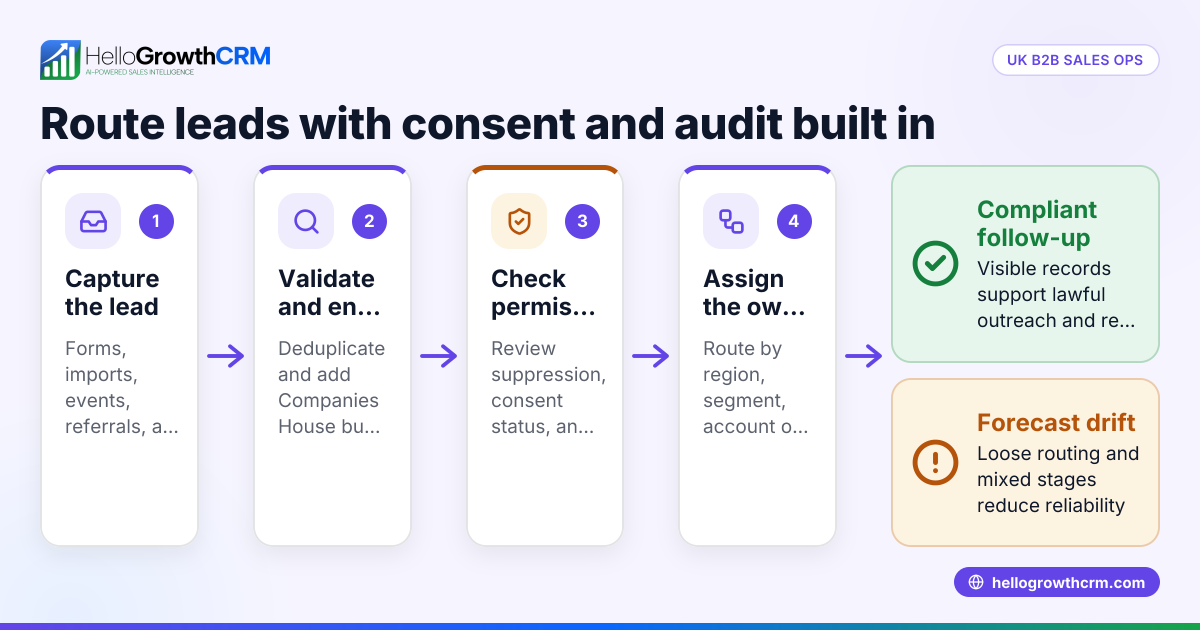
A typical workflow can be:
- A prospect from Birmingham submits a demo request.
- The CRM matches the company using domain and Companies House data.
- AI Lead Scoring calculates fit plus intent.
- Territory Management assigns the correct rep.
- A task is created in Sales Task Boards.
- A follow-up email draft is suggested in AI Sales Copilot.
- If the rep calls, the Post-Call Agent logs outcomes.
- If no response arrives, Email Automation continues the sequence.
Why buyers like this architecture
Buyers usually compare point tools against one platform. Here is the practical difference.
| Option | Strengths | Risks | Best for |
|---|---|---|---|
| Separate scoring tool + CRM + outreach tool | Flexibility and specialist tools | Higher setup effort, more syncing issues, weaker audit trail | Larger RevOps teams with admin capacity |
| HelloGrowthCRM unified workflow | Faster deployment, single source of truth, easier routing and follow-up | Less suitable if you already have a very complex enterprise stack | UK SMB and mid-market B2B teams |
| Manual spreadsheet scoring | Cheap to start | Low accuracy, slow updates, no automation, poor governance | Very early-stage teams only |
HelloGrowthCRM is our product, so that bias should be clear. Even so, for most teams under 50 reps, one-platform workflow usually beats a stitched stack on speed, governance, and adoption. Above that scale, integration depth becomes a bigger buying factor, and you should review All Integrations.
How to assess compliance risk, implementation effort, and ROI
UK B2B buyers should assess AI lead scoring by reviewing compliance risk, implementation effort, and ROI together, because the best system is not the most advanced model but the one your team can deploy quickly, govern properly, and turn into measurable pipeline gain within one quarter.
Compliance risk checklist
Ask these questions before go-live:
- What exact fields are we importing?
- Which are company-level versus personal data?
- What is our lawful basis?
- Does our privacy notice mention profiling?
- Which outreach steps trigger PECR review?
- How long will we retain data?
- Can we explain score logic to sales and prospects if needed?
The ICO’s direct marketing guidance is the right benchmark for email and similar outreach: https://ico.org.uk/for-organisations/direct-marketing-and-privacy-and-electronic-communications/.
Implementation effort checklist
For most teams, implementation work falls into four buckets:
- Data mapping and field hygiene
- Scoring model design
- Routing rules and automation
- Reporting and rep enablement
In one implementation for a Manchester B2B services firm, the hidden blocker was duplicate accounts, not scoring logic. Once we cleaned domains, companies, and owner rules, conversion reporting became trustworthy within two weeks.
ROI model in GBP
A simple ROI formula works well:
ROI = (extra won revenue from better prioritisation + time saved) - software and setup cost
Example for a UK mid-market team:
- 300 inbound leads per month
- 15% more meetings from faster prioritisation
- Average deal value: £8,000
- One extra deal won per month
- Annual gain: about £96,000
- Platform and setup: for example, £12,000 to £24,000 per year depending on scope
Before buying, run a baseline with the CRM ROI Calculator and test model design with the Lead Scoring Calculator.
How to implement AI lead scoring for UK B2B teams: Step-by-Step
Implementing AI lead scoring for UK B2B teams works best when you start with a narrow, compliant use case, map only the fields that affect prioritisation, connect scoring to routing and follow-up, then measure conversion lift and response time before expanding to more segments or channels.
- Define one business goal
Start with one outcome, such as increasing demo-to-meeting rate or cutting first-response time for inbound leads. - Choose a small set of lawful data fields
Use company-level Companies House data, first-party web actions, and CRM engagement fields first. Avoid importing personal fields unless you can justify them. - Create your fit and intent model
Build separate fit and intent components. This makes the score easier to explain and tune later. - Connect scoring to ownership rules
A score without routing is just a dashboard. Use Territory Management and queue logic to assign the right rep instantly. - Automate the first follow-up
Trigger tasks, email drafts, or call prompts with Email Automation and the CRM Dialer. - Add reporting before launch
Track score-to-meeting rate, stage conversion, response time, and pipeline value by score band. You can also benchmark pipeline quality with the Pipeline Health Score. - Review compliance and notices
Check privacy wording, retention windows, and PECR-sensitive steps. Document your rationale. - Pilot with one team for 30 days
Start with one SDR pod or one city team. Compare against a control group if possible. - Tune thresholds and workflows
Adjust score bands based on actual outcomes. A good model is updated often, not set once.
If you want a lower-lift rollout, Managed RevOps can help map fields, clean routing logic, and set up the dashboards.
For British teams that want faster lead prioritisation without messy tooling, HelloGrowthCRM brings scoring, routing, and follow-up into one system. You can review Pricing, book a Demo, or start a Free Trial to see how UK-ready workflows fit your sales process.
About the author
James Porter is a Sales Operations Lead at HelloGrowthCRM with 11 years of experience in B2B SaaS revenue operations, CRM design, and pipeline governance. He has led lead-routing and scoring projects for UK sales teams across London, Manchester, and Birmingham. One project that informed this article involved rebuilding inbound scoring and SLA workflows for a 12-person SaaS team, using company enrichment and first-party intent data to improve speed-to-lead and reporting accuracy.
Frequently Asked Questions
Q: Is Companies House data legal to use for AI lead scoring in the UK?
A: Yes, Companies House data is legal to use for AI lead scoring in the UK when you use relevant company-level fields for a clear business purpose and handle any personal data carefully under UK GDPR and the Data Protection Act 2018. Public availability does not remove your compliance duties.
Q: Does PECR apply to lead scoring itself or only to outreach?
A: PECR mainly applies to outreach channels such as email, SMS, calls, and cookies rather than scoring alone. The scoring model still falls under data protection rules if personal data is involved, but PECR risk usually appears when you act on that score through electronic marketing.
Q: What are the safest data fields to start with?
A: The safest data fields to start with are company-level firmographics, filing status, geography, and first-party engagement actions captured in your CRM. These usually give strong prioritisation value with lower compliance risk than importing director-level or consumer-style personal data.
Q: How accurate is AI lead scoring for UK B2B sales teams?
Frequently Asked Questions
Ready to put this into practice?
Set up your pipeline, WhatsApp follow-ups, and AI lead scoring in minutes — free, no credit card.
Try HelloGrowthCRM freeGet CRM tips in your inbox
Join thousands of sales professionals who get weekly insights on CRM strategy, AI automation, and pipeline optimization.

The HelloGrowthCRM team publishes guides on CRM strategy, AI sales tools, and revenue operations for small business sales teams.