HelloGrowthCRM software
Built for real small-business sales teams
HelloGrowthCRM helps reps qualify faster, follow up on time, and close more deals—with practical automation in one place.
- AI lead scoring and pipeline visibility
- Built-in dialer, WhatsApp, and email automation
- Sales forecasting and RevOps-ready reporting
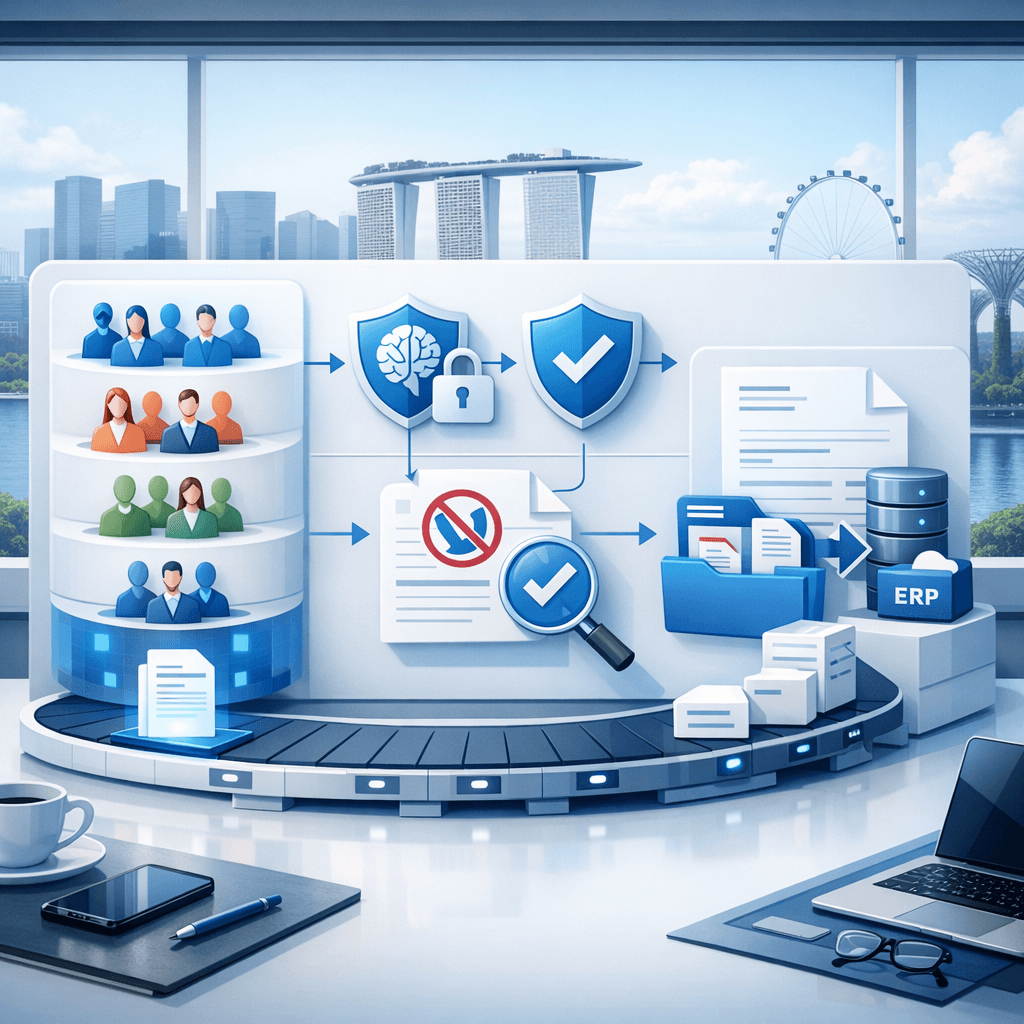
AI lead scoring workflows for Singapore B2B teams combine machine-led lead prioritisation, PDPA-aware data handling, Do Not Call screening, and CRM automation so sales teams can rank prospects, trigger compliant follow-up, and pass qualified deals into PEPPOL-ready finance processes without breaking local compliance expectations.
Key Takeaways
- Singapore B2B teams should score leads only after defining lawful data use, consent rules, and DNC screening steps.
- The best workflow links AI Lead Scoring, AI CRM, messaging controls, and finance handoffs in one system.
- PDPA-safe automation needs clear purpose limitation, access controls, retention rules, and audit trails.
- DNC checks should happen before outbound calls or texts, especially when using a CRM Dialer or WhatsApp & SMS CRM.
- Qualified opportunities can move from sales to invoice-ready workflows with PEPPOL-compatible finance data and integrations.
- For Singapore teams in areas like CBD, Jurong East, and Tampines, simple workflows usually outperform overbuilt enterprise setups.
Why AI lead scoring matters for Singapore B2B teams
AI lead scoring matters for Singapore B2B teams because it helps sales and marketing decide which accounts deserve action first, while reducing wasted follow-up and supporting local compliance steps like PDPA controls and DNC screening before outreach starts.
In practice, most Singapore teams do not have a lead volume problem. They have a prioritisation problem. SDRs in Singapore CBD may get inbound demo requests, Meta Ads responses, webinar sign-ups, and partner referrals in the same day. Without scoring, every lead looks urgent.
A useful scoring model ranks leads using three layers:
- Fit: company size, industry, location, use case, buying role
- Intent: page visits, demo requests, email replies, meeting bookings
- Readiness: budget signal, timeline, authority, data completeness
In HelloGrowthCRM, this is easier when AI Lead Scoring is connected to Email Automation, the Meeting Scheduler, and AI Pipeline Management. That way, scores are not static. They update when prospects act.
In one rollout we did with a 12-person sales team selling into Jurong East industrial accounts, the biggest win was not model sophistication. It was getting reps to trust the score. We did that by exposing the reasons behind each score, such as repeat site visits, pricing-page activity, job title match, and recent reply behaviour.
What a good score should actually predict
A good lead score should predict the next business outcome, not just engagement. For most B2B teams, that means:
- Sales accepted lead
- Qualified meeting held
- Opportunity created
- Proposal sent
- Closed-won revenue
If your model only predicts email opens, it will inflate false positives. That creates noise. A stronger approach links scoring to downstream revenue using tools like Revenue Attribution and Sales Forecasting.
How PDPA affects AI lead scoring and CRM automation
PDPA affects AI lead scoring and CRM automation by requiring Singapore teams to define why personal data is collected, how it is used, who can access it, and when it should be deleted, while making sure automation stays within those stated business purposes.
The Personal Data Protection Commission says organisations must notify individuals of purposes for collecting, using, or disclosing personal data under the PDPA, subject to the Act’s exceptions and obligations, as explained on the PDPC’s Overview of the PDPA.
For lead scoring, this matters because AI models usually combine many signals. Some are obvious, like form submissions. Others are inferred, like engagement trends or role-based buying intent. Teams need to document what enters the score and why.
PDPA controls that should exist before automation goes live
Before switching on scoring in AI CRM, set these controls:
- Purpose mapping: define which fields support qualification, outreach, and finance handoff
- Consent and notification review: check forms, landing pages, and event sign-ups
- Access controls: limit sensitive fields to the right teams
- Retention rules: archive or delete stale leads on schedule
- Audit logging: track score changes, outreach actions, and user edits
When I have audited pipelines like this, the most common issue is not “bad AI.” It is poor field hygiene. Teams pull in personal mobile numbers, direct emails, or notes from multiple channels without deciding whether each field is necessary. That creates compliance risk and weakens model quality at the same time.
PDPA-safe does not mean zero automation
Some teams assume PDPA means they should avoid automation. That is the wrong takeaway. PDPA-safe automation is possible if you set clear rules and keep humans accountable. In HelloGrowthCRM, you can combine Smart Inbox, Sales Task Boards, and AI Sales Copilot while still requiring manual approval for high-risk actions.
This works best for teams under 50 reps. Above that, expect more governance work, especially if multiple business units share one CRM.
Where DNC checks fit in the workflow
DNC checks fit in the workflow before outbound calls, SMS, or marketing messages are sent, because Singapore teams need to screen numbers against the Do Not Call requirements and suppress restricted contacts before any sales sequence, dialer workflow, or text automation begins.
Singapore’s DNC regime is administered by the PDPC, and businesses should review the official Do Not Call Registry guidance before launching outbound campaigns.
This is where many CRM automations fail. Teams score a lead, auto-assign it, and trigger a call task instantly. That may be efficient, but it can be risky if the number has not passed DNC screening.
A practical DNC-safe flow in HelloGrowthCRM
A simple workflow inside HelloGrowthCRM can look like this:
- Lead enters through web form, event list, partner upload, or Zapier
- AI Lead Scoring assigns an initial score
- Mobile number is normalised to Singapore format
- DNC check status is applied through your screening process
- Only DNC-cleared leads can enter CRM Dialer or WhatsApp & SMS CRM queues
- Non-cleared leads route to email-only or manual review workflows
DNC checks by channel
Different channels need different controls. This is a practical planning view:
| Channel | DNC check before outreach | Recommended HelloGrowthCRM control | Risk if skipped |
|---|---|---|---|
| Phone calls | Yes | Gate CRM Dialer task creation until status is cleared | Complaint or non-compliant outreach |
| SMS or WhatsApp | Yes, where applicable to message type and number use | Suppress number in WhatsApp & SMS CRM automation | Fast, high-volume compliance exposure |
| Usually governed by broader consent and notice rules rather than DNC registry itself | Use Email Automation with unsubscribe and purpose controls | Poor trust and consent issues | |
| LinkedIn/manual outreach | Lower automation risk but still needs policy review | Route to task queue for human check | Inconsistent handling |
The point is not to turn sales into legal operations. The point is to insert one compliance gate before high-risk outreach starts.
What a PEPPOL-ready handoff from sales to finance looks like
A PEPPOL-ready handoff from sales to finance means qualified opportunities leave the CRM with complete customer, billing, tax, and entity data so finance can generate compliant e-invoicing workflows without rekeying details or chasing sales reps for missing information.
IMDA explains that PEPPOL is an international e-invoicing network that allows businesses to exchange invoices in a standard digital format through accredited service providers, as outlined on the IMDA InvoiceNow page.
For B2B teams, this matters after the deal is qualified and commercial terms are approved. If sales captures poor account data, finance has to clean it up later. That delays invoicing and cash collection.
Fields sales should capture before finance handoff
A practical PEPPOL-ready handoff usually needs:
- Legal entity name
- UEN
- Billing contact
- Billing email
- Bill-to address
- Currency
- Payment terms
- Product or service description
- Tax treatment
- PO number, if needed
HelloGrowthCRM helps here because Proposal Builder, Revenue Attribution, and integrations like QuickBooks, Stripe, and All Integrations can keep commercial data aligned across systems.
In one Singapore deployment for a services firm near Raffles Place, we added a “finance-ready” stage gate before proposal approval. Reps had to complete UEN, billing entity, and payment terms before the opportunity could move forward. That alone cut handoff delays.
Why PEPPOL readiness should start in the CRM
Do not wait until invoice creation to collect invoicing fields. The CRM is where account truth should start. If your opportunity owner cannot identify the right buying entity, finance will end up invoicing the wrong one.
For teams selling multi-entity deals across Singapore and ASEAN, this becomes even more important. Create required fields early and validate them before close.
How to set up AI lead scoring workflows in HelloGrowthCRM: Step-by-Step
Setting up AI lead scoring workflows in HelloGrowthCRM means mapping your funnel, defining compliant data rules, building a scoring model, inserting DNC checkpoints, and creating stage-based automations so qualified leads move cleanly from first touch to sales action and finance-ready handoff.
- Define your conversion goal
Pick the outcome your score should predict. For most Singapore B2B teams, start with qualified opportunity creation, not just MQL status. - Map allowed data inputs
List every field used in scoring. Include source, purpose, owner, and retention rule. Review PDPA notice language before you ingest more data. - Create fit and intent scoring bands
Add firmographic signals, role relevance, engagement recency, and negative signals. Use Lead Scoring Calculator logic to stress-test weightings. - Set DNC as a workflow gate
Block phone and message tasks until the lead has a cleared status. This is essential if you use CRM Dialer or AI Voice Agent workflows. - Build routing rules by score threshold
High-score leads can go to SDRs in the Singapore CBD team. Mid-score leads can enter nurture via Email Automation. Low-score leads can be recycled. - Add sales qualification criteria
Use MEDDPICC, BANT, or your own framework. Pair the lead score with mandatory discovery fields so reps do not over-trust the model. - Create finance-ready opportunity stages
Add required fields for billing entity, UEN, payment terms, and proposal status. Connect downstream tools through HubSpot, Salesforce, or native integrations where needed. - Review model performance monthly
Compare score bands against conversion to pipeline and revenue. Use Pipeline Health Score and CRM ROI Calculator to show whether the workflow is actually paying off.
Common mistakes Singapore teams should avoid
Singapore B2B teams should avoid treating AI lead scoring as a plug-and-play feature, because most failures come from unclear data rules, weak qualification design, missing DNC gates, and poor handoff discipline between marketing, sales, and finance.
The biggest mistakes I see are:
- Scoring before defining lifecycle stages
- Using too many engagement signals
- Ignoring negative scoring
- Skipping DNC checks in outbound automation
- Letting reps edit critical finance fields without controls
- Measuring opens instead of revenue impact
Budget context in SGD for small and mid-sized teams
For many small and mid-sized Singapore teams, the workable budget is not enterprise-level. A realistic starting plan often includes:
- CRM and automation subscription
- One-time workflow setup
- DNC screening process design
- Basic integration work
- Monthly reporting review
That usually lands far below the cost of custom enterprise RevOps builds. If your team wants a guided rollout, Managed RevOps can help shorten setup time. If you want to test first, start with a Free Trial or book a Demo.
IMDA also provides support for SME digital adoption through programmes and guidance on digital readiness, which teams can explore on the IMDA website.
Why HelloGrowthCRM fits this Singapore workflow
HelloGrowthCRM fits this Singapore workflow because it combines AI scoring, sales automation, compliance-friendly routing, and finance handoff readiness in one operating layer, which is exactly what local B2B teams need when they want speed without creating avoidable PDPA or DNC risk.
This article is about HelloGrowthCRM, so here is the direct disclosure: HelloGrowthCRM is our product. That means we are opinionated. We believe lead scoring should not sit in a disconnected point tool.
For Singapore teams, the stronger setup is one where Features connect across the funnel:
- AI Lead Scoring ranks and explains priority
- AI Pipeline Management tracks conversion health
- AI Deal Insights flags missing qualification
- Meeting Scheduler reduces booking friction
- Revenue Attribution ties scoring to revenue outcomes
If your team sells from CBD offices, supports field reps in Jurong East, or manages distributed sales in Tampines, HelloGrowthCRM gives you one system to route leads, control outreach, and prepare clean handoffs for finance. Try HelloGrowthCRM to build PDPA-aware, DNC-conscious, PEPPOL-ready automation for Singaporean teams.
About the author
Marcus Tan is a Revenue Operations Lead at HelloGrowthCRM with 11 years of experience across B2B SaaS, CRM architecture, and sales process design. He has led lead-routing, scoring, and compliance workflow rollouts for Singapore sales teams ranging from five to 80 reps. One project that informed this article involved redesigning a Singapore services pipeline so DNC checks, qualification scoring, and finance handoff fields were enforced before outbound follow-up and invoicing.
Frequently Asked Questions
Q: What is AI lead scoring in a Singapore CRM setup?
A: AI lead scoring in a Singapore CRM setup is the use of machine-based rules and signals to rank leads by likely sales value while fitting local compliance needs like PDPA-safe data handling and DNC-aware outreach controls. It helps teams act faster on the right accounts. It also reduces wasted follow-up on weak-fit leads.
Q: Does PDPA allow AI lead scoring for B2B teams?
A: Yes, PDPA allows AI lead scoring for B2B teams when personal data is handled for clear business purposes and with proper notice, controls, access limits, and retention practices. The key issue is governance, not whether AI is used. Teams should document what data enters the model and why.
Q: Do I need DNC checks before sales follow-up?
A: Yes, you need DNC checks before sales follow-up for outbound calls and messages where Singapore’s DNC rules apply, especially when workflow automation can trigger large volumes quickly. The safest setup is to make DNC clearance a system gate. That prevents reps and automations from contacting restricted numbers.
Q: How does PEPPOL relate to CRM automation?
A: PEPPOL relates to CRM automation because qualified deals need complete billing and entity data before they move into invoice workflows and finance systems. A CRM that captures UEN, billing contact, and payment terms early reduces rework later. It also shortens invoice turnaround.
Q: What data should be used in an AI lead score?
A: The data used in an AI lead score should include fit, intent, and readiness signals that are relevant to conversion and justified by your sales process. Good examples include company size, role, form activity, meeting bookings, and reply behaviour. Avoid collecting unnecessary personal data just because it is available.
Q: How much does a Singapore team need to budget for this?
Frequently Asked Questions
Ready to put this into practice?
Set up your pipeline, WhatsApp follow-ups, and AI lead scoring in minutes — free, no credit card.
Try HelloGrowthCRM freeGet CRM tips in your inbox
Join thousands of sales professionals who get weekly insights on CRM strategy, AI automation, and pipeline optimization.

The HelloGrowthCRM team publishes guides on CRM strategy, AI sales tools, and revenue operations for small business sales teams.