HelloGrowthCRM software
Built for real small-business sales teams
HelloGrowthCRM helps reps qualify faster, follow up on time, and close more deals—with practical automation in one place.
- AI lead scoring and pipeline visibility
- Built-in dialer, WhatsApp, and email automation
- Sales forecasting and RevOps-ready reporting
Average deal size is the average revenue generated per closed deal in your sales pipeline over a specific timeframe. Knowing this number helps you understand how much each customer is worth on average and assists in sales forecasting and resource allocation.
Why this comes up / what goes wrong
Small-business owners often want to know their average deal size to evaluate sales performance and plan growth. Without this metric, you might misjudge how many deals you need to close to reach revenue targets. For example, if you only track total sales revenue without considering deal size, you could miss signs like shrinking deal values or the need to focus on higher-value customers. This can lead to poor sales planning, wasted effort, and missed opportunities to increase profits.
Many small businesses run sales through text messages, email, and spreadsheets, which can make it hard to track deal values accurately. Without a clear average deal size, forecasting revenue and setting realistic goals becomes guesswork. This is why understanding and calculating average deal size is a practical step toward better sales management.
Step-by-step
- Choose a time period: Decide if you want to calculate average deal size monthly, quarterly, or annually. Using the same period consistently helps you track trends over time.
- Gather total revenue from closed deals: Collect the revenue amounts from all deals closed during your chosen time period. Make sure these are finalized sales.
- Count the number of closed deals: Determine how many deals were successfully closed in that period.
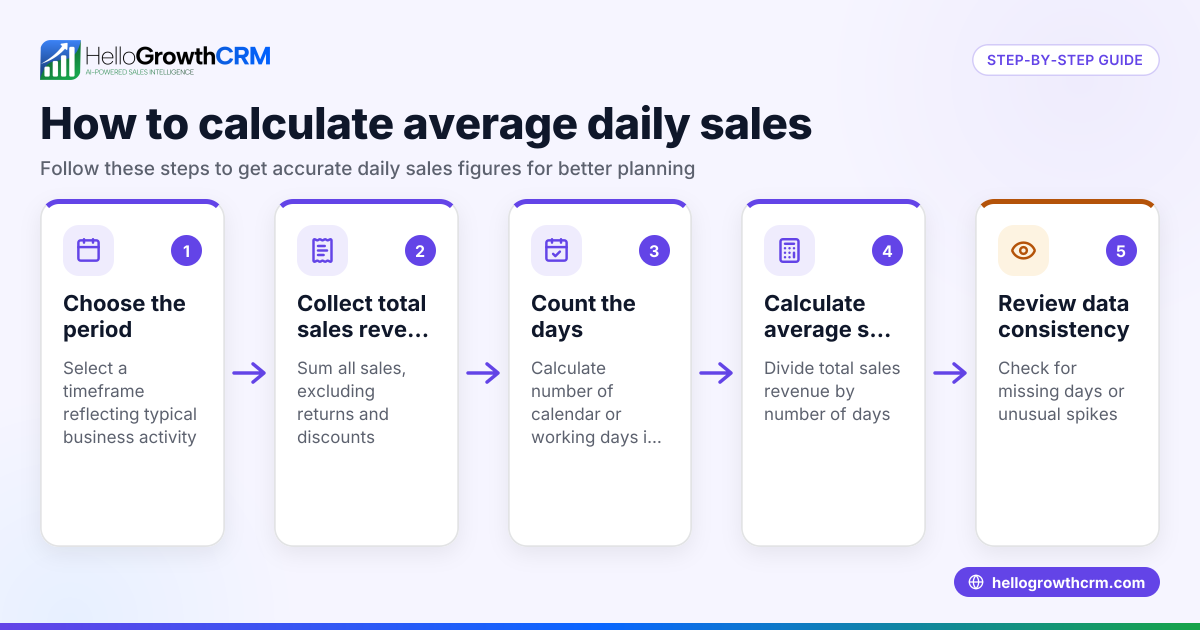
- Calculate average deal size: Divide the total revenue by the number of closed deals.
- Verify data accuracy: Check that all included deals are finalized sales, excluding pending or lost deals. Use net revenue after discounts and refunds for accuracy.
- Review periodically: Repeat this calculation regularly to monitor changes and adjust your sales strategy as needed.
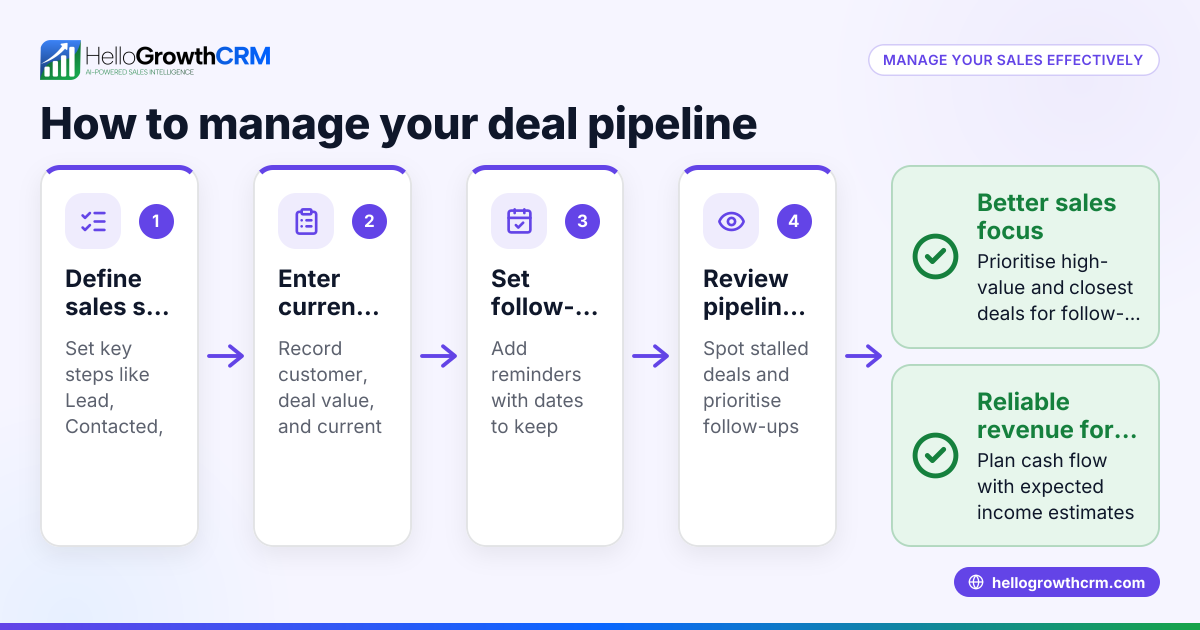
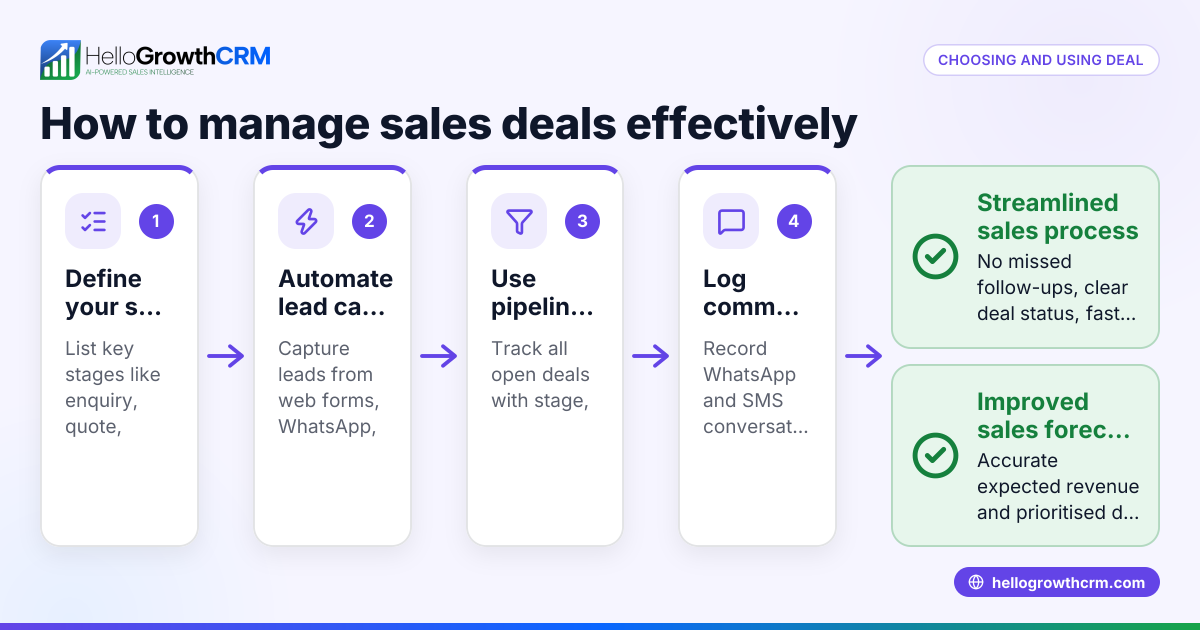
Using a CRM with a deals pipeline, like HelloGrowthCRM’s Deals pipeline, helps keep track of deal stages and follow-ups, ensuring your data is current and accurate.
Example (fictional figures)
Consider a two-location dental practice in Columbus, Ohio. From 01/01/2026 to 03/31/2026, they closed 15 new patient treatment plans. The total revenue from these deals was $150,000.
Step 1: Total revenue = $150,000
Step 2: Number of closed deals = 15
Step 3: Average deal size = Total revenue ÷ Number of closed deals
$150,000 ÷ 15 = $10,000
Therefore, the average deal size for this dental practice in the first quarter of 2026 was $10,000.
Common mistakes
- Including unclosed or lost deals: Only finalized deals should be counted. Prevent this by regularly updating deal statuses in your CRM.
- Mixing time periods: Don’t combine deals from different months or quarters. Use consistent timeframes for accurate comparisons.
- Ignoring discounts or refunds: Always use net revenue figures after discounts and refunds to avoid overstating deal size.
- Not updating data promptly: Delayed updates can skew your calculations. Tools like HelloGrowthCRM help keep your deal data current.
- Overlooking changes over time: Average deal size can fluctuate. Track it regularly to spot trends and adjust your sales approach.
- Failing to segment deals: Different types of deals may have different sizes. Segmenting by product or customer type can give clearer insights.
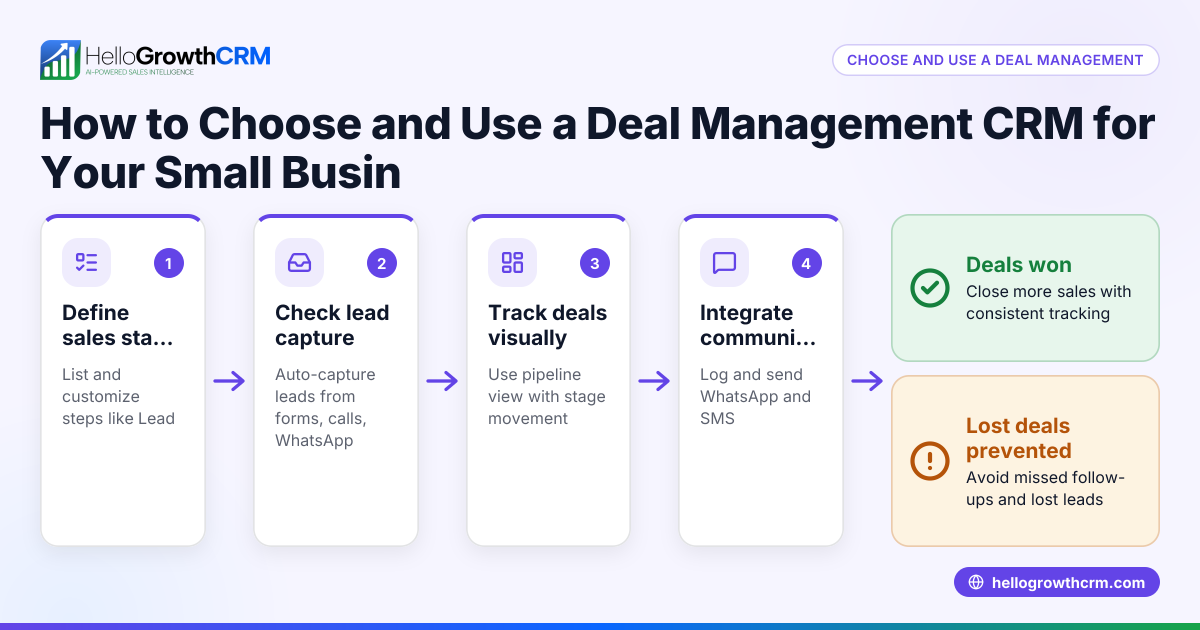
Using a CRM that integrates communication channels like WhatsApp and SMS, such as HelloGrowthCRM’s WhatsApp and SMS CRM, can improve deal tracking and follow-up efficiency.
Doing this in HelloGrowthCRM
HelloGrowthCRM’s Deals (pipeline) feature helps you manage your sales pipeline by tracking open opportunities from first contact through close. For example, a quotation sent last week appears as a deal at the 'quote sent' stage with a follow-up date, so it is not forgotten. This keeps your deal data organized and up to date, making average deal size calculations more accurate and timely.
Frequently asked questions
What is a good average deal size for small businesses? A good average deal size varies widely by industry and business model. Small businesses should compare their average deal size to industry benchmarks or their own historical data to set realistic targets. Regular tracking helps identify opportunities to increase deal size.
How does average deal size affect sales forecasting? Average deal size helps estimate future revenue by multiplying it by the expected number of deals to close. Accurate deal size data improves forecasting precision, allowing better resource planning and goal setting.
Can average deal size change over time? Yes, average deal size can increase or decrease due to factors like pricing changes, product mix, or customer segments. Regularly monitoring it helps you adapt your sales strategies accordingly.
How can I increase my average deal size? You can increase average deal size by upselling, cross-selling, offering bundled packages, or targeting higher-value customers. Tracking deals in a CRM like HelloGrowthCRM can help identify opportunities to grow deal values.
Why should I use a CRM to track deals? A CRM centralizes deal information, tracks stages, and reminds you of follow-ups. This reduces the chance of lost deals and improves data accuracy for metrics like average deal size. HelloGrowthCRM integrates WhatsApp and SMS, making communication and deal management easier for small teams.
Key takeaways
- Average deal size is total revenue divided by the number of closed deals in a set period.
- Knowing your average deal size helps with sales forecasting and identifying growth opportunities.
- Use consistent timeframes and accurate deal data when calculating average deal size.
- Avoid common mistakes like including unclosed deals or mixing time periods.
- Segment deals when possible to get clearer insights.
- HelloGrowthCRM’s Deals pipeline feature keeps your sales data organized and up to date.
Start tracking your average deal size and sales pipeline today with HelloGrowthCRM. Start on the Free Forever plan (200 leads, no credit card).
Ready to put this into practice?
Set up your pipeline, WhatsApp follow-ups, and AI lead scoring in minutes — free, no credit card.
Try HelloGrowthCRM freeGet CRM tips in your inbox
Join thousands of sales professionals who get weekly insights on CRM strategy, AI automation, and pipeline optimization.

The HelloGrowthCRM team publishes guides on CRM strategy, AI sales tools, and revenue operations for small business sales teams.