HelloGrowthCRM software
Built for real small-business sales teams
HelloGrowthCRM helps reps qualify faster, follow up on time, and close more deals—with practical automation in one place.
- AI lead scoring and pipeline visibility
- Built-in dialer, WhatsApp, and email automation
- Sales forecasting and RevOps-ready reporting
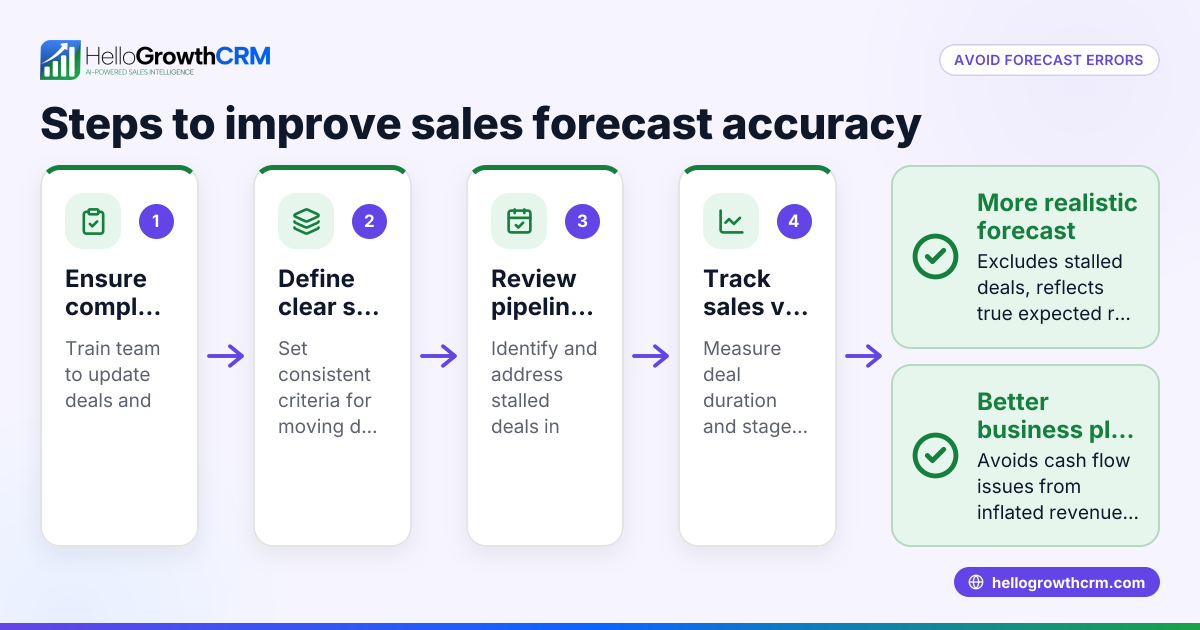
To avoid forecast errors in CRM, keep your sales data accurate and up to date, regularly review deal stages, and use AI insights to identify stalled deals early. This article covers why forecast errors happen, step-by-step actions to improve accuracy, a worked example with Singapore figures, common mistakes to avoid, and how HelloGrowthCRM features support better forecasting.
Why this comes up / what goes wrong
Small and mid-sized business owners in Singapore often rely on CRM systems to forecast sales revenue and manage pipelines. However, errors in forecasting arise when sales data is incomplete, outdated, or inconsistently entered. For example, leads stuck in early pipeline stages or deals incorrectly marked as likely to close can distort revenue projections. Many businesses still use WhatsApp, email, and spreadsheets, which complicates data consolidation and timely updates. Without clear visibility on deal progress and sales rep activities, forecasts become unreliable, leading to poor business decisions and cash flow problems.
Step-by-step
- Keep sales data current and accurate
- Update deal stages promptly after each sales interaction.
- Ensure contact details and deal values are correct.
- Verify that no deals are forgotten or duplicated.
- Regularly review pipeline stages
- Check for deals stalled in early or mid pipeline stages.
- Identify deals with no recent activity and follow up.
- Remove or reclassify deals unlikely to close in the forecast period.
- Use AI insights to spot patterns
- Employ AI-assisted forecasting to detect where deals typically stall.
- Analyse historical conversion rates by stage and sales rep.
- Adjust forecast probabilities based on AI analysis.
- Log all sales communications in one system
- Record calls, WhatsApp, and SMS conversations linked to each lead.
- Avoid separate tracking on WhatsApp or email alone.
- Use CRM sequences to automate follow-ups and reminders.
- Train your sales team on consistent CRM usage
- Establish clear guidelines for updating deal status.
- Encourage timely logging of interactions.
- Monitor CRM data quality regularly.
- Review and adjust forecasts weekly or monthly
- Compare forecasted revenue to actuals regularly.
- Update the forecast based on new information or closed deals.
- Communicate forecast changes with stakeholders.
For more on how AI helps with forecasting, see sales forecasting.
Example (fictional figures)
A renovation contractor in Jurong has a pipeline with 5 active deals as of 01/06/2024:
| Deal | Stage | Deal Value (S$) | Probability (%) | Expected Revenue (S$) |
|---|---|---|---|---|
| A | Proposal Sent | 120,000 | 70 | 120,000 × 70% = 84,000 |
| B | Negotiation | 80,000 | 50 | 80,000 × 50% = 40,000 |
| C | Initial Contact | 150,000 | 20 | 150,000 × 20% = 30,000 |
| D | Closed Won | 60,000 | 100 | 60,000 × 100% = 60,000 |
| E | Stalled | 90,000 | 10 | 90,000 × 10% = 9,000 |
Total forecasted revenue:
84,000 + 40,000 + 30,000 + 60,000 + 9,000 = S$223,000
The contractor notices deal E has been stalled for 3 months with no activity. They decide to follow up immediately or remove it from the forecast to avoid overestimating revenue.
Common mistakes
- Not updating deal stages promptly
- Prevent by setting reminders and training sales reps to log changes immediately.
- Mixing communication channels outside CRM
- Prevent by logging all calls and WhatsApp conversations inside the CRM to keep data consolidated.
- Ignoring stalled deals
- Prevent by reviewing pipeline weekly and re-engaging or removing inactive deals.
- Overestimating probabilities based on wishful thinking
- Prevent by using AI insights and historical conversion data to set realistic probabilities.
- Relying solely on spreadsheets and email for forecasting
- Prevent by adopting a CRM with integrated forecasting and communication tools.
For tips on logging calls efficiently, see the built-in dialer section.
Doing this in HelloGrowthCRM
HelloGrowthCRM helps avoid forecast errors with its pipeline forecast and AI insights feature. It projects expected close amounts based on current pipeline stages, deal velocity, and historical conversion patterns, showing where deals stall without needing spreadsheets. The built-in dialer lets your telecaller work leads directly from the CRM, logging call outcomes automatically. WhatsApp conversations with leads are also logged on their records, and follow-ups can be sent as WhatsApp or SMS messages, keeping all communications in one place. Learn more about HelloGrowthCRM for Singapore businesses at HelloGrowthCRM for Singapore.
Frequently asked questions
How often should I update my sales forecast in CRM? Updating your sales forecast weekly or monthly is ideal. Frequent updates capture changes in deal status and new information, making your forecast more accurate and actionable.
Can AI really help improve forecast accuracy? Yes, AI analyses historical data and current pipeline health to identify patterns like stalled deals and conversion rates. This helps set realistic probabilities and revenue projections.
What if my sales team resists using the CRM consistently? Encourage adoption by training the team on CRM benefits, setting clear usage guidelines, and choosing a CRM that integrates with channels they already use, like WhatsApp.
Why is logging WhatsApp conversations in CRM important? Logging WhatsApp conversations keeps all sales communications in one place, providing context for forecasting and follow-ups. It prevents data loss and errors from scattered messaging.
How can I prevent overestimating revenue in my forecast? Use AI insights to adjust deal probabilities realistically, regularly review stalled deals, and avoid including deals unlikely to close soon.
Key takeaways
- Keep CRM data accurate and updated regularly to avoid forecast errors.
- Use AI insights to identify stalled deals and adjust probabilities.
- Log all sales communications, including WhatsApp and calls, inside the CRM.
- Review and adjust your sales forecast weekly or monthly.
- Train your sales team on consistent CRM usage to improve data quality.
Start improving your sales forecasting accuracy by trying HelloGrowthCRM. Start on the Free Forever plan (200 leads, no credit card).
Ready to put this into practice?
Set up your pipeline, WhatsApp follow-ups, and AI lead scoring in minutes — free, no credit card.
Try HelloGrowthCRM freeGet CRM tips in your inbox
Join thousands of sales professionals who get weekly insights on CRM strategy, AI automation, and pipeline optimization.

The HelloGrowthCRM team publishes guides on CRM strategy, AI sales tools, and revenue operations for small business sales teams.