HelloGrowthCRM software
Built for real small-business sales teams
HelloGrowthCRM helps reps qualify faster, follow up on time, and close more deals—with practical automation in one place.
- AI lead scoring and pipeline visibility
- Built-in dialer, WhatsApp, and email automation
- Sales forecasting and RevOps-ready reporting
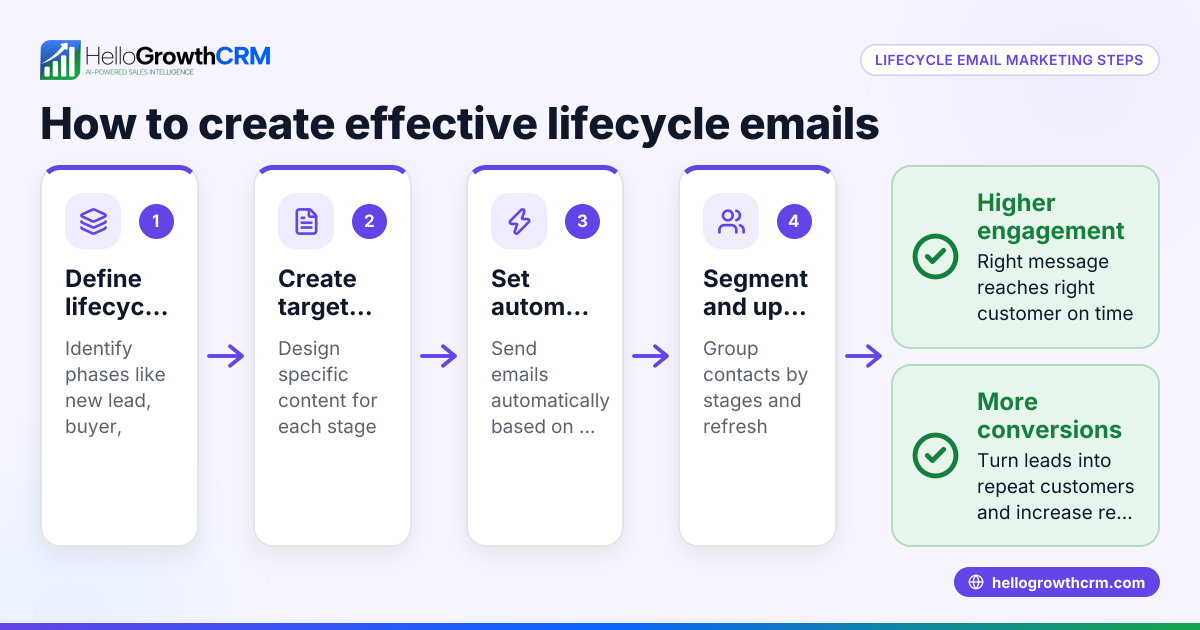
B2B lifecycle marketing means managing business customers through specific stages: awareness, consideration, purchase, retention, and advocacy. At each stage, you use marketing and sales strategies designed to meet the customer’s current needs and encourage progress to the next step.
Why this comes up / what goes wrong
Small business owners often face lost sales and wasted effort because their marketing does not match the customer’s buying journey. For example, sending the same generic message to a new lead and to a long-time client misses chances to engage effectively. Many businesses use disconnected tools like spreadsheets, emails, and texts, which cause slow follow-up and lost leads. Without a clear lifecycle marketing plan, sales teams struggle to prioritize and nurture leads properly.
Step-by-step
- Map your customer lifecycle stages. Define phases such as Awareness, Consideration, Purchase, Retention, and Advocacy. Check that these stages reflect how your typical B2B buyers move through their decision process.
- Set goals for each stage. For example, build brand awareness in the Awareness stage and reduce churn in Retention. Confirm these goals align with your overall business objectives.
- Create targeted content and messages. Develop emails, calls, or messages tailored to each stage’s needs. Ensure your messaging addresses specific pain points or questions relevant to that phase.
- Choose the right channels. Decide whether to use email, WhatsApp, SMS, or phone calls based on customer preferences and stage. Confirm your team has tools to manage these channels efficiently, such as a built-in CRM dialer or WhatsApp and SMS CRM.
- Implement tracking and automation. Monitor leads’ progress through stages and automate follow-ups to avoid delays. Check that your system can capture leads from web forms and integrate with your marketing tools.
- Measure and optimize. Use sales forecasting and reporting regularly to identify bottlenecks or drop-offs. Adjust your lifecycle marketing tactics accordingly.
Example (fictional figures)
A landscaping contractor in Charlotte, North Carolina, wants to improve B2B sales.
- They define stages: Awareness, Consideration, Purchase, Retention.
- In Awareness, they spend $5,000 on local digital ads.
- From ads, 200 leads enter Consideration.
- They nurture leads with targeted emails and WhatsApp messages, converting 20% to Purchase.
Calculation:
200 leads × 20% conversion = 40 customers
- Average sale per customer is $3,000.
- Total revenue from campaign = 40 × $3,000 = $120,000
- Retention efforts keep 30 customers for repeat service.
- Each retained customer spends $2,000 annually.
- Annual revenue from retained customers = 30 × $2,000 = $60,000
This example shows how lifecycle marketing guides leads through stages, increasing sales and customer loyalty.
Common mistakes
- Treating all leads the same. Prevent this by segmenting leads by lifecycle stage and customizing communication.
- Ignoring retention. Avoid focusing only on new sales; build loyalty programs and regular check-ins.
- Using too many disconnected tools. Prevent confusion by consolidating communication channels with a WhatsApp and SMS CRM and a built-in CRM dialer.
- Not measuring results. Regularly check sales forecasting and reporting to adjust strategies.
- Delaying follow-up. Speed up responses using lead capture from web forms and automation.
- Not aligning messaging with stage. Always match your message to the buyer’s current needs to keep them engaged.
Frequently asked questions
What is the difference between B2B lifecycle marketing and general marketing? B2B lifecycle marketing focuses on managing the stages a business customer goes through, tailoring communication and sales tactics to each phase. General marketing may not focus on this progression or customized engagement.
How do I know which marketing channels to use at each stage? Choose channels based on where your customers are and their preferences. Early stages often use email and social media, while later stages benefit from direct calls or WhatsApp messaging. Using tools like a built-in CRM dialer can help manage calls efficiently.
Can small businesses automate B2B lifecycle marketing? Yes, automation tools can handle lead capture, follow-up sequences, and reminders. This reduces delays and ensures consistent communication.
How do I measure success in B2B lifecycle marketing? Track metrics like lead conversion rates, sales forecasting accuracy, customer retention rates, and revenue growth. Regular reporting helps identify what works and what needs improvement.
Is it necessary to have a CRM for lifecycle marketing? While not mandatory, a CRM that supports multiple channels like WhatsApp and SMS, and offers lead capture and reporting, greatly simplifies managing the lifecycle and improves team coordination. See more on WhatsApp and SMS CRM and built-in CRM dialer.
What are the benefits of using a built-in CRM dialer? A built-in CRM dialer lets your sales team make calls directly from the CRM, saving time and keeping call records organized. This helps speed up follow-up and improves sales team efficiency.
Key takeaways
- B2B lifecycle marketing manages customer relationships through defined stages to improve sales and retention.
- Tailor your messaging and channels to each lifecycle phase, using tools suited to your customers’ preferences.
- Avoid common mistakes like generic messaging, ignoring retention, and using disconnected tools.
- Track performance with sales forecasting and reporting to optimize your approach.
- Using a CRM with multi-channel support and lead capture can streamline lifecycle marketing efforts.
- A built-in CRM dialer supports faster, organized follow-up calls.
Start your B2B lifecycle marketing journey today. Start on the Free Forever plan (200 leads, no credit card) to organize your leads and communications in one place.
For US businesses, learn more about HelloGrowthCRM for the United States.
Ready to put this into practice?
Set up your pipeline, WhatsApp follow-ups, and AI lead scoring in minutes — free, no credit card.
Try HelloGrowthCRM freeGet CRM tips in your inbox
Join thousands of sales professionals who get weekly insights on CRM strategy, AI automation, and pipeline optimization.

The HelloGrowthCRM team publishes guides on CRM strategy, AI sales tools, and revenue operations for small business sales teams.