HelloGrowthCRM software
Built for real small-business sales teams
HelloGrowthCRM helps reps qualify faster, follow up on time, and close more deals—with practical automation in one place.
- AI lead scoring and pipeline visibility
- Built-in dialer, WhatsApp, and email automation
- Sales forecasting and RevOps-ready reporting
Boost B2B Sales with AI Lead Scoring: A Practical Guide for United States Companies
AI lead scoring is an AI-powered method that ranks sales leads by their likelihood to convert. It uses data and machine learning algorithms to prioritize prospects, helping B2B sales teams focus on opportunities that matter most. This approach reduces guesswork and increases efficiency in pipeline management and outreach.
Key takeaways - AI lead scoring uses AI software to analyze multiple data points and prioritize leads. - It helps B2B sales teams in the US increase conversion rates by focusing on quality prospects. - Automated with AI, lead scoring reduces manual data entry and subjective judgment. - Compliance with US laws such as CAN-SPAM and TCPA remains crucial in AI-driven outreach. - Integration with existing CRM systems improves tracking, forecasting, and sales automation. - HelloGrowthCRM offers AI lead scoring combined with managed RevOps to streamline your sales process.
What is AI lead scoring and why does it matter for US B2B sales?
AI lead scoring is the process where an AI tool evaluates and scores each sales lead based on their behavior, firmographic data, and engagement patterns. This score predicts the chance the lead will convert into a customer. In the competitive US B2B market, sales teams face a flood of prospects, making manual prioritization inefficient and error-prone.
By applying AI-powered scoring, teams can:
- Focus outreach on leads most likely to buy.
- Allocate resources effectively.
- Improve sales forecasting and pipeline accuracy.
- Reduce the load of low-value leads, saving time and money.
For example, a technology company in Chicago can use AI lead scoring integrated into their CRM to identify which prospects show buying signals, such as frequent website visits or specific email interactions. This insight means the sales rep spends time on prospects ready to engage, enhancing close rates.
How does AI lead scoring work in practice?
AI lead scoring combines multiple data inputs—such as company size, industry, past buying behavior, and engagement with emails or calls—processed by machine learning models to generate a predictive score. These models qualify leads by learning from historical sales data, outcomes, and patterns.
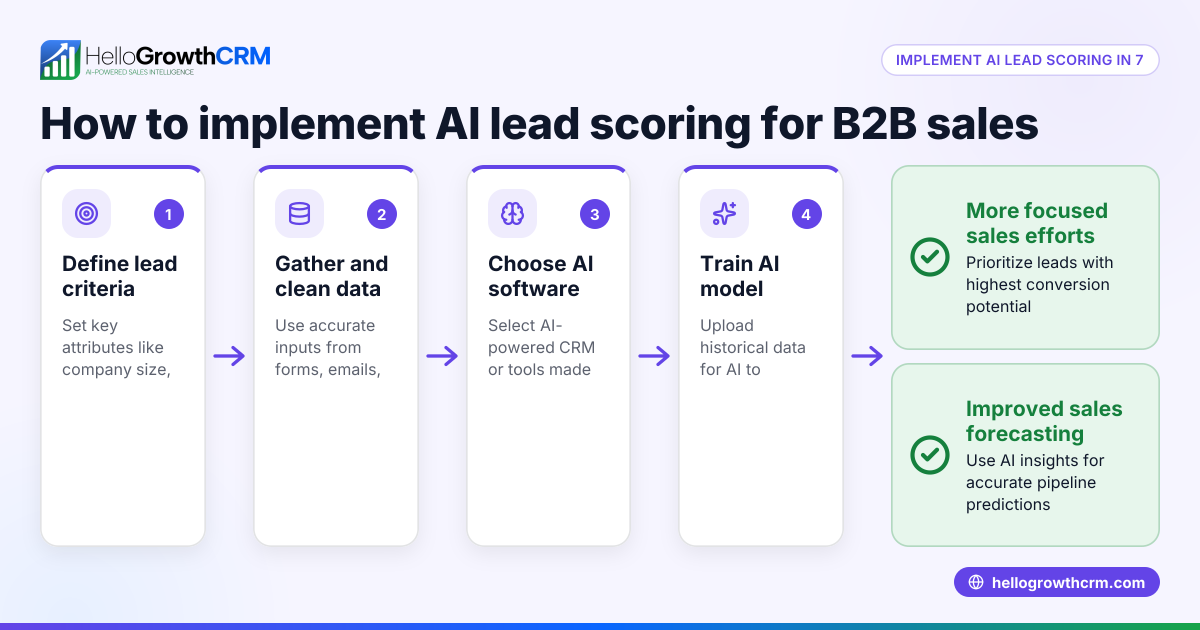
The process generally involves these steps:
- Data Collection: Gather data from various sources like website visits, email responses, phone calls, and CRM entries.
- Data Integration: Consolidate data into a single platform, often your CRM, for seamless analysis.
- Model Training: Use historical conversion data to teach the AI software what characteristics define a promising lead.
- Lead Scoring: Apply the AI scores to new and existing leads to prioritize outreach.
- Continuous Learning: The AI model refines itself over time with new data and feedback.
This approach enhances accuracy compared to traditional scoring, which may rely solely on static factors like company revenue or job title. For US companies, integrating AI lead scoring with compliance tools helps maintain outreach standards per CAN-SPAM and TCPA regulations.
How can AI lead scoring improve sales forecasting and reporting?
AI lead scoring gives sales leaders better visibility into the quality of their pipeline. By scoring leads based on conversion likelihood, sales forecasting becomes more precise because it considers lead readiness, not just volume. This reduces surprises in monthly or quarterly revenue forecasts.
With a CRM that supports sales forecasting and reporting enhanced by AI automation, your team can view pipeline health in real time. This means managers can:
- Detect bottlenecks early.
- Allocate resources dynamically.
- Adjust strategies with confidence.
For example, a manufacturing firm in Detroit using an AI-powered CRM can spot which deals are likely to close this quarter and which leads need nurturing. This allows finance teams to sync sales forecasts with ERP systems and accounting tools like QuickBooks or Stripe efficiently.
What are the legal considerations for using AI lead scoring in US outbound sales?
AI-driven lead scoring itself does not conflict with US laws, but the methods used in outreach must comply with critical regulations. The CAN-SPAM Act mandates clear identification of marketing emails and an opt-out mechanism. The Telephone Consumer Protection Act (TCPA) restricts certain automated calls and texts without consent.
When using AI to identify whom to contact and when, companies should:
- Obtain consent before automated voicemail drops or text messages.
- Keep accurate records of consent and opt-out requests.
- Avoid contacting numbers on the National Do Not Call Registry unless exceptions apply.
AI automation tools embedded in CRMs can help track these legal requirements and flag leads who have opted out, ensuring compliance.
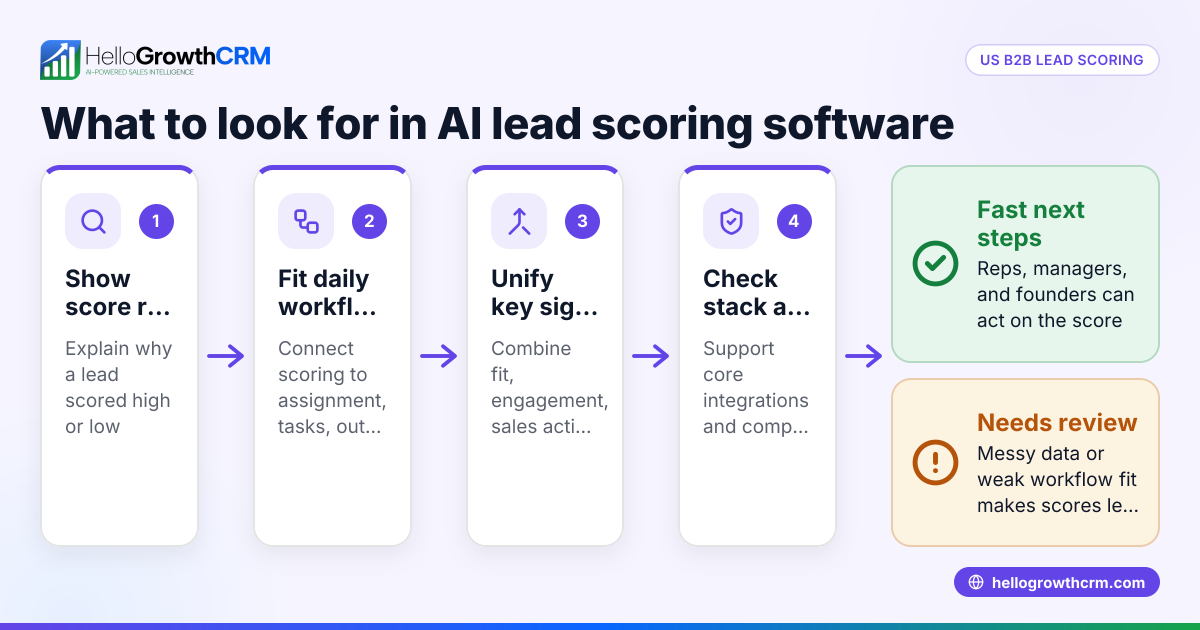
How do you choose the right AI lead scoring solution?
Selecting an AI tool for lead scoring requires focusing on these criteria:
- Data Sources: It should integrate well with your CRM and marketing platforms.
- Accuracy: Look for solutions that use robust machine learning models trained on relevant data.
- Usability: The system must present scores in an actionable, understandable way for sales reps.
- Compliance: The platform should support legal requirements in the US for outreach.
- Integration: Ensure compatibility with existing sales and finance stacks like QuickBooks and phone systems.
- Support: Managed services or RevOps help with setup, optimization, and troubleshooting.
HelloGrowthCRM combines an AI-powered lead scoring system with email automation and phone outreach features. It offers native integrations and can be paired with its managed RevOps expert help to ensure your US B2B sales team leverages AI effectively.
What are common challenges in implementing AI lead scoring?
The biggest challenges include:
- Data quality: Incomplete or inaccurate data leads to poor scoring results. Teams must clean and standardize data continuously.
- Change management: Sales reps used to their own lead judgment might resist adopting AI scores.
- Over-reliance on automated scores: Scores should guide—not replace—human intuition.
- Integration complexity: Connecting all relevant data sources and tools can be technically challenging.
Addressing these requires training, ongoing data governance, and selecting an AI lead scoring system designed for small to mid-sized US businesses, offering easy integration and user-friendly interfaces.
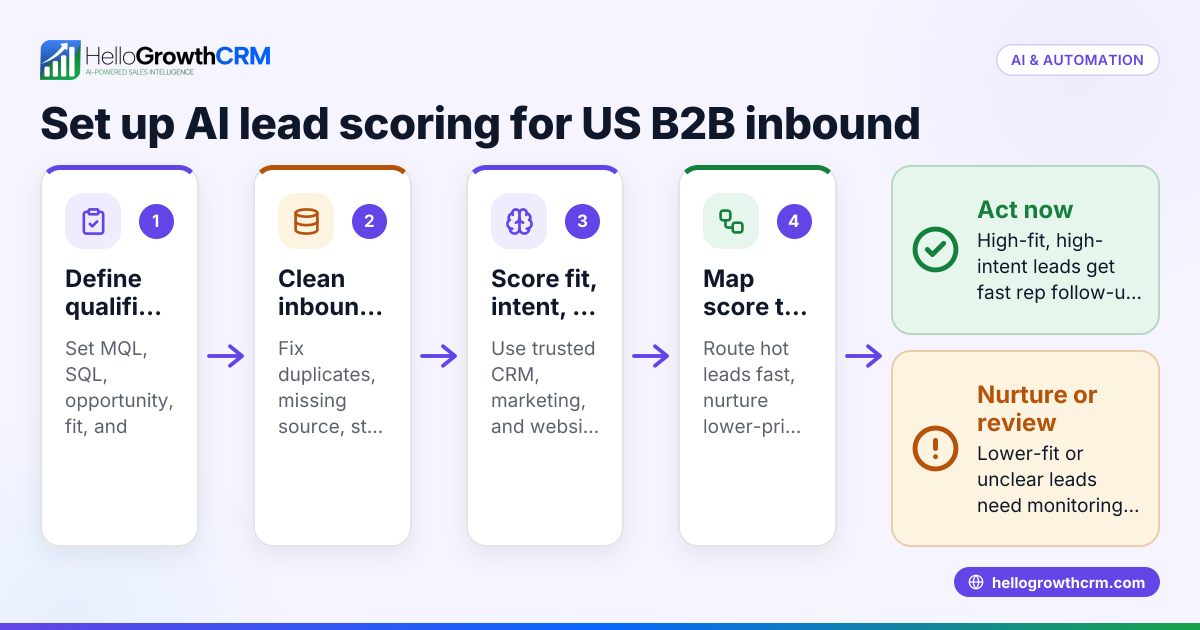
How can small and mid-sized US companies start using AI lead scoring today?
Step 1: Assess your current sales data and CRM capabilities. Identify gaps in data sources or processes.
Step 2: Choose an AI lead scoring platform with proven US compliance and integration options. HelloGrowthCRM offers a turnkey solution with AI lead scoring built in.
Step 3: Integrate marketing, web analytics, and sales data into your CRM system.
Step 4: Work with your team or a managed RevOps partner to train the AI model on your historical sales outcomes.
Step 5: Launch lead scoring and monitor results. Adjust outreach prioritization based on scores.
Step 6: Combine lead scores with automated email outreach and calling workflows for a full AI-powered sales approach.
Frequently asked questions
What is the main benefit of AI lead scoring for B2B sales teams?
AI lead scoring helps sales teams focus on leads most likely to convert, improving efficiency, forecasting accuracy, and ultimately increasing revenue.
Can AI lead scoring work with my existing CRM system?
Yes, platforms like HelloGrowthCRM offer AI lead scoring that integrates seamlessly with your CRM and other key sales tools.
Is AI lead scoring legal under US sales and marketing laws?
Using AI for lead prioritization is legal. However, you must ensure outreach complies with CAN-SPAM and TCPA regulations.
How often should AI lead scoring models be updated?
AI models improve with fresh data and feedback. Updating scores weekly or monthly is common to reflect changing behaviors.
Will AI lead scoring replace my sales reps’ judgment?
No. AI scores guide reps on prioritization but should complement their expertise and relationship-building skills.
Ready to boost your sales with AI lead scoring? Start your free trial of HelloGrowthCRM or book a demo to see how our AI-powered CRM can transform your B2B sales pipeline today.
Read next
This article covers one part of a bigger topic. For the complete picture, read our guide to ai lead scoring.
Frequently Asked Questions
Ready to put this into practice?
Set up your pipeline, WhatsApp follow-ups, and AI lead scoring in minutes — free, no credit card.
Try HelloGrowthCRM freeGet CRM tips in your inbox
Join thousands of sales professionals who get weekly insights on CRM strategy, AI automation, and pipeline optimization.

The HelloGrowthCRM team publishes guides on CRM strategy, AI sales tools, and revenue operations for small business sales teams.