HelloGrowthCRM software
Built for real small-business sales teams
HelloGrowthCRM helps reps qualify faster, follow up on time, and close more deals—with practical automation in one place.
- AI lead scoring and pipeline visibility
- Built-in dialer, WhatsApp, and email automation
- Sales forecasting and RevOps-ready reporting
A call center scorecard template helps small businesses measure the effectiveness of their call center operations by tracking essential metrics in one place. It enables managers to identify strengths and weaknesses and make data-driven decisions to improve sales or customer service outcomes. This article explains why such templates are crucial, how to build one step-by-step, common pitfalls, and provides a fictional example relevant to a US business.
Why this comes up / what goes wrong
Small business owners running call centers often struggle to keep track of multiple performance metrics spread across emails, spreadsheets, and notes. Without a clear, unified scorecard, they lose sight of lead follow-up speed, call success rates, and agent productivity. This leads to inconsistent customer experiences and lost sales opportunities. Many want a ready-to-use call center scorecard template to organize data efficiently and monitor progress regularly.
Step-by-step
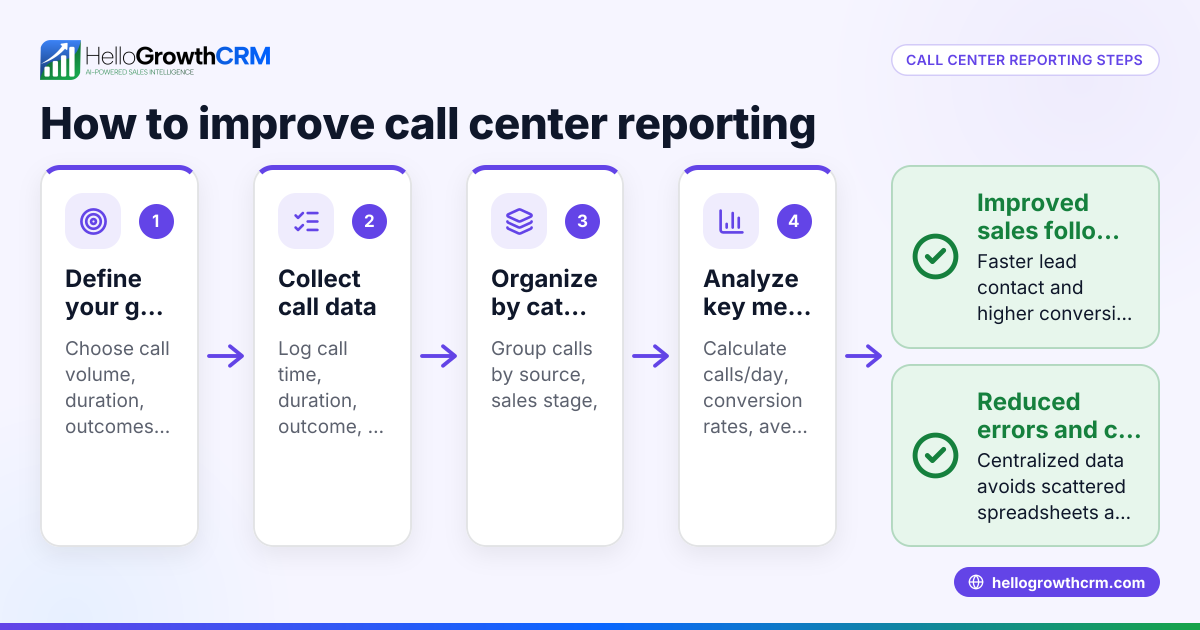
- Define your key metrics: Decide which KPIs matter most for your call center. Typical ones include:
- Number of calls made
- Calls connected
- Conversion rate (calls leading to sales or desired outcomes)
- Average handling time
- Follow-up tasks completed
- Customer satisfaction scores
- Choose a format: Use a spreadsheet or a simple table format that can be updated daily or weekly. Ensure it is easy for your team to access and understand.
- Set targets for each metric: Establish realistic benchmarks based on past data or industry standards. For example, aim for a 20% conversion rate or an average call time under 5 minutes.
- Collect data consistently: Train your team to log call outcomes and durations accurately. If you use a CRM, ensure calls and results are recorded in real time.
- Calculate scores and percentages: Use formulas to convert raw data into percentages or scores that indicate performance against targets.
- Review and update regularly: Schedule weekly reviews to analyze the scorecard, discuss challenges, and adjust targets or processes as needed.
- Visualize results: Add charts or color coding to highlight areas that meet or fall short of goals.
Check that your scorecard is simple enough for your team to use without confusion and comprehensive enough to cover all critical performance aspects.
Example (fictional figures)
A B2B software reseller in Denver, Colorado, tracks call center performance for March 2026.
- Total calls made: 1,200
- Calls connected: 900
- Sales from calls: 180
- Average handling time: 4 minutes
- Follow-up tasks completed: 170
Calculations:
Conversion rate = (Sales from calls ÷ Calls connected) × 100 Conversion rate = (180 ÷ 900) × 100 = 20%
Follow-up completion rate = (Follow-up tasks completed ÷ Sales from calls) × 100 Follow-up completion rate = (170 ÷ 180) × 100 = 94.4%
Average handling time target: under 5 minutes (met)
This scorecard shows the team is meeting conversion and handling time targets but should maintain follow-up task completion to sustain sales.
Common mistakes
- Tracking too many metrics: Focus on essential KPIs to avoid overwhelming your team. Prevent by prioritizing a manageable number of key metrics.
- Inconsistent data entry: Missing or inaccurate call logs distort performance insights. Prevent by using tools like a built-in CRM dialer that logs outcomes automatically (/product/crm-dialer).
- Ignoring targets: Not setting or reviewing targets leads to unclear goals. Prevent by establishing and revisiting benchmarks regularly.
- Using a complicated format: Overly complex scorecards discourage use. Prevent by keeping the template simple and user-friendly.
- Not updating scorecards frequently: Delayed updates reduce the scorecard’s usefulness. Prevent by scheduling regular updates and reviews.
Doing this in HelloGrowthCRM
HelloGrowthCRM offers a built-in dialer where reps work a list from inside the CRM, and the outcome of each call is logged on the lead automatically. This ensures accurate, real-time data collection for your scorecard. Additionally, you can download free sales tools, including follow-up cadence templates and pipeline templates, without needing an account (/tools). These resources help you build and maintain your call center scorecard efficiently.
Frequently asked questions
What should a call center scorecard include? A call center scorecard should include key metrics like call volume, call connection rate, conversion rate, average handling time, follow-up completion, and customer satisfaction. These metrics provide a balanced view of call center effectiveness.
How often should I update my call center scorecard? Updating your scorecard weekly is ideal to track trends and address issues promptly. Daily updates can be useful for high-volume centers, while monthly reviews help evaluate overall performance.
Can I use a CRM to create a call center scorecard? Yes. A CRM with a built-in dialer helps log calls and outcomes automatically, making data collection easier and more accurate. HelloGrowthCRM offers such features to support scorecard creation (/product/crm-dialer).
Where can I find templates for call center workflows? You can find call center workflow templates and other sales templates to organize your processes at HelloGrowthCRM’s sales templates page (/templates).
How do I avoid common mistakes in scorecard use? Focus on essential metrics, ensure consistent data entry, set clear targets, keep the format simple, and update regularly. Using CRM tools and free templates helps prevent errors (/tools).
Key takeaways
- Select 4-6 key call center metrics to track performance clearly.
- Use a simple, accessible format updated regularly to keep data relevant.
- Set realistic targets and review them weekly to guide your team.
- Avoid common mistakes like complex templates and inconsistent data entry.
- Use tools like HelloGrowthCRM’s built-in dialer for automatic call logging.
- Download free sales templates and calculators to support your scorecard setup.
Start organizing your call center performance today with a clear scorecard template. Get started on the Free Forever plan (200 leads, no credit card) at HelloGrowthCRM.
Ready to put this into practice?
Set up your pipeline, WhatsApp follow-ups, and AI lead scoring in minutes — free, no credit card.
Try HelloGrowthCRM freeGet CRM tips in your inbox
Join thousands of sales professionals who get weekly insights on CRM strategy, AI automation, and pipeline optimization.

The HelloGrowthCRM team publishes guides on CRM strategy, AI sales tools, and revenue operations for small business sales teams.