HelloGrowthCRM software
Built for real small-business sales teams
HelloGrowthCRM helps reps qualify faster, follow up on time, and close more deals—with practical automation in one place.
- AI lead scoring and pipeline visibility
- Built-in dialer, WhatsApp, and email automation
- Sales forecasting and RevOps-ready reporting
Cold call training teaches salespeople how to initiate and manage calls to potential customers, focusing on skills to engage prospects, handle objections, and convert calls into leads or sales. This article explains why cold call training matters for small businesses, outlines step-by-step training actions, highlights common pitfalls, and shows how HelloGrowthCRM’s built-in dialer can help teams work smarter.
Why this comes up / what goes wrong
Many small-business owners rely on cold calling as a key method to generate new leads but often face challenges like low contact rates, poor conversion, and wasted time. Without proper training, sales reps may feel unprepared or lack confidence, leading to ineffective calls and lost opportunities. They might use scripts that sound robotic or fail to handle objections well. This results in a demoralized sales team and stagnant growth. Business owners search for "cold call training" to improve their team’s skills in connecting with prospects, overcoming objections, and closing more deals without relying solely on email or text messages.
Step-by-step
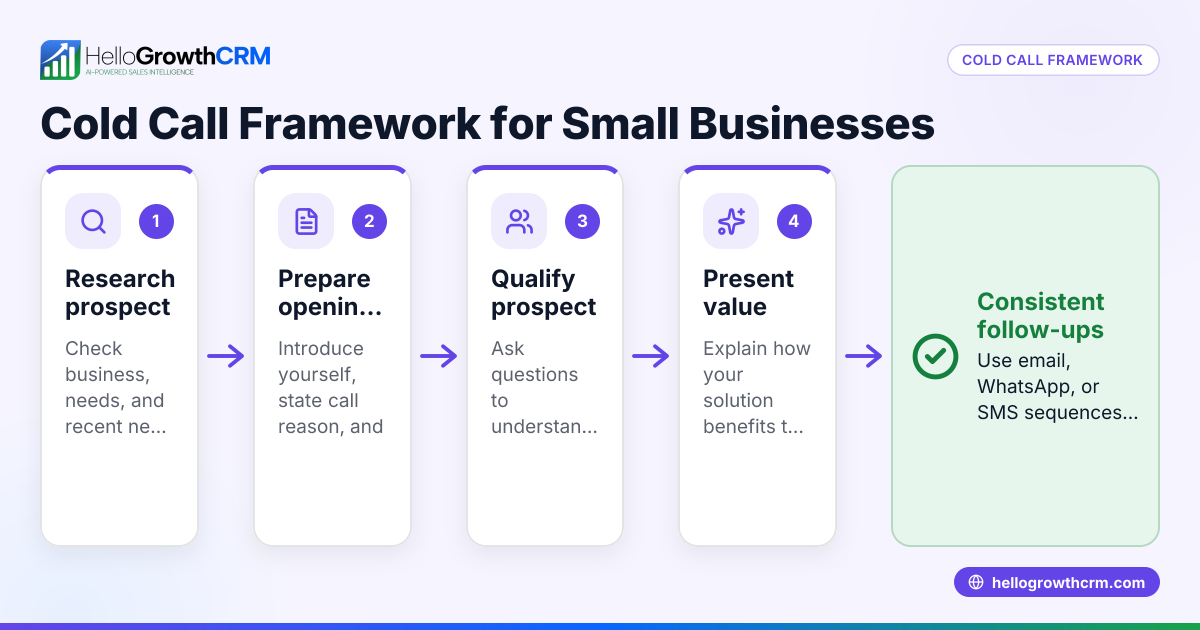
- Define clear goals for cold calling: Identify what each call should accomplish—whether it’s setting appointments, qualifying leads, or closing sales. Check that these goals are realistic, measurable, and aligned with your overall sales targets.
- Develop a call script framework: Create a flexible script that includes a strong introduction, key qualifying questions, clear value propositions, and prepared responses to common objections. Check that the script sounds natural and allows room for conversation.
- Train on tone and listening skills: Teach your reps to speak clearly and confidently while actively listening to the prospect’s needs. Use role-playing exercises to practice and provide constructive feedback.
- Practice objection handling: Compile a list of common objections your team encounters and coach reps on responding calmly and persuasively. Check their understanding by running mock calls that simulate real objections.
- Teach call outcome logging and follow-up: Instruct reps on how to record call results accurately and schedule follow-up actions promptly. Check that follow-up tasks are created and tracked to ensure no lead is lost.
- Use technology to support calling: Equip your team with tools like a built-in CRM dialer that lets reps call directly from the CRM and log outcomes automatically. Check that reps use the dialer to efficiently work through call lists and keep records updated.
- Review and refine regularly: Analyze call results and coach reps on improving scripts, tone, and objection handling. Check progress against goals and adjust training as needed.
Example (fictional figures)
A landscaping contractor in Charlotte, North Carolina, wants to increase new client leads through cold calls. They set a goal to make 100 calls weekly, aiming to schedule 10 appointments.
- Calls made: 100
- Appointments set: 10
- Conversion rate: 10 appointments ÷ 100 calls = 10%
After training focused on objection handling and active listening, they improve appointments to 15 weekly.
- Calls made: 100
- Appointments set: 15
- New conversion rate: 15 ÷ 100 = 15%
This 5% increase means 5 more appointments per week. If each appointment converts to a $300 job, the added revenue is:
5 appointments × $300 = $1,500 additional revenue per week
Over a month (4 weeks), this equals:
$1,500 × 4 = $6,000 additional revenue monthly
This example shows how cold call training can directly impact your bottom line by improving conversion rates.
Common mistakes
- Using a rigid script: A strict script sounds unnatural and can alienate prospects. Prevent this by encouraging reps to adapt their language to the conversation flow.
- Not listening actively: Ignoring what the prospect says leads to missed opportunities. Prevent by training reps to pause, ask clarifying questions, and respond thoughtfully.
- Failing to log call outcomes: Without logging, you lose track of leads and follow-ups. Prevent by using CRM tools and enforcing logging as a standard practice.
- Skipping follow-up: Many deals are lost because follow-up tasks aren’t scheduled or completed. Prevent by setting clear follow-up steps immediately after calls.
- Ignoring call metrics: Without reviewing call data, it’s hard to improve. Prevent by regularly analyzing call outcomes and coaching your team based on the insights.
Doing this in HelloGrowthCRM
HelloGrowthCRM includes a built-in dialer that lets your reps work through call lists directly inside the CRM. Every call outcome is logged on the lead record, keeping your sales pipeline updated automatically. This helps managers track progress and reps stay organized without switching apps. Learn more about the built-in CRM dialer.
Frequently asked questions
What is the best way to start cold call training? Start by defining clear objectives for your calls and creating a flexible script that your team can personalize. Then practice with role-playing sessions and provide feedback to build confidence and skills.
How can I measure cold call training success? Track key call metrics such as number of calls made, appointments set, conversion rates, and follow-up completion. Regularly review these metrics with your team to identify areas for improvement.
Can cold call training help reduce sales team turnover? Yes. Effective training improves reps’ confidence and competence, which can increase job satisfaction and reduce burnout, leading to lower turnover.
How does technology support cold call training? Tools like HelloGrowthCRM’s built-in dialer let reps call directly from the CRM and log outcomes, helping them focus on conversations and enabling managers to monitor performance. Check out the CRM academy for additional training resources.
Is cold calling still effective for small businesses? When executed well, cold calling remains a direct way to reach prospects and build relationships, especially when combined with follow-up via email or WhatsApp. For US businesses, integrating calls with CRM tools like HelloGrowthCRM for the United States can improve results.
Key takeaways
- Cold call training equips reps to engage prospects and handle objections effectively.
- Setting clear goals, using flexible scripts, and practicing active listening are essential.
- Logging call outcomes and prompt follow-up improve conversion rates.
- Avoid rigid scripts, poor listening, and neglecting call data analysis.
- A CRM with a built-in dialer supports efficient calling and tracking.
Start improving your team’s cold calling skills today by trying HelloGrowthCRM. You can Start on the Free Forever plan (200 leads, no credit card) and see how the built-in dialer helps your sales reps work smarter.
Ready to put this into practice?
Set up your pipeline, WhatsApp follow-ups, and AI lead scoring in minutes — free, no credit card.
Try HelloGrowthCRM freeGet CRM tips in your inbox
Join thousands of sales professionals who get weekly insights on CRM strategy, AI automation, and pipeline optimization.

The HelloGrowthCRM team publishes guides on CRM strategy, AI sales tools, and revenue operations for small business sales teams.