HelloGrowthCRM software
Built for real small-business sales teams
HelloGrowthCRM helps reps qualify faster, follow up on time, and close more deals—with practical automation in one place.
- AI lead scoring and pipeline visibility
- Built-in dialer, WhatsApp, and email automation
- Sales forecasting and RevOps-ready reporting
In the UK, the right commercial real estate CRM is one that matches how enquiries arrive, how viewings are arranged across regions, how deals are documented, and how your firm handles VAT, marketing consent and payment records.
That matters in commercial property because the work is rarely one clean sales funnel. You may be tracking occupier requirements, landlord instructions, investor conversations, agency referrals, rent reviews, renewals and service suppliers at the same time. A generic CRM can store names and notes, but a useful system for the UK needs to reflect local lead sources, UK messaging rules, bank-transfer habits and the paperwork created long before a deal completes.
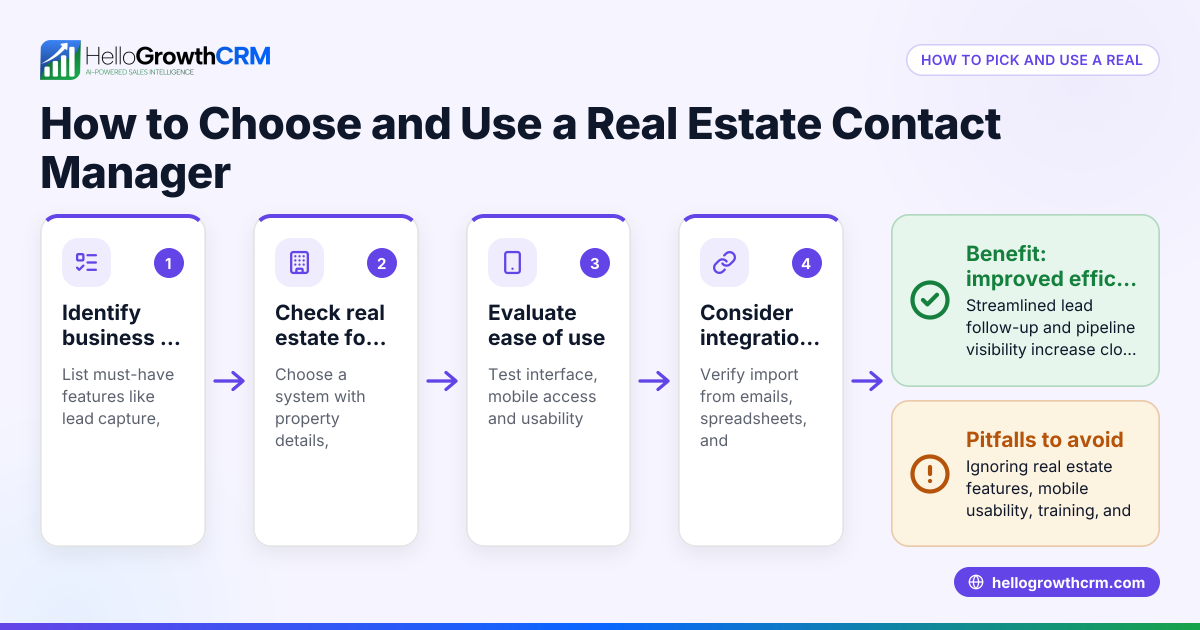
If you are choosing between systems, judge them on operational fit rather than on the length of the feature list. The best option is the one your team can use consistently without creating compliance gaps or off-system spreadsheets.
Commercial property enquiries in the UK do not arrive in one channel
Commercial real estate firms in the UK rarely live on one lead source. Instructions and tenant enquiries may come through Google Business Profile, LinkedIn, Facebook, Yell and direct referrals from solicitors, surveyors or finance brokers. If you also handle smaller units or mixed-use sites, listing traffic and local-search traffic can behave very differently from corporate referral work.
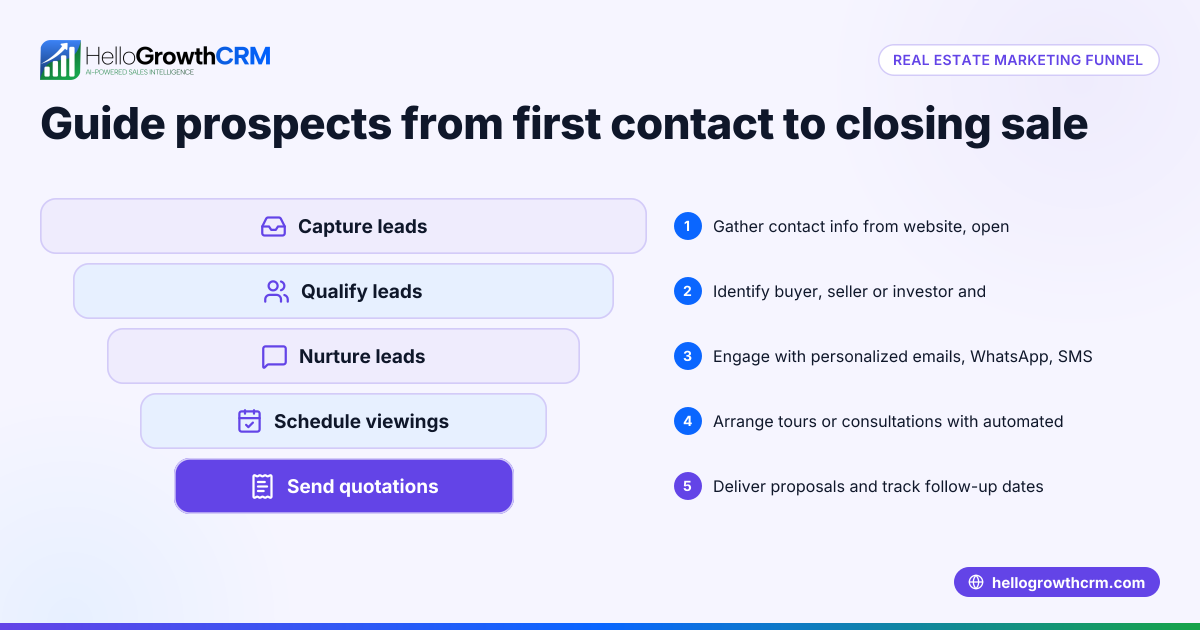
That is why source capture is not an administrative nice-to-have. It tells you which channels produce serious occupier demand, which ones send poor-fit enquiries, and which introducers deserve faster follow-up. A CRM should let your team record source at the point of entry, qualify the enquiry quickly and push it into the right pipeline without retyping details. HelloGrowthCRM’s lead capture and qualification tools are relevant here because they keep new enquiries organised from first contact rather than leaving source and fit to be reconstructed later.
For UK property teams, source design also affects consent and retention. If a contact arrives through a web form asking for details on one unit, that is different from a broker introduction or a business card collected at an event. Your CRM should preserve where the details came from, what was asked for and what follow-up was expected.
PECR and UK GDPR start at the enquiry form, not the campaign tool
Many firms think about compliance only when they start bulk email. In the UK, that is too late. Marketing by electronic mail and text is regulated by the Privacy and Electronic Communications Regulations, enforced by the ICO, and it sits alongside the UK GDPR and the Data Protection Act 2018. For a commercial real estate business, the practical issue is simple: the form, inbox and contact record need to show what the person asked for and what communications they should receive next.
The soft opt-in can apply in some situations, but it is narrow. It depends on how the contact details were obtained and whether the person had a proper opportunity to refuse marketing at that point. A CRM cannot decide that legal question for you, but it should make the evidence visible enough for your team to act carefully.
When reviewing a system, check whether it can keep the lawful basis, source, communication preference and unsubscribe status tied to the contact record rather than buried in a mailbox. The ability to answer a subject access request, apply a retention policy and minimise the data you collect all begin with that structure. If your enquiry form invites health disclosures for accessibility needs at viewings, remember that health data can be special category data under the UK GDPR and needs additional conditions and tighter handling.
The Equality Act 2010 matters here as well. A customer-facing booking or enquiry page should not create avoidable barriers for disabled users. For firms operating in Wales, Welsh-language provision may also be a practical consideration for forms, booking confirmations and standard messages.
VAT timing and retained deposits can turn a CRM note into evidence
Commercial property firms often focus on heads of terms and forget the accounting trail. In the UK, VAT is administered by HMRC, and the point at which VAT must be accounted for can turn on when payment is received. A deposit arriving before the underlying service or transaction stage is complete may matter on the day the money reaches you, not only when a deal later closes.
Retained deposits are especially awkward because HMRC has issued specific guidance and the treatment has changed over time. That means a CRM should not treat a deposit as just another free-text note. You need a dated record showing what the payment was for, whether it was refundable, what later happened to it and how the commercial document evolved. Current VAT rules, registration rules and Making Tax Digital requirements are published by HMRC, and those are the sources to check before deciding how your team should code deposits, cancellations or no-shows.
For that reason, a property CRM should connect the deal record to the commercial paperwork. If a tool can generate quotes, proposals or invoices from the live opportunity, and tie payments received back to that record, it reduces the risk of sales and finance holding different versions of the truth. It is also worth asking whether the CRM can fit around your existing finance stack through integration options, because Making Tax Digital shapes how VAT records must be kept even if the CRM itself is not your accounting system.
The arithmetic below is illustrative; the figures are made up to show the shape of the decision. Imagine a commercial agency in Manchester takes an illustrative marketing deposit of £1,200 for a landlord instruction, then later retains that illustrative sum after a cancellation dispute. The CRM record should show the illustrative date the money arrived, the made-up invoice reference, the agreed terms around refundability and the later outcome. This illustrative example leaves out the legal analysis of the contract wording and the current HMRC position, which you should check in official guidance before deciding the VAT treatment.
Bank transfer is normal in the UK, so card-only payment tracking is a blind spot
In UK business-to-business property work, card payments are only part of the picture. Deposits and one-off fees are often paid by Faster Payments, while ongoing management or retained-advisory fees may be collected by Direct Debit or BACS. Some firms now also encounter Open Banking payments. If a CRM assumes everything happens by card checkout, payment reconciliation will be patchy from the start.
This affects everyday decisions. A negotiator marks a client as committed because an email says payment is coming; finance has not yet seen the bank receipt; the viewing team proceeds; then someone else chases for payment because the CRM has no clean received-money status. That confusion is avoidable if the system records the rail used, the payment status and the document it relates to.
For commercial real estate, that link matters because instructions, reservation fees, marketing spends and consultancy work are often approved by one person and paid by another entity within the same group. A useful CRM should let you distinguish the contact, the legal entity and the payment trail instead of flattening them into one account.
Viewing calendars need four-nation holiday logic and realistic travel time
Commercial real estate is physical work. The quality of your CRM shows up not in a dashboard but in whether the right person reaches the right site with the right context. In the UK, that means accounting for geography and the fact that bank holidays differ across England and Wales, Scotland and Northern Ireland. A system using one generic UK holiday calendar will eventually create avoidable booking mistakes for firms operating across borders.
Travel time matters as much as availability. Industrial estates, retail parks and out-of-town offices create dead time between appointments, and urban appointments can be delayed by parking constraints or building access procedures. A CRM with scheduling should help your team turn an enquiry into a confirmed conversation quickly, but it should also avoid pretending that three viewings in different locations are interchangeable diary slots. HelloGrowthCRM’s scheduling and booking tools can shorten the path from interest to meeting, but the process still needs rules for region, travel and property type.
If you run field-based teams, territory ownership also matters. Some firms divide work by patch, others by client type or asset class. That is not only a reporting preference; it changes who follows up first and who attends viewings. Territory and field-operation tools can be useful where agents are mobile and handoffs are frequent.
Phone calls, WhatsApp and inbox traffic need one property record
Commercial property work in the UK still moves on direct conversation. A prospect calls after seeing a board, a landlord replies to an email thread with extra conditions, then a viewing time is settled on WhatsApp. If those interactions sit in separate personal devices and inboxes, the firm loses continuity whenever someone is away or leaves.
The practical requirement is not omnichannel jargon. It is a single property and deal record that shows what was said, what was promised and what needs doing next. A built-in dialer can help teams call from inside the CRM and keep the call history tied to the contact and deal record. Shared inbox and messaging workflows matter for the same reason: they keep customer communications visible to the business instead of trapped with one negotiator. For teams that rely heavily on messaging, HelloGrowthCRM offers a WhatsApp and SMS capability, and its activity logging and task boards can keep follow-up attached to the live deal rather than scattered across notebooks.
This is also where PECR discipline becomes operational, not theoretical. The system should make it obvious which messages are service-related, which are marketing, and which contacts should not be added to broader outreach at all.
Landlord, occupier and asset records should not be forced into one contact model
A weak CRM design treats every record as just a person with a phone number. Commercial real estate in the UK needs more structure than that. One instruction may involve a landlord contact, an asset manager, a surveyor, a solicitor, a facilities lead and a prospective occupier, all connected to one property and one opportunity in different ways. If the CRM cannot model those relationships cleanly, your team will duplicate contacts and lose track of who has authority to approve what.
Look for a system that can distinguish organisation records from individual contacts, and both from deals or opportunities. You also need property-specific fields that matter in practice: tenure discussions, service-charge context, use-class issues where relevant, access notes, compliance documents held elsewhere, and the current stage of the instruction. The pipeline should mirror how your firm actually works, whether that means appraisal to instruction, marketing to viewing, heads to legal, or acquisition brief to shortlist.
HelloGrowthCRM’s pipeline management layer is useful if you need stage movement, expected value and a clear record from first contact through close. The value is not the existence of a pipeline itself; it is whether the stages reflect commercial property work rather than generic software sales.
Ask implementation questions about record hygiene, not just features
Most CRM disappointments come from messy migration and unclear rules, not from the absence of a flashy function. Before you buy, ask:
- How will duplicate companies, contacts and properties be identified before import?
- Which fields are mandatory at enquiry stage, and which are optional until a deal is qualified?
- How will source, consent status and communication preference be carried over from existing forms and inboxes?
- Can the system support your actual payment and document trail without forcing staff into side spreadsheets?
- Who owns pipeline stages, close definitions and archive rules once the system is live?
Those questions matter because commercial real estate data ages badly when neglected. Contacts move roles, instructions lapse, units are withdrawn, and old notes can mislead current staff if nobody owns cleanup. If your team is already stretched, implementation support may be more valuable than another reporting widget. Some firms prefer outside help with data cleanup, routing rules and weekly hygiene rather than trying to configure everything internally from scratch. If that is your situation, a service such as managed RevOps support may be worth considering.
The best commercial real estate CRM for the UK is the one that fits HMRC realities, ICO rules, UK payment habits and four-nation scheduling without making your negotiators work around it every day.
Ready to put this into practice?
Set up your pipeline, WhatsApp follow-ups, and AI lead scoring in minutes — free, no credit card.
Try HelloGrowthCRM freeGet CRM tips in your inbox
Join thousands of sales professionals who get weekly insights on CRM strategy, AI automation, and pipeline optimization.

The HelloGrowthCRM team publishes guides on CRM strategy, AI sales tools, and revenue operations for small business sales teams.