HelloGrowthCRM software
Built for real small-business sales teams
HelloGrowthCRM helps reps qualify faster, follow up on time, and close more deals—with practical automation in one place.
- AI lead scoring and pipeline visibility
- Built-in dialer, WhatsApp, and email automation
- Sales forecasting and RevOps-ready reporting
In Singapore, good customer retention starts with a CRM record that reflects how people actually buy, pay and reply here: often through WhatsApp, PayNow, referrals and tightly scheduled service windows, all under PDPA and local tax rules.
Many retention articles treat the CRM as a broadcast tool. For a Singapore business, it is closer to an operating record. If your team cannot see which customer paid by bank transfer, who came from Google Business Profile, which family prefers Mandarin messages, or whether a reminder is transactional rather than promotional, repeat revenue becomes fragile. The fix is not more campaigns. It is better structure in the record itself.
This matters whether you run an aesthetic clinic in Orchard, a tuition centre in Tampines, an air-conditioning service firm in Jurong, or a B2B logistics broker near Changi. The customers differ, but the retention question is similar: what information lets your team make the next purchase easy without creating tax, privacy or service mistakes?
PayNow, FAST and SGQR should sit inside the customer history
Retention weakens when payment history is incomplete. In Singapore, that often happens because repeat customers pay through rails that do not show up in one card dashboard. A customer may settle an invoice by PayNow, FAST, GIRO, NETS, credit card or ordinary bank transfer. If the team only records card payments automatically and leaves the rest in someone’s inbox or a finance spreadsheet, the CRM gives a false picture of who has paid on time, who needs a receipt, and who is ready for the next offer.
PayNow and bank transfers are the common trap. Staff see the money in bank records, but the account manager looking at the customer record does not. That leads to awkward reminders sent to a good customer, or missed follow-up because the system still shows an invoice as open. For retention, the practical standard is simple: every payment method used by customers in Singapore should be reflected against the same account record, even when a human has to match it manually.
This is also where deposits matter. Under Singapore GST rules, a payment received for a taxable supply can affect the tax point at the earlier of invoice or payment. The tax is GST, the authority is IRAS, and the current rule position should be checked in IRAS guidance because the exact treatment depends on the supply. Operationally, a deposit is not just sales progress; it is part of the commercial and tax record. If your CRM shows only “won” and not “deposit received on this date for this job,” both service follow-up and paperwork suffer.
Retention improves when the record answers a very ordinary question fast: what did this customer agree to, how did they pay, and what remains outstanding?
PDPA turns consent and message purpose into retention data
Singapore businesses cannot treat every follow-up as a marketing blast. The Personal Data Protection Act, enforced by the Personal Data Protection Commission, matters directly to retention because the channel and purpose of a message affect what you can send and what evidence you should keep. The Do Not Call provisions are especially relevant when your team sends SMS or calls Singapore numbers. The sender must check the relevant Do Not Call Registry before sending specified messages, unless an exception applies or the person has given clear and unambiguous consent. The duty sits with the sender, not the software vendor.
That means the CRM should distinguish at least three things: service messages tied to an existing transaction, promotional outreach, and consent-backed marketing. A tuition centre reminder about a class timing change does not sit in the same category as a broad promotion for a holiday programme. A dental practice appointment confirmation differs from a cosmetic upsell. These distinctions are not legal decoration; they determine whether staff can safely use a channel for retention.
One more Singapore-specific point is easy to miss: PDPC guidance restricts collection of NRIC numbers. If your enquiry or booking form asks for NRIC by default, you may be keeping data that adds risk without helping the customer buy again. For retention, less can be better. Keep the fields that help service continuity and communication; avoid default collection of sensitive identifiers unless there is a clear legal or operational basis.
Google Business Profile, Carousell and WhatsApp predict repeat behaviour
Lead source is often treated as acquisition reporting. In Singapore, it also predicts how a customer is likely to return. A customer who first found you on Google Business Profile may care about location, opening hours and review signals. One from Carousell may be price-sensitive and want quick chat-based negotiation. A referral may trust you faster but expect high-touch service. A B2B lead from LinkedIn or GeBIZ may need formal quotations, documented follow-up and a longer internal approval path.
If all those customers enter one generic pipeline with no source-specific fields, the CRM cannot support retention properly. Your second sale to a Carousell buyer may depend on a short WhatsApp check-in. Your renewal with a GeBIZ-related contact may depend on whether the prior scope, quote version and service performance notes are easy to retrieve. A home services firm in Jurong that gets many WhatsApp enquiries should not design retention around long email newsletters. A Novena dental practice should care more about recall timing, treatment completion and appointment convenience than about broad promotional frequency.
The useful question is not “Which source converts best?” It is “Which source tells us how this person prefers to buy again?” That is a retention field.
Singapore calendars reward precise scheduling, not generic reminders
Singapore is compact, but scheduling is not simple. Public holidays span different communities, and some are tied to lunar or Islamic calendars, so dates move from year to year. Lunch-hour and post-work slots can carry demand that mid-morning does not. CBD customers may prefer short weekday windows near the office, while heartland customers may choose evenings or weekends. If your reminders ignore these patterns, you create friction exactly where retention should feel easy.
A CRM used for retention should store the customer’s preferred slot pattern, not just the next appointment date. For a tuition centre in Tampines, family scheduling may matter more than the student record alone. For an air-conditioning company, condo access timing, parking notes and technician lead time may decide whether a customer rebooks. For B2B clients near Changi, regional contacts may sit on different ASEAN time offsets even though your Singapore team runs on one time zone. The issue is not geography size; it is whether the next interaction fits the customer’s working rhythm.
This is one place where booking tools earn their keep. If customers can pick suitable windows and staff can see prior no-show or reschedule patterns, retention becomes less about persuasion and more about reducing hassle. A clean meeting scheduler setup is often more valuable than another discount.
Language choice in the record affects whether people come back
English is the working language in Singapore, but customer-facing communication in Mandarin or Malay can matter a great deal by segment. Retention suffers when the CRM stores only the legal name and email but not the preferred language for reminders, quotations or care instructions. This is especially visible in family services, healthcare-adjacent settings and neighbourhood businesses where trust is built through clarity, not formality.
The point is not to translate everything into every language. It is to know when language affects comprehension and comfort. A first-time sale can survive a little confusion. A repeat sale often does not. If a parent at a tuition centre responds more reliably to Mandarin reminders, or a home services customer is more comfortable confirming access details in Malay, that belongs in the customer record the same way payment preference does.
There is also a compliance angle for regulated sectors. Licensed medical, dental and aesthetic practices in Singapore face advertising and communication rules from the Ministry of Health and professional boards. A retention message for a clinic should therefore be designed around appropriate patient communication and follow-up, not loose promotional claims. The right workflow depends on the service context, which is another reason to structure records carefully.
Quotes, deposits and GST timing shape the second sale
Retention is not only about messages; it is about making the next transaction administratively smooth. In Singapore, that means your CRM should preserve the commercial thread from quotation to invoice to payment. If a customer accepted a quoted package, paid a deposit, postponed the work, and returned later for a related add-on, your team needs one view of that history. Without it, customers have to repeat themselves, and staff make avoidable billing errors.
The arithmetic below is illustrative; the figures are made up to show the shape of the decision. Suppose an air-conditioning firm quotes S$480 for servicing two units and later offers an additional chemical wash for S$220. The customer pays a S$150 deposit by PayNow to hold a Saturday slot, then settles the balance by card after the job. If the CRM records only the final card payment, the operations team may think the customer still owes S$150, while finance may already have treated the deposit as part of the taxable supply record. If, instead, the record shows the quote, the accepted scope, the deposit receipt date, the remaining balance and the service notes, the next rebooking is straightforward: “same site, same access note, same equipment, last service on this date.”
What this leaves out: GST treatment nuances, card fees, refunds, partial cancellations and whether any part of the work is non-taxable. For current GST treatment, check IRAS guidance under the Goods and Services Tax Act and related publications. The retention lesson is simpler than the tax detail: accurate money history reduces friction on the next purchase.
One clean service timeline beats scattered notes across inboxes
Repeat business often breaks because the business remembers the customer socially but not operationally. In Singapore SMEs, details are easily scattered across WhatsApp threads, personal phones, desk diaries and email chains. When the original staff member is on leave or has left, the customer experiences the business as forgetful.
A retention-ready CRM keeps one service timeline: enquiry, quote, visit notes, promises made, payment status, complaints, resolutions and future tasks. That matters more in Singapore because many transactions move quickly and informally at first, then become formal later. The same customer may start with an Instagram message, confirm by WhatsApp, pay by PayNow and later request a proper quotation for the next job. If those steps are split across tools, no one owns the relationship properly.
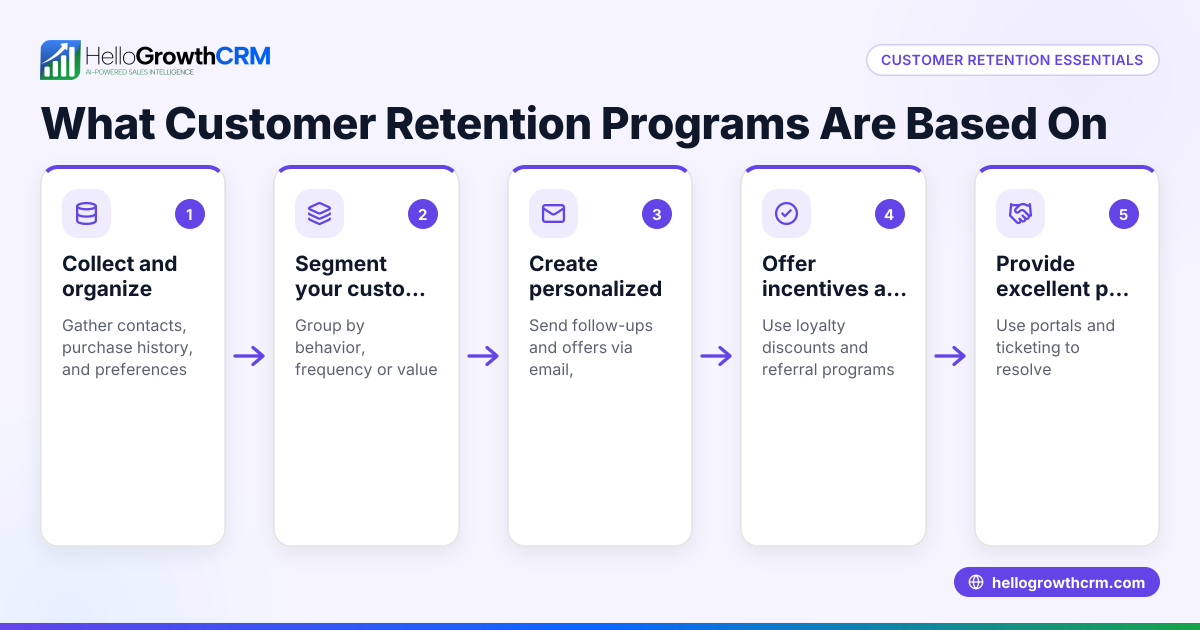
For teams trying to tidy this up, these are the only fields worth debating first:
- message purpose and consent basis for each active channel
- payment method used and whether staff must reconcile it manually
- lead source that best predicts how the customer buys again
- preferred language and preferred contact window
- service-specific notes that make the next booking easier
If those fields are present and maintained, retention work becomes visible and transferable.
A CRM helps only if it reduces admin without erasing responsibility
Automation is useful in retention, but Singapore businesses still need a clear audit trail. That is especially true where PDPA, DNC checks, regulated communications or deposit handling are involved. The right setup is one where the system helps staff follow through while preserving who sent what, who updated the record and why a task was triggered.
HelloGrowthCRM can support that operating style with lead capture and pipeline records in Leads, activity history and handoffs through task boards, customer messaging via WhatsApp and SMS workflows, and commercial tracking around quotes, invoices and payments inside the CRM. If you need to fit those records into other systems, the integrations tooling is the relevant starting point. The value for retention is not flashy automation; it is keeping the commercial and communication history attached to the customer.
For a Singapore business, customer retention improves when your CRM mirrors local reality: the payment rails people use, the consent rules you actually operate under, the timing windows customers prefer, and the service details that save them from repeating themselves. Build the record that way, and follow-up stops feeling like chase work and starts feeling like competence.
Ready to put this into practice?
Set up your pipeline, WhatsApp follow-ups, and AI lead scoring in minutes — free, no credit card.
Try HelloGrowthCRM freeGet CRM tips in your inbox
Join thousands of sales professionals who get weekly insights on CRM strategy, AI automation, and pipeline optimization.

The HelloGrowthCRM team publishes guides on CRM strategy, AI sales tools, and revenue operations for small business sales teams.