HelloGrowthCRM software
Built for real small-business sales teams
HelloGrowthCRM helps reps qualify faster, follow up on time, and close more deals—with practical automation in one place.
- AI lead scoring and pipeline visibility
- Built-in dialer, WhatsApp, and email automation
- Sales forecasting and RevOps-ready reporting
CRM customer retention means actively managing your existing customers' experience using CRM software to increase loyalty and repeat business. It focuses on tracking customer interactions, handling service requests efficiently, and maintaining timely communication. This article explains why small business owners search for CRM with retention features, guides you through evaluating and using CRM for retention, shares a realistic example, highlights common mistakes, and shows how HelloGrowthCRM supports retention.
Why this comes up / what goes wrong
Many small business owners lose customers not because their product or service is poor, but because follow-up and service fall through the cracks. Without a system, customer requests, complaints, and opportunities for upselling get missed. Sales and support teams may use separate tools like email, spreadsheets, or text messages, leading to scattered customer information. This fragmentation causes slow responses, inconsistent communication, and ultimately customer churn. When evaluating CRM for customer retention, owners want a solution that centralizes customer data, tracks all interactions, and helps their team respond faster and smarter.
Step-by-step
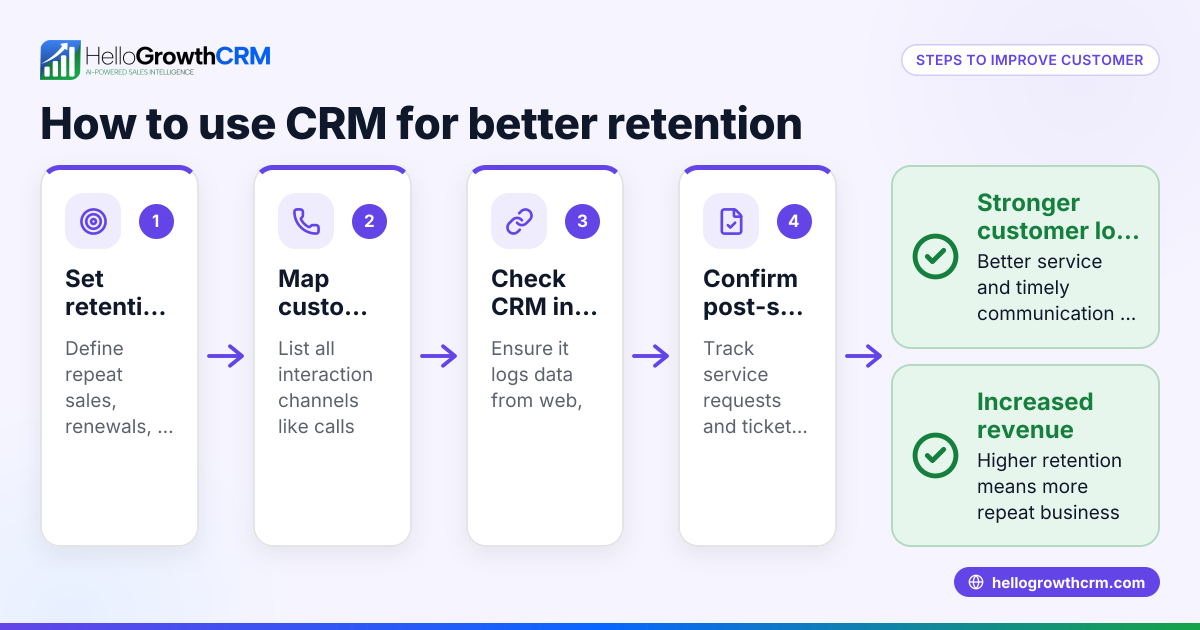
- Identify your retention goals and metrics
- Decide what retention means for your business (repeat purchases, subscription renewals, referrals).
- Determine metrics to track such as customer lifetime value, repeat purchase rate, or churn rate.
- Check CRM’s customer data management
- Ensure the CRM stores all customer interactions in one place, including sales, support tickets, and messages.
- Verify it supports a customer portal or knowledge base so customers can self-serve and reduce support load.
- Evaluate communication channels
- Confirm the CRM supports your main communication channels like WhatsApp and SMS, with conversations logged automatically.
- Look for automation features such as AI agents that draft follow-ups to keep customers engaged without extra manual work.
- Assess tracking and reporting capabilities
- The CRM should provide clear reports on customer health, retention trends, and service response times.
- Check if it allows you to track referrals and customer satisfaction through tickets or surveys.
- Test ease of use and team adoption potential
- Choose a CRM your sales, support, and marketing teams find intuitive to ensure consistent use.
- Confirm it integrates smoothly with your existing tools and workflows.
- Plan for ongoing customer engagement
- Use CRM features like task boards and sequences to schedule regular check-ins, promotions, or service follow-ups.
For more on tracking customer health, see customer health score.
Example (fictional figures)
A landscaping contractor in Charlotte, North Carolina, wants to reduce customer churn and increase referrals.
- Current customers: 500
- Average revenue per customer per year: $2,000
- Annual churn rate: 20% (100 customers lost yearly)
- Goal: reduce churn to 15% (75 customers lost yearly)
Calculations:
Current annual revenue = 500 × $2,000 = $1,000,000
Revenue lost to churn annually = 100 × $2,000 = $200,000
Target revenue lost to churn = 75 × $2,000 = $150,000
Revenue saved by reducing churn = $200,000 - $150,000 = $50,000
If the CRM costs $5,000 per year and helps achieve this retention improvement, the net gain is:
$50,000 - $5,000 = $45,000
This shows investing in CRM with retention features can increase revenue by keeping more customers and encouraging referrals.
Common mistakes
- Not centralizing customer data: Prevent by choosing a CRM that logs all interactions, including WhatsApp and SMS messages, so no info is lost.
- Ignoring service requests after sale: Prevent by using a CRM with a customer portal and ticketing system to track and resolve issues on the same customer record.
- Lack of follow-up automation: Prevent by implementing AI agents that draft messages after calls, ensuring timely and consistent communication.
- Overlooking team adoption: Prevent by selecting a CRM that your team finds easy and natural to use daily.
- Failing to measure retention impact: Prevent by regularly reviewing retention metrics and customer health scores to adjust strategies.
For communication and follow-up automation, see WhatsApp and SMS CRM.
Doing this in HelloGrowthCRM
HelloGrowthCRM supports customer retention with features designed for small and mid-sized businesses. After the sale, service requests stay linked to the same customer record as the deal via the customer portal, referrals tracking, tickets, and knowledge base. WhatsApp conversations with leads and customers are logged automatically, and follow-ups can be sent as WhatsApp or SMS messages. AI agents draft follow-up messages after calls so reps only review and send, reducing manual work and speeding response times. Learn more about these features at HelloGrowthCRM for the United States.
Frequently asked questions
What is the relationship between CRM and customer retention? CRM helps collect and organize customer data, enabling timely communication and personalized service that improve retention. It centralizes information so teams can track issues, follow up consistently, and build loyalty.
What customer retention strategies can CRM support? CRM supports strategies like personalized follow-ups, loyalty programs, referral tracking, and resolving service tickets quickly. Automation features help maintain regular contact without extra manual effort.
How does HelloGrowthCRM help with customer retention? HelloGrowthCRM keeps service requests, referrals, and customer interactions linked on the same record. It logs WhatsApp conversations and supports follow-ups via WhatsApp and SMS. AI agents draft follow-up messages after calls so reps only review and send, helping teams respond faster.
Can CRM track referrals to help retention? Yes, many CRMs, including HelloGrowthCRM, track referrals as part of the customer record. This helps you measure and reward customers who bring in new business.
Is WhatsApp integration important for customer retention? For many US small businesses, WhatsApp is a key communication channel. A CRM that logs WhatsApp conversations and allows follow-ups on that platform helps maintain engagement where customers prefer to interact.
See also customer health score for measuring retention.
Key takeaways
- CRM centralizes customer data, making retention easier to manage.
- Track all communication channels, especially WhatsApp and SMS, for consistent follow-up.
- Use automation like AI agents to draft follow-ups and reduce manual work.
- Include service requests and referrals in the same customer record for full visibility.
- Measure retention impact regularly with customer health scores and reports.
- Choose a CRM your team will actually use daily to avoid data gaps.
Start improving your customer retention today. Start on the Free Forever plan (200 leads, no credit card).
Ready to put this into practice?
Set up your pipeline, WhatsApp follow-ups, and AI lead scoring in minutes — free, no credit card.
Try HelloGrowthCRM freeGet CRM tips in your inbox
Join thousands of sales professionals who get weekly insights on CRM strategy, AI automation, and pipeline optimization.

The HelloGrowthCRM team publishes guides on CRM strategy, AI sales tools, and revenue operations for small business sales teams.