HelloGrowthCRM software
Built for real small-business sales teams
HelloGrowthCRM helps reps qualify faster, follow up on time, and close more deals—with practical automation in one place.
- AI lead scoring and pipeline visibility
- Built-in dialer, WhatsApp, and email automation
- Sales forecasting and RevOps-ready reporting
A CRM for business growth is software that helps small and mid-sized businesses organize leads, automate follow-ups, and track sales pipelines to convert more prospects efficiently. This article explains why businesses seek growth-focused CRMs, provides step-by-step guidance on evaluating options, highlights common mistakes, and shows how HelloGrowthCRM supports growth with WhatsApp messaging, AI agents, and managed revenue operations.
Why this comes up / what goes wrong
Small-business owners often search for a CRM for business growth when they notice leads slipping through the cracks due to slow or inconsistent follow-up. Many run their sales processes on text messages, email chains, and spreadsheets, which become unmanageable as the team grows. Without a system that centralizes communication and automates routine tasks, sales reps waste time on manual data entry and miss opportunities to engage prospects quickly. Founders without dedicated sales managers struggle to keep the pipeline clean and ensure every lead is nurtured. This leads to lost revenue and stalled growth.
Step-by-step
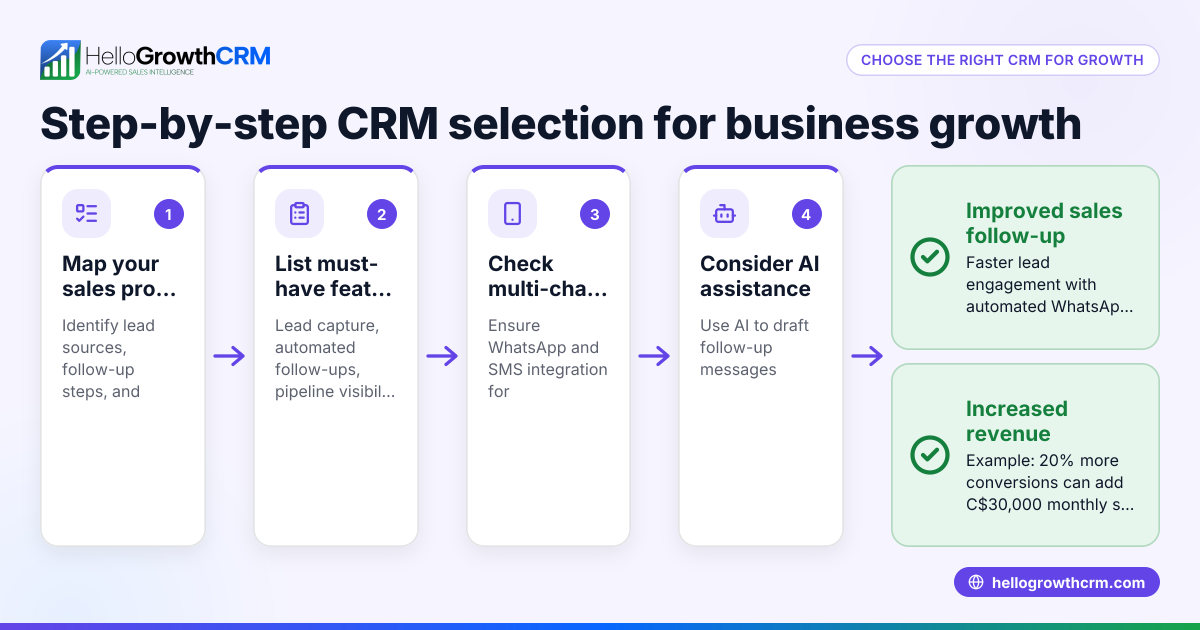
- Identify your sales process needs: Write down how leads currently enter your system, how you follow up, and how deals progress. Check if you need multi-channel messaging like WhatsApp or SMS, task automation, or AI assistance.
- Evaluate CRM features: Look for features that enable lead capture from web forms and integrations, pipeline visualization, task boards, and communication logging. Confirm if the CRM supports channels your customers prefer, such as WhatsApp and SMS.
- Check automation and AI capabilities: Determine if the CRM offers AI agents that can draft follow-up messages or update records to reduce rep workload. Beta features may offer early benefits but consider stability.
- Consider revenue operations support: If you lack a sales manager, see if the CRM provider offers managed RevOps services to maintain pipeline hygiene and execute follow-ups regularly.
- Assess integration and reporting: Ensure the CRM can integrate with your existing tools and provides sales forecasting and reporting to track growth accurately.
- Test usability and adoption: Choose a CRM that your team will actually use daily. Look for intuitive interfaces and mobile-friendly options.
- Review pricing and plans: Compare plans based on features and support but avoid focusing solely on cost. Consider the value added for your growth goals.
Example (fictional figures)
A B2B software reseller in Denver, Colorado, wants to grow sales by improving lead follow-up efficiency. They receive 500 leads monthly from web forms and events.
- Current conversion rate: 5% (500 × 5% = 25 sales)
- Average sale value: $4,000
- Monthly revenue: 25 × $4,000 = $100,000
They adopt a CRM with AI agents and WhatsApp messaging to increase follow-up speed and quality.
- New conversion rate: 7% (500 × 7% = 35 sales)
- Monthly revenue: 35 × $4,000 = $140,000
Revenue increase: $140,000 - $100,000 = $40,000 monthly
This $40,000 growth results from better lead engagement and pipeline management.
Common mistakes
- Choosing a CRM without multi-channel support: Many customers prefer WhatsApp or SMS. Avoid CRMs that only handle email. Prevent this by verifying channels supported, such as WhatsApp and SMS CRM features described at WhatsApp and SMS CRM.
- Ignoring automation capabilities: Manually drafting follow-ups wastes time. Look for AI agents that draft messages for quick review, reducing rep burden. Check out AI CRM features at AI CRM.
- Overlooking managed revenue operations: Founders without sales managers may struggle to keep pipelines clean. Using managed RevOps services ensures weekly follow-up and pipeline hygiene. Learn more at HelloGrowthCRM for the United States.
- Picking a CRM too complex for the team: A complicated system reduces adoption. Choose one with an intuitive interface and mobile capabilities.
- Neglecting integration needs: If the CRM doesn’t connect to your web forms or other tools, data silos form. Confirm integrations before buying.
- Focusing only on price: The cheapest CRM may lack essential growth features. Prioritize functionality over cost.
Doing this in HelloGrowthCRM
HelloGrowthCRM supports business growth by enabling WhatsApp and SMS conversations to be logged directly on lead records, so follow-ups happen in the channels customers already use. Its AI agents (currently in Beta) draft follow-up messages after calls, letting sales reps review and send quickly, saving time. For founders without sales managers, HelloGrowthCRM offers managed RevOps services that handle weekly follow-up queues, pipeline cleanup, and KPI reporting. Learn more about these features at WhatsApp and SMS CRM and AI CRM.
Frequently asked questions
What is a growth CRM? A growth CRM is designed to help businesses scale sales by automating lead management, follow-ups, and pipeline tracking. It often includes AI features and multi-channel communication to increase efficiency.
How does AI-powered CRM improve business growth? AI-powered CRMs automate routine tasks like drafting follow-ups and updating records, which reduces manual work for sales reps. This speeds up response times and improves lead engagement.
Can a CRM support WhatsApp communication for sales? Yes, some CRMs, including HelloGrowthCRM, integrate WhatsApp messaging natively, logging conversations on lead records and enabling follow-ups directly through WhatsApp.
What should I ask before choosing a CRM for growth? Ask about multi-channel support (WhatsApp, SMS, email), AI automation capabilities, managed revenue operations services, ease of use, integration options, and reporting features.
Is managed RevOps necessary for small businesses? If you don’t have a dedicated sales manager, managed RevOps can maintain pipeline hygiene, execute timely follow-ups, and provide strategic insights to support growth.
Key takeaways
- A CRM for business growth organizes leads, automates follow-ups, and tracks pipelines to increase sales efficiency.
- Multi-channel support, especially WhatsApp and SMS, is critical for engaging customers where they respond.
- AI-powered features reduce manual tasks by drafting follow-ups and updating records.
- Managed RevOps services help founders without sales managers maintain pipeline health and follow-up consistency.
- Evaluate CRMs for usability, integration, automation, and support, not just price.
Start improving your sales follow-up and pipeline management today. Start on the Free Forever plan (200 leads, no credit card).
Ready to put this into practice?
Set up your pipeline, WhatsApp follow-ups, and AI lead scoring in minutes — free, no credit card.
Try HelloGrowthCRM freeGet CRM tips in your inbox
Join thousands of sales professionals who get weekly insights on CRM strategy, AI automation, and pipeline optimization.

The HelloGrowthCRM team publishes guides on CRM strategy, AI sales tools, and revenue operations for small business sales teams.