HelloGrowthCRM software
Built for real small-business sales teams
HelloGrowthCRM helps reps qualify faster, follow up on time, and close more deals—with practical automation in one place.
- AI lead scoring and pipeline visibility
- Built-in dialer, WhatsApp, and email automation
- Sales forecasting and RevOps-ready reporting
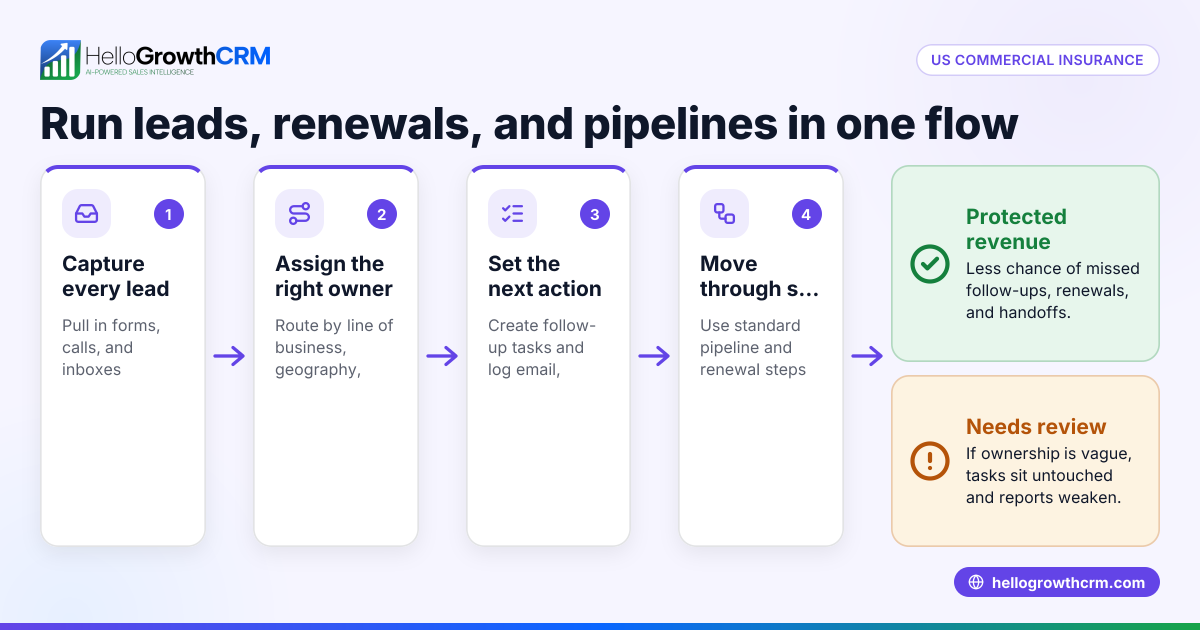
A CRM for insurance renewals helps insurance businesses track policy expiry dates, schedule timely follow-ups, and automate reminders through channels like WhatsApp and SMS. This reduces missed renewals and improves customer retention. This article covers why insurance businesses struggle with renewals, step-by-step guidance to implement a CRM for renewals, a worked example for an insurance agency in Mumbai, common mistakes, and how HelloGrowthCRM supports insurance renewal management.
Why this comes up / what goes wrong
Insurance business owners and accountants often rely on manual methods like spreadsheets, phone calls, and WhatsApp chats to track policy renewals. This leads to missed follow-ups, delayed reminders, and lost revenue. Policies have fixed expiry dates, and customers expect timely renewal communication. Without a dedicated CRM, it’s hard to manage hundreds or thousands of policies, especially across multiple agents. The volume and frequency of renewals create a complex workflow that manual tracking cannot handle efficiently.
Insurance agents need a system that captures leads, stores policy details with expiry dates, automates reminders via WhatsApp or SMS, and tracks follow-up status. Without this, agents spend excessive time chasing customers, leading to slow responses and lost renewals.
Step-by-step
- List all active policies with expiry dates: Gather data from your sales records, spreadsheets, or existing systems. Check that each policy record includes customer contact details and renewal date.
- Choose a CRM that supports WhatsApp and SMS follow-ups: Verify the CRM can log conversations on lead records and send automated reminders on these channels where customers are responsive.
- Import your policy data into the CRM: Ensure the expiry date field is correctly mapped to trigger reminders.
- Set up automated renewal reminders: Configure sequences to send messages before the expiry date (e.g., 30 days, 15 days, 3 days prior) and after expiry if needed.
- Assign follow-up tasks to agents: Use the CRM task boards to track calls and messages. Check that agents receive notifications for pending renewals.
- Use AI agents (if available) to draft follow-ups: This saves time by generating message drafts after calls for quick review and sending.
- Monitor renewal progress and pipeline hygiene: Regularly check for policies that need attention and clean duplicate or incorrect records.
- Train your team on CRM usage: Make sure all agents update records and use the system consistently.
- Review follow-up queues weekly: If you lack internal sales management, consider external support to maintain follow-up discipline.
For more on insurance and financial services sales, see Insurance agents, NBFCs and financial services.
Example (fictional figures)
An insurance agency in Mumbai manages 1,000 policies with an average premium of ₹10,000 each. They want to automate renewal reminders starting 30 days before expiry.
- Total policies: 1,000
- Average premium per policy: ₹10,000
- Renewal reminder schedule: 30, 15, and 3 days before expiry
If the CRM helps increase renewals by 5% more policies renewed than before, that means 50 additional renewals:
₹10,000 × 50 = ₹5,00,000
By automating reminders, the agency can potentially increase revenue by ₹5,00,000 each renewal cycle.
Common mistakes
- Not updating policy expiry dates accurately: Prevent by regularly syncing CRM data with sales records.
- Relying only on manual follow-ups: Use automated WhatsApp and SMS sequences to ensure timely reminders.
- Ignoring follow-up task management: Assign and track tasks in the CRM to avoid missed calls.
- Not training agents on CRM usage: Conduct regular training and enforce usage policies.
- Overlooking pipeline hygiene: Schedule regular data clean-ups to remove duplicates and stale leads.
- Failing to monitor follow-up effectiveness: Adjust communication frequency and messaging based on results.
Learn more about managing follow-ups with WhatsApp and SMS CRM.
Doing this in HelloGrowthCRM
HelloGrowthCRM supports insurance renewal workflows with WhatsApp and SMS messaging logged directly on lead records, ensuring all conversations are tracked. Its AI agents (in Beta on Growth plans) draft follow-up messages after calls, so agents only review and send, saving time. For founders without a sales manager, Managed RevOps provides a specialist who works the follow-up queue weekly, helping maintain consistent renewal outreach. Visit HelloGrowthCRM for India to learn more.
Frequently asked questions
What features should a CRM for insurance renewals have? It should track policy expiry dates, automate reminders via WhatsApp and SMS, log conversations on lead records, assign follow-up tasks, and provide clear visibility of renewal status. AI drafting of messages and managed follow-up support are useful extras.
Can I use WhatsApp for insurance renewal reminders legally? Yes, WhatsApp is widely used for customer communication in India. Make sure to follow WhatsApp Business policies and obtain customer consent for promotional messages. Using a CRM that logs conversations helps maintain compliance.
How often should I send renewal reminders? A common schedule is 30 days, 15 days, and 3 days before policy expiry. You can add a reminder after expiry if the customer hasn’t renewed. Adjust frequency based on customer response and policy type.
How does AI help in insurance renewal CRM? AI agents can draft follow-up messages after calls, reducing manual effort. They can also update records and execute workflow steps automatically, speeding up communication and improving consistency.
What if I don’t have a sales manager to oversee renewals? Managed RevOps services provide dedicated support to manage your follow-up queue weekly, helping maintain steady customer contact and pipeline hygiene even without an internal manager.
Key takeaways
- Track policy expiry dates and customer contacts in a CRM that supports WhatsApp and SMS.
- Automate renewal reminders at multiple intervals before expiry.
- Assign and monitor follow-up tasks to ensure timely customer contact.
- Use AI agents to draft messages and speed up follow-ups.
- Consider Managed RevOps support if you lack a sales manager.
- Regularly clean data and review renewal progress.
Start improving your insurance renewal process today. Start on the Free Forever plan (200 leads, no credit card).
Ready to put this into practice?
Set up your pipeline, WhatsApp follow-ups, and AI lead scoring in minutes — free, no credit card.
Try HelloGrowthCRM freeGet CRM tips in your inbox
Join thousands of sales professionals who get weekly insights on CRM strategy, AI automation, and pipeline optimization.

The HelloGrowthCRM team publishes guides on CRM strategy, AI sales tools, and revenue operations for small business sales teams.