HelloGrowthCRM software
Built for real small-business sales teams
HelloGrowthCRM helps reps qualify faster, follow up on time, and close more deals—with practical automation in one place.
- AI lead scoring and pipeline visibility
- Built-in dialer, WhatsApp, and email automation
- Sales forecasting and RevOps-ready reporting
For insurance businesses in Canada, choosing between a CRM and spreadsheets comes down to how you manage leads, track customer interactions, and support sales processes. A CRM offers automation, centralised communication, and sales insights that spreadsheets lack. Spreadsheets may be simpler at first but often cause missed leads and slow follow-ups as the business grows. This article compares CRM and spreadsheets on key criteria for Canadian insurance businesses, includes a practical example, common mistakes to avoid, and how HelloGrowthCRM supports insurance sales teams.
Why this comes up / what goes wrong
Insurance business owners or accountants often start with spreadsheets to track leads and policies because they are low cost and familiar. However, as lead volume and team size increase, spreadsheets become difficult to maintain and error-prone. Common problems include:
- Losing track of leads or follow-ups due to manual updates and no automation.
- Difficulty sharing up-to-date information across multiple team members.
- No automatic reminders or prioritisation of hot leads.
- Time wasted reconciling data from calls, emails, and text messages.
- Lack of sales forecasting and reporting tools to guide decisions.
These issues lead to lost sales opportunities and inefficient use of staff time. A CRM designed for insurance centralises customer data, automates workflows, and provides insights needed to grow revenue reliably.
Step-by-step
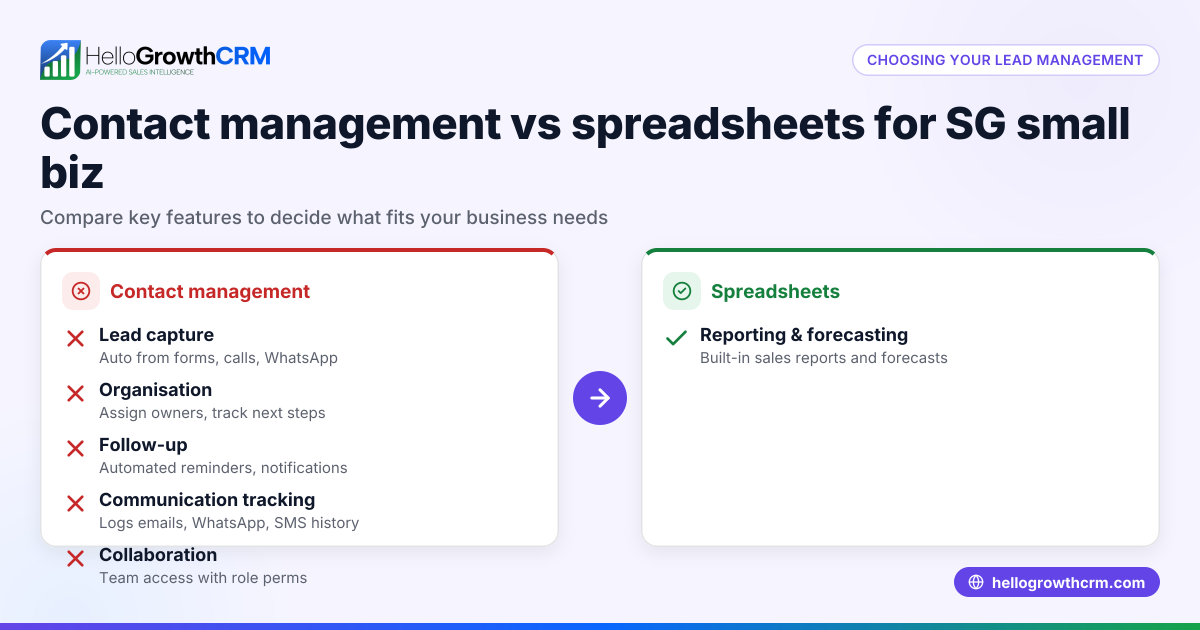
Here is a comparison of CRM for insurance vs spreadsheets on key criteria for Canadian insurance businesses:
| Criteria | CRM for Insurance | Spreadsheets |
|---|---|---|
| Lead Capture | Automated from web forms and integrations | Manual entry |
| Follow-up Automation | AI agents draft messages; scheduled tasks | Manual reminders or none |
| Communication Tracking | WhatsApp, SMS conversations logged | Separate apps; no central log |
| Collaboration | Shared pipeline and task boards | Shared files but prone to version conflicts |
| Sales Forecasting | Built-in forecasting and reporting | Requires manual calculations |
| Data Accuracy | Validation and automatic updates | Prone to human error |
| Scalability | Supports growing teams and workflows | Becomes unmanageable as data grows |
Who should pick which?
- CRM for Insurance: Best for teams with multiple agents, frequent follow-ups, and growth goals. It saves time, reduces errors, and improves sales effectiveness.
- Spreadsheets: May suffice for solo agents or very small businesses with simple needs and low lead volumes.
For more detailed CRM options, see compare CRMs.
Example (fictional figures)
A bilingual insurance agency in Laval, Quebec, has 3 agents and generates about C$1,000,000 in annual premiums. They track 500 leads per year.
Using spreadsheets, each agent spends 10 hours weekly updating records and managing follow-ups.
- Weekly hours per agent: 10
- Number of agents: 3
- Total weekly hours: 10 × 3 = 30 hours
- Annual hours (50 weeks): 30 × 50 = 1,500 hours
Assuming an average wage of C$25/hour:
- Annual cost of manual tracking: 1,500 × C$25 = C$37,500
Switching to a CRM reduces manual tracking time by 70%, saving:
- Time saved: 1,500 × 70% = 1,050 hours
- Cost saved: 1,050 × C$25 = C$26,250
Additionally, the CRM's AI agents draft follow-up messages after calls, increasing lead contact rates and potentially boosting sales.
Common mistakes
- Underestimating data complexity — Prevent by assessing lead volume and follow-up needs before relying on spreadsheets.
- Ignoring team collaboration needs — Prevent by choosing tools that allow real-time updates and shared access.
- Skipping automation — Prevent by adopting CRMs with AI agents and messaging workflows to reduce manual work.
- Delaying CRM adoption — Prevent by transitioning early when lead volume grows beyond spreadsheet management.
- Neglecting communication tracking — Prevent by using CRMs that log WhatsApp and SMS conversations centrally.
For more on industry-specific solutions, visit Insurance agents, NBFCs and financial services.
Doing this in HelloGrowthCRM
HelloGrowthCRM supports insurance teams with WhatsApp and SMS workflows, logging conversations on lead records and enabling follow-up messages directly from the CRM. Its AI agents draft follow-up messages after calls for reps to review and send, saving time. For founders without a sales manager, Managed RevOps ensures weekly follow-up queue management, keeping sales moving. Learn more about HelloGrowthCRM for Canadian businesses at HelloGrowthCRM for Canada.
Frequently asked questions
Is a CRM necessary for a small insurance agency in Canada? A CRM is not mandatory but highly beneficial as your lead volume and team size grow. It helps automate follow-ups, track communications, and provide sales insights that spreadsheets cannot.
Can spreadsheets handle insurance lead tracking effectively? Spreadsheets can work initially but become error-prone and inefficient with more leads and agents. They lack automation, communication logging, and forecasting features.
How does WhatsApp integration help insurance sales teams? WhatsApp integration logs all conversations on lead records, ensuring no communication is lost. It also allows sending follow-ups within the CRM, streamlining outreach.
What is Managed RevOps and how can it help? Managed RevOps provides ongoing revenue operations support including lead follow-up management and pipeline hygiene, ideal for founders without dedicated sales managers.
Can AI agents improve follow-up efficiency? Yes, AI agents can draft follow-up messages based on call outcomes, reducing rep workload and speeding up lead engagement.
Key takeaways
- CRMs offer automation, communication tracking, and sales insights that spreadsheets lack.
- Spreadsheets may work for very small insurance businesses with minimal leads.
- AI agents and WhatsApp integration in CRMs save time and improve follow-up quality.
- Managed RevOps supports founders without sales managers by managing lead queues.
- Early CRM adoption prevents lost leads and inefficiencies as your business grows.
Start managing your insurance leads more effectively today. Start on the Free Forever plan (200 leads, no credit card).
Ready to put this into practice?
Set up your pipeline, WhatsApp follow-ups, and AI lead scoring in minutes — free, no credit card.
Try HelloGrowthCRM freeGet CRM tips in your inbox
Join thousands of sales professionals who get weekly insights on CRM strategy, AI automation, and pipeline optimization.

The HelloGrowthCRM team publishes guides on CRM strategy, AI sales tools, and revenue operations for small business sales teams.