HelloGrowthCRM software
Built for real small-business sales teams
HelloGrowthCRM helps reps qualify faster, follow up on time, and close more deals—with practical automation in one place.
- AI lead scoring and pipeline visibility
- Built-in dialer, WhatsApp, and email automation
- Sales forecasting and RevOps-ready reporting
Canadian manufacturing business owners often face a choice between managing sales and customer data using spreadsheets or adopting a CRM system. This decision matters because slow follow-up and disorganized lead tracking can lose sales opportunities.
Why this comes up / what goes wrong
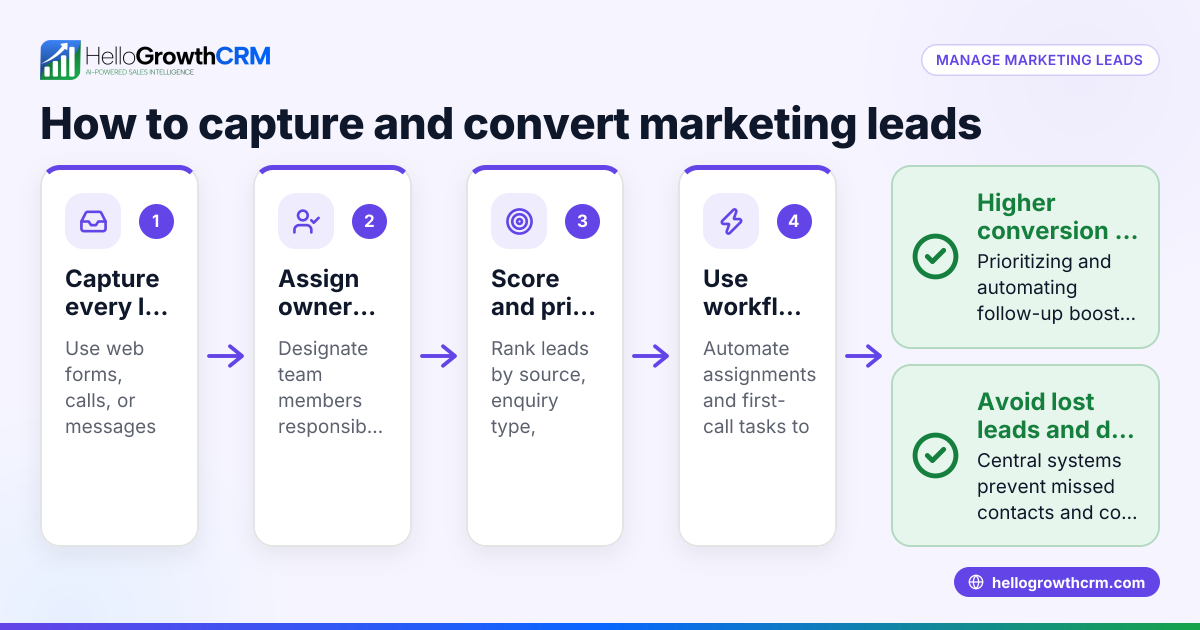
Many small to mid-sized manufacturers in Canada start with spreadsheets due to familiarity and low cost. They track leads, quotes, and orders in Excel or Google Sheets. However, as sales volume grows, spreadsheets become cumbersome and error-prone. Important follow-ups get missed because there is no automated reminder system. Communication runs across email, text messages, and phone calls without a central record. This scattered approach leads to lost leads and frustrated sales teams.
Manufacturing sales often involve multiple touchpoints and technical details that spreadsheets do not handle well. Without a clear sales pipeline view, it is hard to prioritise leads or forecast sales accurately. This causes delays and lost revenue.
Step-by-step
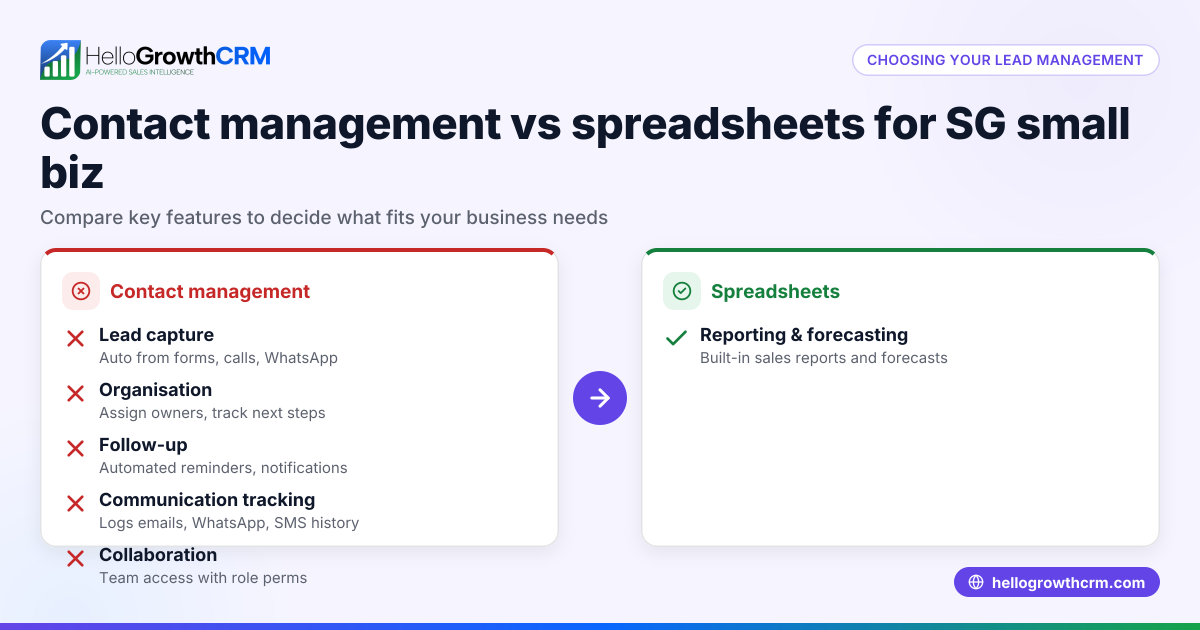
Here is a comparison table between CRM and spreadsheets for manufacturing businesses in Canada:
| Criteria | CRM for Manufacturing | Spreadsheets |
|---|---|---|
| Lead Capture | Automated capture from web forms and integrations | Manual data entry from emails and calls |
| Follow-up Automation | AI agents draft follow-up messages; reminders | No automatic reminders; manual tracking |
| Communication Tracking | Logs WhatsApp, SMS, email conversations on lead record | No communication history in one place |
| Sales Pipeline Visibility | Visual pipeline and task boards | No visual pipeline; data in rows and columns |
| Collaboration | Shared access with role-based updates | Shared files risk version conflicts |
| Reporting & Forecasting | Built-in sales forecasting and reports | Requires manual report creation |
| Scalability | Grows with business; supports multiple users | Becomes complex and error-prone as data grows |
Who should pick which?
- Choose a CRM if you want to speed up lead follow-up, track conversations centrally, and have clear sales visibility.
- Spreadsheets may suffice for very small manufacturers with few leads and simple sales processes.
For manufacturing-specific CRM needs and more comparisons, see Manufacturing and compare CRMs.
Example (fictional figures)
A Calgary-based manufacturer, "Calgary Custom Parts," has 5 sales reps and generates about C$2,000,000 in annual sales. They track 1,000 leads a year.
Using spreadsheets:
- Each rep spends 10 hours weekly updating and checking spreadsheets = 10 hrs × 5 reps × 52 weeks = 2,600 hrs/year
- At C$30/hr average wage, labour cost = 2,600 hrs × C$30 = C$78,000/year
- Estimated lost sales due to slow follow-up: 5% of leads = 50 lost leads
- Average sale value per lead = C$4,000
- Lost revenue = 50 × C$4,000 = C$200,000/year
Using a CRM:
- CRM subscription and training cost = C$15,000/year (assumed)
- Labour time reduced by 50% = 1,300 hrs × C$30 = C$39,000/year
- Lost sales reduced to 1% = 10 lost leads
- Lost revenue = 10 × C$4,000 = C$40,000/year
Calculation: Labour + lost sales cost with spreadsheets = C$78,000 + C$200,000 = C$278,000 Labour + lost sales cost with CRM = C$39,000 + C$40,000 + C$15,000 = C$94,000
Switching to a CRM saves Calgary Custom Parts approximately C$184,000 annually.
Common mistakes
- Underestimating data entry time in spreadsheets: Track actual hours spent updating spreadsheets to understand hidden costs.
- Ignoring communication tracking: Without logging messages and calls centrally, sales reps lose context. Use tools that log WhatsApp and SMS conversations.
- Not automating follow-up reminders: Manual tracking leads to missed leads. Set up automated reminders or AI-assisted follow-ups.
- Overcomplicating spreadsheets: Avoid complex formulas and multiple sheets that confuse users. Consider a CRM for better scalability.
- Not involving the sales team in tool choice: Get input from reps who use the system daily to ensure adoption.
Learn more about managing sales operations with HelloGrowthCRM for Canada.
Doing this in HelloGrowthCRM
HelloGrowthCRM supports manufacturing teams with WhatsApp and SMS integration, logging all conversations on the lead record. AI agents draft follow-up messages after calls, so reps only review and send, saving time. For founders without sales managers, Managed RevOps provides weekly follow-up execution and pipeline hygiene, ensuring no lead is forgotten. To explore these features, visit HelloGrowthCRM product pages and AI CRM.
Frequently asked questions
What are the main benefits of a CRM over spreadsheets for manufacturing? A CRM automates lead capture, follow-up reminders, and communication tracking, which spreadsheets cannot do. This results in faster lead response and better sales visibility.
Can small manufacturers manage with spreadsheets only? Yes, if sales volume and leads are very low, spreadsheets might suffice. However, as the business grows, spreadsheets become inefficient and error-prone.
How does WhatsApp integration help manufacturing sales? WhatsApp conversations with leads are logged on their records, so the team has full context. Follow-ups can be sent directly as messages, improving response rates.
What is Managed RevOps and who needs it? Managed RevOps is a service where a revenue specialist manages your sales follow-up queue weekly. It’s ideal for founders without a dedicated sales manager.
Are AI agents reliable for drafting follow-ups? AI agents in HelloGrowthCRM draft follow-up messages based on call outcomes, which reps then review before sending, reducing workload while maintaining accuracy.
Key takeaways
- CRMs provide automation, communication logging, and pipeline visibility that spreadsheets lack.
- Spreadsheets may work for very small, simple sales but quickly become inefficient.
- AI and messaging integration in CRMs speed up lead follow-up and improve sales outcomes.
- Managed RevOps supports founders without sales managers to keep leads moving.
- Choosing the right tool depends on sales volume, team size, and growth plans.
Start improving your manufacturing sales process today by trying HelloGrowthCRM. Start on the Free Forever plan (200 leads, no credit card).
Ready to put this into practice?
Set up your pipeline, WhatsApp follow-ups, and AI lead scoring in minutes — free, no credit card.
Try HelloGrowthCRM freeGet CRM tips in your inbox
Join thousands of sales professionals who get weekly insights on CRM strategy, AI automation, and pipeline optimization.

The HelloGrowthCRM team publishes guides on CRM strategy, AI sales tools, and revenue operations for small business sales teams.