HelloGrowthCRM software
Built for real small-business sales teams
HelloGrowthCRM helps reps qualify faster, follow up on time, and close more deals—with practical automation in one place.
- AI lead scoring and pipeline visibility
- Built-in dialer, WhatsApp, and email automation
- Sales forecasting and RevOps-ready reporting
Manufacturing businesses in New Zealand often start with spreadsheets to track leads and sales because they are familiar and low cost. However, as the business grows, spreadsheets can cause issues like lost leads, slow follow-ups, and poor visibility of sales progress. This leads many to consider a CRM system tailored for manufacturing needs.
Why this comes up / what goes wrong
A manufacturing business owner or accountant in New Zealand typically juggles multiple sales channels, customer enquiries, and order processes. They might start tracking leads and customer details in Excel or Google Sheets because it’s simple and free. But over time, they find:
- Leads get lost or forgotten due to manual tracking.
- Communication happens over text messages or email without a clear record.
- Sales progress and forecasting are hard to track.
- Multiple team members updating spreadsheets cause version conflicts.
These problems slow down sales follow-up and reduce conversion rates, which is critical in a competitive manufacturing market. This search arises because the business is deciding whether to continue with spreadsheets or invest in a CRM designed for manufacturing.
Step-by-step
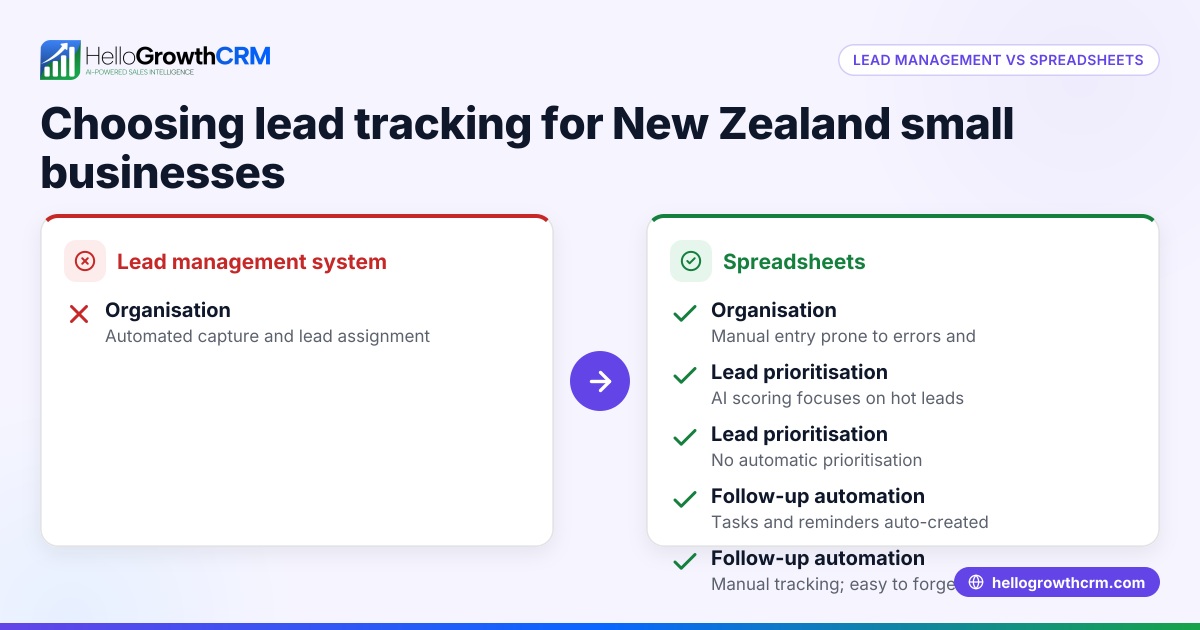
Here is a comparison of CRM and spreadsheets on key criteria for New Zealand manufacturing businesses:
| Criteria | CRM for Manufacturing | Spreadsheets |
|---|---|---|
| Lead Management | Centralised lead capture from web forms and integrations, AI lead scoring prioritises hot leads | Manual entry, prone to errors and missed leads |
| Communication Tracking | WhatsApp, SMS, and email conversations logged and sequenced automatically | Separate apps, no automatic logging or follow-up reminders |
| Pipeline Visibility | Visual pipeline and task boards show deal stages clearly | Manual updates, no visual pipeline, hard to track status |
| Sales Forecasting | Automated forecasting and reporting based on live data | Manual calculations, time-consuming and error-prone |
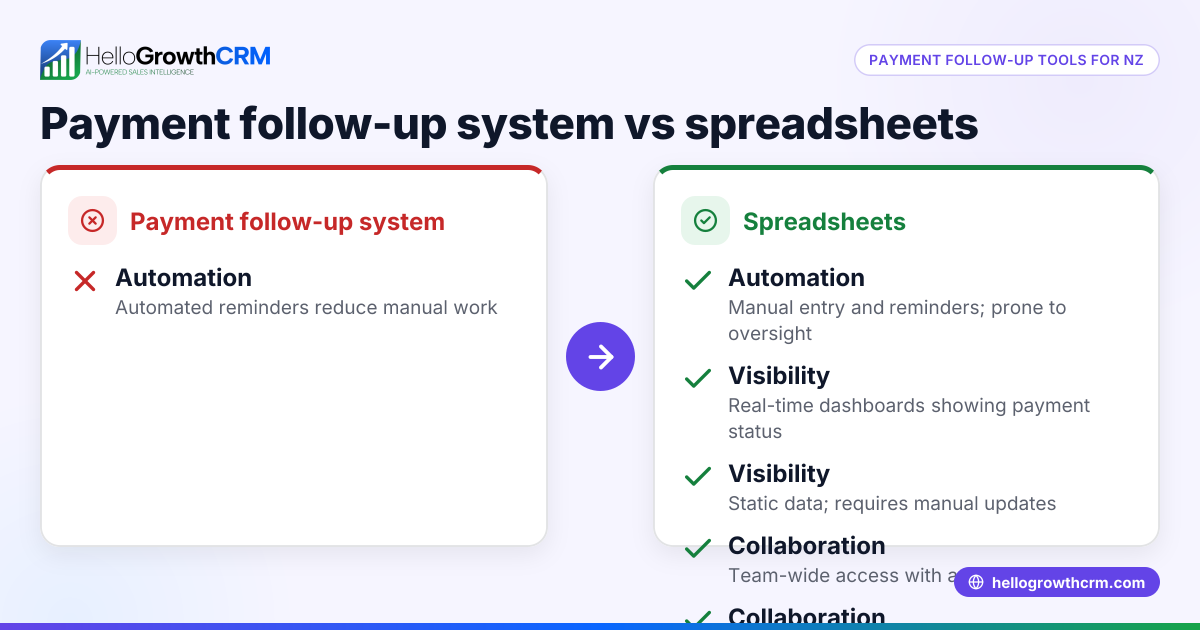
| Collaboration | Multiple users update records in real time without conflicts | Version control issues, risk of overwriting data |
| Automation | AI agents draft follow-ups, reminders sent automatically | No automation, all manual tasks |
| Scalability | Designed to grow with business, adding users and features | Difficult to scale, becomes cumbersome with growth |
Who should pick which?
- Choose a CRM if you have a growing sales team, need to track many leads, want to automate follow-ups, and require accurate sales forecasting.
- Stick with spreadsheets if your lead volume is very low, your sales process is simple, and you have no plans to scale soon.
For more on CRM options tailored to industries, see Manufacturing.
Example (fictional figures)
A small manufacturing business in Hamilton, "Kiwi Metalworks Ltd", makes custom metal parts. They receive about 200 leads annually from their website and trade shows.
Using spreadsheets, they track leads manually but miss about 20% due to slow follow-up. Their average sale is NZ$15,000.
Switching to a CRM, they improve follow-up speed and increase conversion by 10%.
Calculations:
- Leads per year = 200
- Missed leads with spreadsheets = 20% × 200 = 40
- Leads followed up with spreadsheets = 200 - 40 = 160
- Conversion rate with spreadsheets = 15%
- Sales with spreadsheets = 160 × 15% = 24 sales
- Revenue with spreadsheets = 24 × NZ$15,000 = NZ$360,000
- Conversion rate with CRM = 15% + 10% = 25%
- Sales with CRM = 200 × 25% = 50 sales
- Revenue with CRM = 50 × NZ$15,000 = NZ$750,000
Difference in revenue:
NZ$750,000 - NZ$360,000 = NZ$390,000 more revenue with CRM
This example shows how better lead management and follow-up can significantly increase sales and revenue.
Common mistakes
- Continuing with spreadsheets despite growth: Prevent by regularly reviewing if your current system handles your lead volume and team size.
- Not tracking communication centrally: Prevent by adopting tools that log WhatsApp and SMS conversations alongside emails.
- Ignoring automation opportunities: Prevent by using CRM features like AI agents to draft follow-ups and send reminders.
- Poor data hygiene: Prevent by cleaning and updating lead records regularly to avoid duplicates and errors.
- Overcomplicating spreadsheets: Prevent by keeping data simple or switching to CRM when complexity grows.
Learn more about CRM features for New Zealand businesses at HelloGrowthCRM for New Zealand.
Doing this in HelloGrowthCRM
HelloGrowthCRM offers WhatsApp and SMS messaging where conversations with leads are logged on the lead record, and follow-ups can be sent as messages. It includes AI agents (in Beta) that draft follow-up messages after calls, allowing reps to review and send quickly. For founders without a sales manager, HelloGrowthCRM provides Managed RevOps support where a specialist works the follow-up queue weekly to keep leads engaged. These features help manufacturing teams stay organised and responsive.
Explore these capabilities in more detail at HelloGrowthCRM for New Zealand.
Frequently asked questions
Is a CRM necessary for a small manufacturing business? If your lead volume is low and sales are simple, spreadsheets might suffice. But as you grow, a CRM helps manage leads, automate follow-ups, and improve sales forecasting.
Can I use WhatsApp for sales follow-up in a CRM? Yes, HelloGrowthCRM logs WhatsApp conversations on lead records and allows sending follow-ups as WhatsApp or SMS messages, keeping communication centralised.
How does AI help in CRM for manufacturing? AI agents can draft follow-up messages after calls, reducing the time reps spend on manual tasks and ensuring timely responses.
What are common pitfalls when switching from spreadsheets to CRM? Common mistakes include poor data migration, lack of team training, and not using automation features fully. Planning and support can prevent these.
Can a founder manage sales without a dedicated sales manager? HelloGrowthCRM’s Managed RevOps service provides weekly support to manage follow-up queues and pipeline hygiene, helping founders keep sales on track.
See more on CRM choices at compare CRMs.
Key takeaways
- CRMs centralise lead data, automate follow-ups, and improve sales visibility for manufacturing businesses.
- Spreadsheets can work for very small or simple sales but struggle with scale and collaboration.
- Automation and communication tracking (WhatsApp, SMS) are major CRM advantages.
- AI agents and Managed RevOps support reduce manual workload and improve pipeline hygiene.
- Choosing the right system depends on lead volume, team size, and growth plans.
Start organising your manufacturing sales better by trying HelloGrowthCRM. Start on the Free Forever plan (200 leads, no credit card).
Ready to put this into practice?
Set up your pipeline, WhatsApp follow-ups, and AI lead scoring in minutes — free, no credit card.
Try HelloGrowthCRM freeGet CRM tips in your inbox
Join thousands of sales professionals who get weekly insights on CRM strategy, AI automation, and pipeline optimization.

The HelloGrowthCRM team publishes guides on CRM strategy, AI sales tools, and revenue operations for small business sales teams.