HelloGrowthCRM software
Built for real small-business sales teams
HelloGrowthCRM helps reps qualify faster, follow up on time, and close more deals—with practical automation in one place.
- AI lead scoring and pipeline visibility
- Built-in dialer, WhatsApp, and email automation
- Sales forecasting and RevOps-ready reporting
Small business owners in New Zealand often face the challenge of managing payment follow-ups efficiently. Many start with spreadsheets due to their simplicity and low cost, but as business grows, this approach can cause delays, errors, and lost payments. This article explains why payment follow-up matters, compares spreadsheets versus dedicated follow-up methods on important criteria, provides a practical example, highlights common mistakes, and shows how HelloGrowthCRM can help streamline your follow-ups.
Why this comes up / what goes wrong
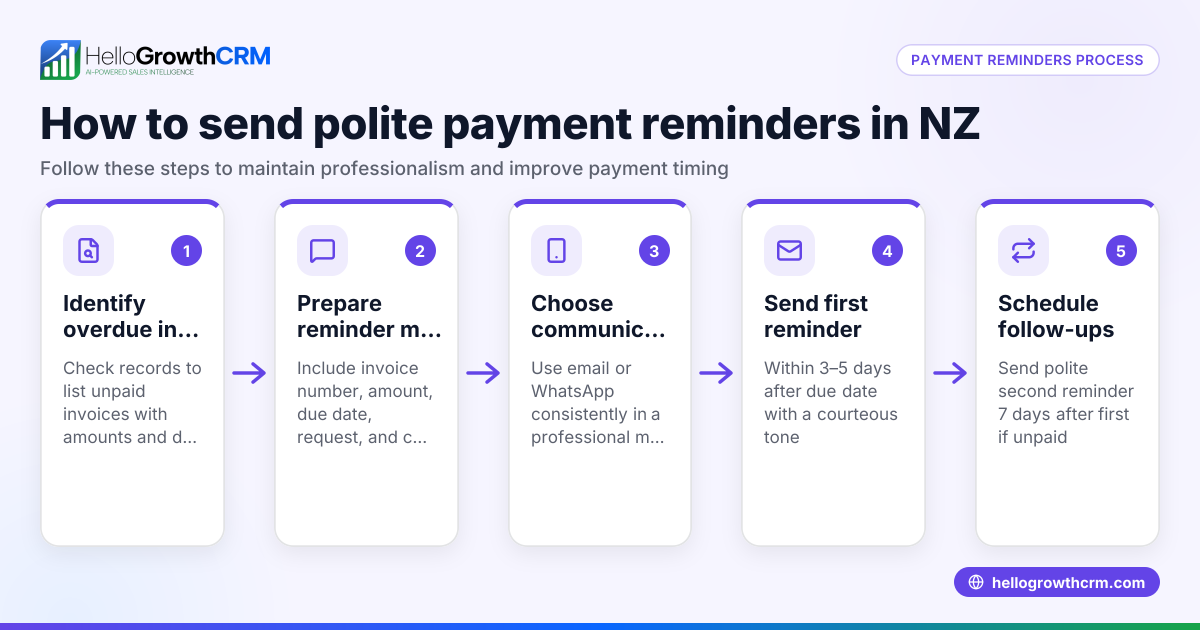
Small businesses typically juggle multiple roles, including sales, invoicing, and collections. When payments are due, following up promptly is critical to cash flow. Spreadsheets are often the first tool owners use because they are familiar and free. However, spreadsheets require manual updates, lack automation, and depend heavily on memory or manual scheduling. This leads to missed calls, forgotten emails, and delayed payments. Slow or inconsistent follow-up can damage customer relationships and increase bad debts.
Step-by-step
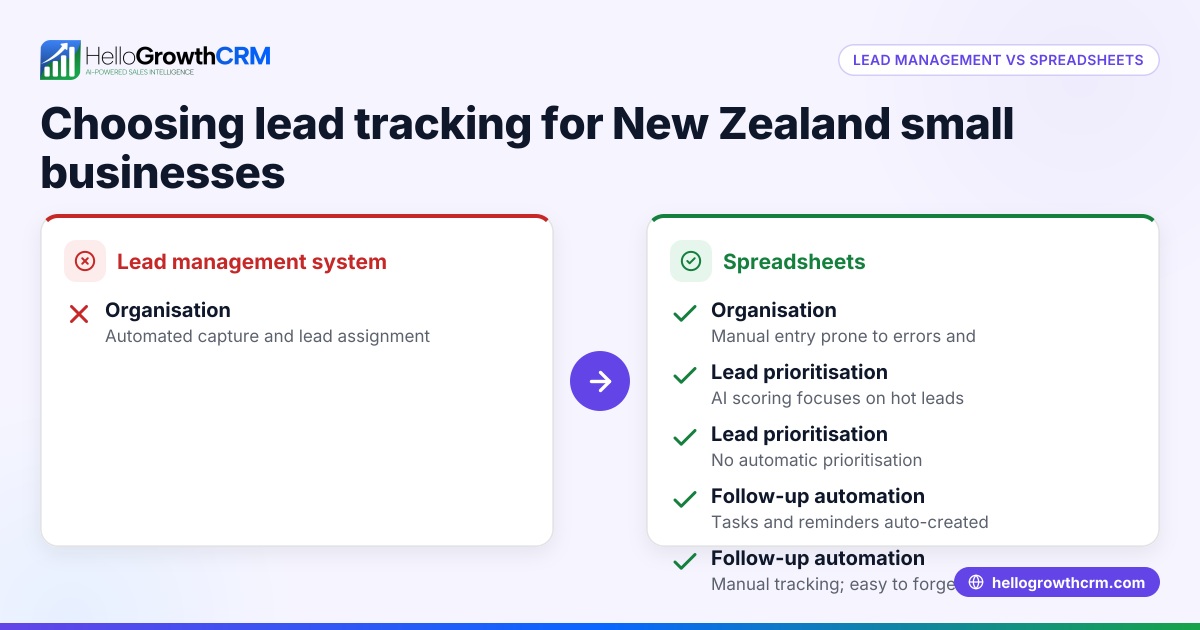
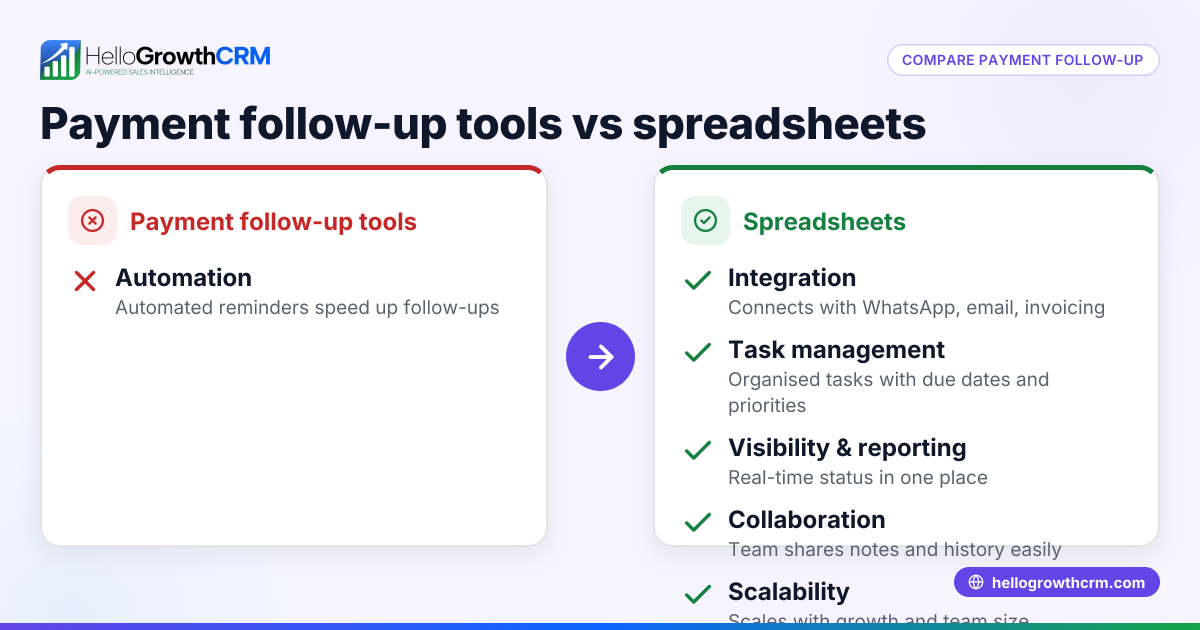
| Criteria | Payment Follow-Up System | Spreadsheets |
|---|---|---|
| Automation | Automated reminders and task scheduling reduce manual work. | Manual entry and reminders; prone to oversight. |
| Visibility | Real-time dashboards show payment status and overdue tasks. | Static data; requires manual updates and review. |
| Collaboration | Team-wide access with activity histories and handoffs. | Single or limited access; version control issues. |
| Integration | Connects with communication tools and task management. | No native integration; separate tools needed. |
| Error Risk | Reduced due to automation and audit trails. | Higher due to manual data entry and updates. |
| Scalability | Scales easily as business grows. | Becomes cumbersome and error-prone with volume. |
| Cost | Subscription fees but saves time and improves cash flow. | Free but costly in time and errors. |
Who should pick which?
- Use spreadsheets if your business is very small, with few clients and simple payment terms.
- Choose a payment follow-up system if you have multiple clients, complex payment schedules, or your current method causes missed payments or delays.
For more on how systems like this support sales teams, see HelloGrowthCRM for New Zealand.
Example (fictional figures)
A dairy-equipment supplier in Hamilton has 50 clients. Each month, 40% of invoices (NZ$120,000 total) are overdue by 10 days on average, causing cash flow issues.
Using spreadsheets, the owner spends 10 hours monthly chasing payments, with a 20% success rate on overdue payments.
If the owner switches to a payment follow-up system with automated reminders:
- Time spent chasing reduces to 4 hours (less manual work).
- Success rate improves to 50% on overdue payments.
Calculations:
Current overdue amount = NZ$120,000
Payments recovered with spreadsheets = NZ$120,000 × 20% = NZ$24,000
Payments recovered with follow-up system = NZ$120,000 × 50% = NZ$60,000
Additional cash flow = NZ$60,000 - NZ$24,000 = NZ$36,000
Time saved = 10 hours - 4 hours = 6 hours
This extra cash and time can be reinvested in growth or operations.
Common mistakes
- Relying solely on memory or manual reminders
- Prevent by using task boards or calendar alerts to schedule follow-ups.
- Not updating spreadsheets promptly
- Prevent by setting a daily routine to review and update payment statuses.
- Lack of team visibility
- Prevent by using shared tools or systems where all team members can see follow-up tasks.
- Ignoring overdue payments until they escalate
- Prevent by prioritising follow-ups based on payment age and amount.
- Using separate tools for invoicing and follow-up without integration
- Prevent by adopting systems that combine task management with quotes and payment tracking.
See also how email automation and sequences can support your team.
Doing this in HelloGrowthCRM
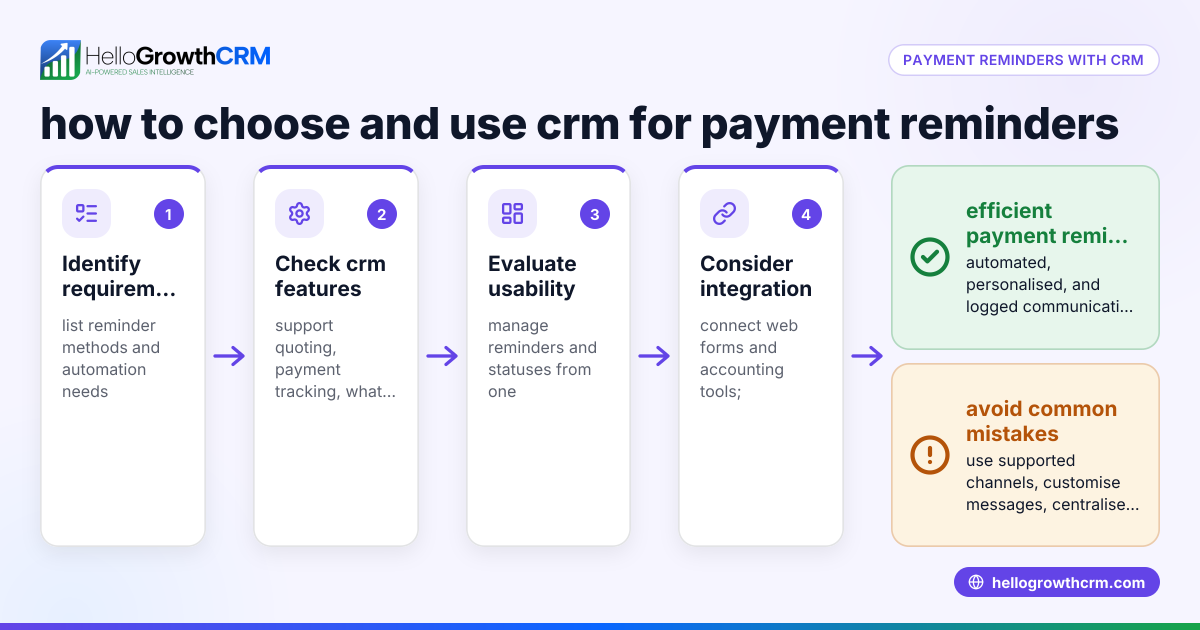
HelloGrowthCRM offers activities and task boards where each payment follow-up becomes a task with a due date, ensuring the day's calls and reminders are a list, not a memory test. Its quoting, proposal, invoice, and payments received features let you build, send, and track commercial documents from the deal record. You can see the status of quotes and invoices alongside follow-up tasks on the same screen, helping your team stay organised and efficient. Learn more about HelloGrowthCRM for New Zealand.
Frequently asked questions
Can I track payment follow-ups without a CRM? Yes, you can use spreadsheets or manual methods, but they require more time and have a higher risk of errors. A CRM automates reminders, tracks history, and improves team collaboration.
Are spreadsheets suitable for all small businesses? Spreadsheets work for very small businesses with few clients and simple payment terms. As your business grows, a dedicated payment follow-up system becomes more efficient.
How does automation improve payment follow-up? Automation sends scheduled reminders and updates tasks, reducing manual work and preventing missed follow-ups. This leads to faster payments and better cash flow.
Can payment follow-up systems integrate with invoicing? Some payment follow-up systems integrate quoting, invoicing, and payment tracking, providing a unified view of your sales and collections. HelloGrowthCRM includes quoting, proposals, invoices, and payments received tied to deals.
Is it difficult for a team to adopt a payment follow-up system? Modern systems are designed to be user-friendly with clear task boards and communication tools. Training and gradual adoption help teams transition smoothly. See how email automation and sequences can support your team.
Key takeaways
- Spreadsheets are low-cost but prone to errors and delays in payment follow-up.
- Payment follow-up systems automate reminders, improve visibility, and reduce manual work.
- Businesses with multiple clients or complex payment schedules benefit most from dedicated systems.
- Common mistakes include relying on memory, not updating data, and ignoring overdue payments.
- HelloGrowthCRM combines task boards with quoting and invoicing tools to streamline follow-ups.
Start managing your payment follow-ups more effectively. Start on the Free Forever plan (200 leads, no credit card).
Ready to put this into practice?
Set up your pipeline, WhatsApp follow-ups, and AI lead scoring in minutes — free, no credit card.
Try HelloGrowthCRM freeGet CRM tips in your inbox
Join thousands of sales professionals who get weekly insights on CRM strategy, AI automation, and pipeline optimization.

The HelloGrowthCRM team publishes guides on CRM strategy, AI sales tools, and revenue operations for small business sales teams.