HelloGrowthCRM software
Built for real small-business sales teams
HelloGrowthCRM helps reps qualify faster, follow up on time, and close more deals—with practical automation in one place.
- AI lead scoring and pipeline visibility
- Built-in dialer, WhatsApp, and email automation
- Sales forecasting and RevOps-ready reporting
For manufacturing businesses in the United Kingdom, choosing between a CRM and spreadsheets depends on how you want to manage leads, sales activities, and customer communication. A CRM centralises data, automates follow-ups, and supports team collaboration, while spreadsheets require manual updates and can lead to errors and delays. This article explains why this choice matters, compares both options on important criteria, gives a realistic example, highlights common mistakes, and shows how HelloGrowthCRM can help.
Why this comes up / what goes wrong
Manufacturing business owners or accountants often start with spreadsheets to track enquiries, orders, and contacts because they are familiar and low-cost. However, as the business grows, spreadsheets become difficult to manage: multiple versions circulate, data entry errors increase, and follow-ups are often missed or delayed. Sales teams working across WhatsApp, email, and spreadsheets lose leads due to slow responses or missed tasks. Business owners struggle to get a clear view of their sales pipeline or forecast revenue accurately. This results in lost sales, inefficiency, and frustration.
Step-by-step
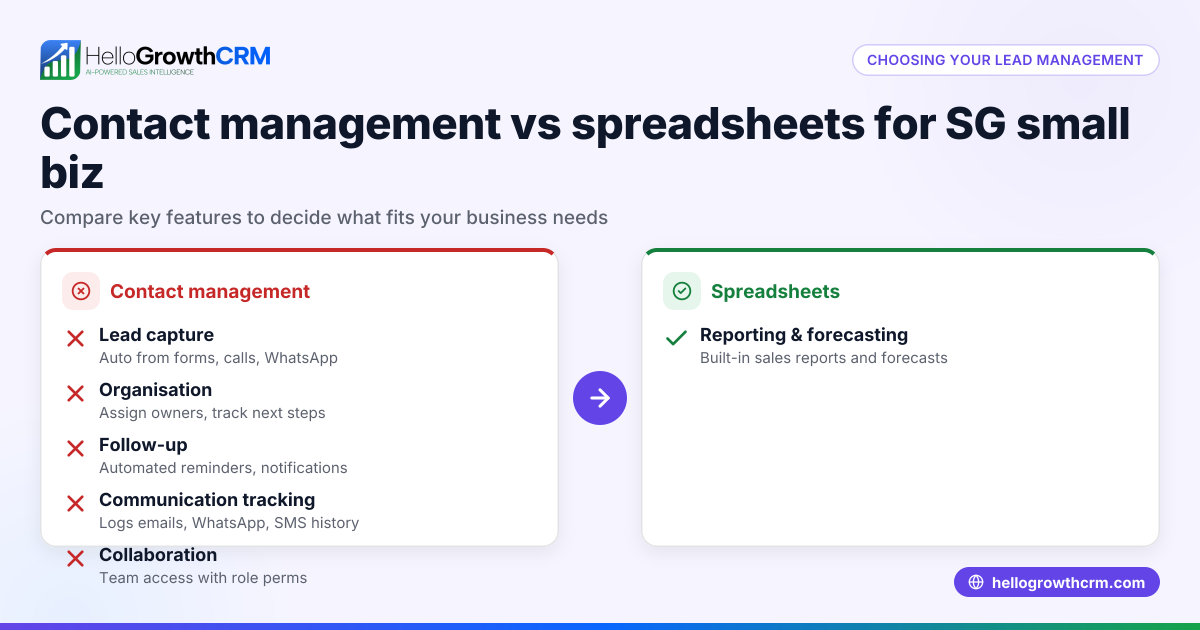
| Criteria | CRM for Manufacturing | Spreadsheets |
|---|---|---|
| Lead Capture | Automated from web forms and integrations, reducing manual entry | Manual entry prone to errors and delays |
| Follow-up Automation | AI agents draft follow-up messages; WhatsApp, SMS, and email sequences | No automation; manual reminders needed |
| Team Collaboration | Centralised with logged WhatsApp conversations; task boards for sales activities | Multiple files, no real-time updates or collaboration |
| Sales Pipeline | Visual pipeline and task boards with forecasting tools | Static tables, no forecasting or pipeline views |
| Data Accuracy | Single source of truth, reduced duplication and errors | Multiple versions risk inconsistent and outdated data |
| Reporting | Automated sales reports, KPIs, and forecasting | Manual report creation, time-consuming and error-prone |
| Scalability | Supports growing teams and leads with automation and managed follow-up | Becomes hard to manage as lead volume grows |
Who should pick which?
- Choose spreadsheets if your manufacturing business has very low lead volume, a simple sales process, and limited budget.
- Choose a CRM if you want to save time, reduce errors, improve follow-ups, and scale sales efficiently.
Manufacturing businesses aiming to professionalise sales and customer management usually benefit from a CRM. See more about Manufacturing CRMs.
Example (fictional figures)
A kitchen-fitting company in Leeds receives 200 leads per month and closes 15% of them. They want to improve follow-up speed and forecast monthly sales accurately.
Using spreadsheets:
- Staff spend 10 hours weekly updating and chasing leads.
- Average order value: £3,000.
- Monthly closed sales: 200 × 15% = 30 orders.
- Monthly revenue: 30 × £3,000 = £90,000.
- Lost leads due to slow follow-up: estimated 10% of leads = 20 leads.
- Potential lost revenue: 20 × 15% × £3,000 = £9,000.
Using a CRM:
- Automation saves 8 hours weekly.
- Faster follow-up reduces lost leads to 2%.
- Lost leads: 200 × 2% = 4 leads.
- Potential lost revenue: 4 × 15% × £3,000 = £1,800.
- Additional revenue saved: £9,000 - £1,800 = £7,200 monthly.
This example shows how a CRM can save time and recover lost sales revenue, improving business profitability.
Common mistakes
- Relying on spreadsheets beyond their capacity: Prevent by reviewing sales volume and complexity regularly and switching to a CRM when needed.
- Not training the team on CRM use: Prevent by providing clear onboarding and ongoing support to ensure adoption.
- Ignoring data hygiene: Prevent by regularly cleaning and updating records in either system.
- Underestimating the importance of follow-up: Prevent by setting reminders or automations to contact leads promptly.
- Failing to centralise communication: Prevent by using tools that log WhatsApp and SMS conversations on lead records.
- Skipping sales reporting: Prevent by scheduling regular sales reviews and using CRM reports or spreadsheet templates.
Learn more about how to avoid these mistakes with compare CRMs.
Doing this in HelloGrowthCRM
HelloGrowthCRM helps manufacturing businesses by logging WhatsApp conversations on lead records and sending follow-ups as messages. Its AI agents draft follow-up messages after calls so sales reps only review and send them. For founders without a sales manager, Managed RevOps support ensures weekly follow-up execution and pipeline hygiene. Discover more about HelloGrowthCRM for the United Kingdom.
Frequently asked questions
Is a CRM expensive compared to spreadsheets? A CRM involves subscription costs but saves time and reduces lost sales, often paying for itself. Spreadsheets have no direct cost but require more manual labour and have a higher risk of errors.
Can I keep using spreadsheets alongside a CRM? Yes, but this can cause data duplication and errors. It is best to centralise data in the CRM as soon as possible to avoid confusion.
How does a CRM improve follow-up speed? CRMs automate reminders and messages via WhatsApp, SMS, and email, reducing manual tasks and ensuring timely contact with leads.
Is data secure in a CRM? Reputable CRMs have security measures to protect data. Spreadsheets stored locally or shared by email can be less secure and harder to control.
Will my team use a CRM easily? Modern CRMs are designed for ease of use, especially those integrated with messaging apps like WhatsApp, which improves adoption and daily use.
Key takeaways
- Spreadsheets suit very simple, low-volume sales but struggle with growth and team collaboration.
- CRMs automate lead capture, follow-up, and reporting, saving time and reducing errors.
- Manufacturing businesses with growing leads benefit from CRM features like AI agents and logged WhatsApp messaging.
- Avoid common mistakes by training teams, centralising data, and maintaining sales hygiene.
- HelloGrowthCRM offers WhatsApp-native CRM features, AI follow-up drafting, and managed RevOps support for UK manufacturers.
Start organising your manufacturing sales better today. Start on the Free Forever plan (200 leads, no credit card).
Ready to put this into practice?
Set up your pipeline, WhatsApp follow-ups, and AI lead scoring in minutes — free, no credit card.
Try HelloGrowthCRM freeGet CRM tips in your inbox
Join thousands of sales professionals who get weekly insights on CRM strategy, AI automation, and pipeline optimization.

The HelloGrowthCRM team publishes guides on CRM strategy, AI sales tools, and revenue operations for small business sales teams.