HelloGrowthCRM software
Built for real small-business sales teams
HelloGrowthCRM helps reps qualify faster, follow up on time, and close more deals—with practical automation in one place.
- AI lead scoring and pipeline visibility
- Built-in dialer, WhatsApp, and email automation
- Sales forecasting and RevOps-ready reporting
In the United States, a CRM for real estate investors should do more than store contacts: it should preserve consent records, separate lead sources, track money that arrives outside card processors, and keep multi-state follow-up usable across time zones.
That matters because a U.S. investor operation usually mixes very different inputs in one pipeline. A seller lead from Google Business Profile behaves differently from a wholesaler referral, a probate-related inquiry, or a landlord response that came in by text after hours. If all of them land in one generic stage called “new lead,” your team loses the information that decides the next action, the legal risk, and the likely outcome.
The best structure is not “a CRM for real estate” in the abstract. It is a record system built around how U.S. investor deals are actually sourced, contacted, documented, and paid for.
U.S. lead sources need different intake fields on day one
Real estate investors in the United States often buy leads from several places at once: Google Business Profile, Yelp, Facebook, LinkedIn, Angi, Thumbtack, and plain referrals. Those sources do not produce the same quality signals. A direct inbound seller from Google may have entered a property address and a preferred callback window. A Facebook lead form may give you almost nothing beyond a phone number. A referral from an agent or contractor may require immediate relationship follow-up even if the property is not yet financeable.
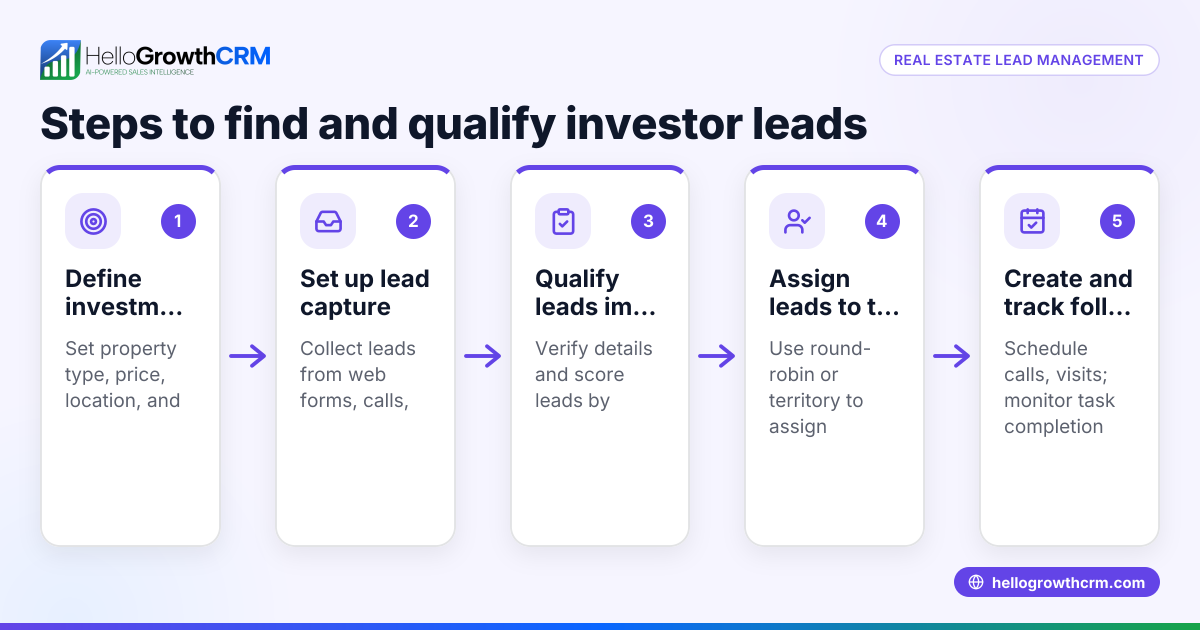
Your CRM should capture source, sub-source, campaign, property address, occupancy, estimated timeline, preferred channel, and whether the lead is seller direct, agent represented, probate-related, landlord, wholesaler, or referral. In the United States that source discipline is not just marketing hygiene. It is how you decide who gets a phone call first, who should get email only, and which channels can be used at all.
If you are evaluating software, look for lead capture and qualification tools that move inquiries straight into pipeline records rather than into a disconnected inbox. HelloGrowthCRM’s lead capture and qualification tools are designed for that front end: getting new inquiries organized and into a pipeline where someone owns the next step.
TCPA, CAN-SPAM, and state privacy laws make consent a recordkeeping issue
In the United States, outreach rules are fragmented. There is no single federal privacy baseline that neatly covers every investor workflow. Instead, real estate investors usually have to think about the Telephone Consumer Protection Act for calls and texts, CAN-SPAM for commercial email, and state privacy statutes such as the California Consumer Privacy Act and the California Privacy Rights Act. The Federal Communications Commission has authority around telecom rules, the Federal Trade Commission enforces parts of the broader consumer protection framework, and state attorneys general can matter depending on where you operate.
For investor teams, the practical consequence is simple: your CRM should store how consent was obtained, when it was captured, what language was shown, and what the prospect opted out of later. TCPA issues become litigation issues because the law has a private right of action. If your file only says “okay to text,” that is not much help when someone asks what was actually agreed to.
A usable record often needs fields for source page, form language version, consent timestamp, channel permission, do-not-call status, and opt-out history. Email records need working unsubscribe handling because CAN-SPAM is not satisfied by good intentions. If you market in California or serve California residents, you should also review the California Privacy Protection Agency guidance and your broader CCPA and CPRA obligations, especially if your CRM is storing household or behavioral data for remarketing.
Spanish-language campaigns deserve the same rigor as English-language ones. In many U.S. metro markets, Spanish copy is not a niche add-on; it is a mainstream operating choice. If you text in Spanish but your internal fields, templates, and opt-out logic only work in English, your process will fail exactly where response rates are strongest.
ACH, Zelle, checks, and wires mean payment status cannot live only in card data
Many investor teams receive and send money through ACH, Zelle, check, and wire transfer. Earnest money, option payments, contractor reimbursements, assignment-related amounts, and reimbursements to vendors do not always pass through the same merchant account as marketing deposits or card charges. In the United States, that means a CRM that relies on card processor activity alone will show an incomplete picture of the deal.
This is especially important when your acquisitions team, dispositions team, and operations staff each assume someone else confirmed receipt. ACH and check payments will not magically appear in a card dashboard. A wire confirmation may arrive by email. A paper check may be logged by an office manager. Zelle may be visible only in the bank interface. The CRM needs a place to record what arrived, by which rail, against which property or vendor, and whether the amount has cleared.
The tax side is also U.S.-specific. There is no federal VAT or GST. Sales tax is imposed at the state level and often at the local level, and the treatment depends on what you are buying or selling and where the customer is. Real estate transfers themselves are not managed like a VAT system, but investor businesses still buy taxable services and software, may face multi-state sales tax questions on other lines of business, and often work with contractors whose forms and tax classification matter. If you issue Forms 1099 to vendors or need an EIN for payee setup, the IRS instructions and the official form guidance are where the current requirements are published. If your business has out-of-state activity, economic nexus questions are published by the relevant state department of revenue, not by a national one-size-fits-all rule.
Property records should connect people, entities, and title obstacles in one place
A U.S. investor CRM works better when the central record is not just “contact” and not just “property.” A deal often involves an owner, a spouse, an heir, a wholesaler, a tenants-in-place issue, an LLC seller, a title company, and at least one decision-maker who is not the person who first filled out the form. If those relationships live only in notes, your team will repeat questions and miss blockers.
At minimum, the deal record should tie together the property, every relevant person, the selling entity if one exists, title or probate flags, occupancy, marketing source, target disposition path, and required next documents. State licensing also matters here. A real estate investor may not need the same license as an agent for every activity, but state licensing boards still shape what your staff can say, advertise, or negotiate in certain contexts. Licensing is a separate problem from tax registration and a separate problem from privacy compliance. Your CRM should therefore have fields that tell staff what kind of transaction this is, not just whether the lead is hot.
That structure also helps when you branch into related lines of business. A team that buys, rehabs, and resells will not document work the same way as a team that wholesales contracts or targets landlord portfolios. The record should reflect the transaction type early, because it changes tasks, documents, and approvals.
Nationwide investing breaks fast when time zones and holidays are assumed away
Many U.S. investor shops market nationally or across several regions. That sounds harmless until callbacks are booked from Eastern Time for a seller in Arizona, or an auto-text fires when Hawaii is still asleep. The United States has multiple time zones, and Arizona and Hawaii do not observe daylight saving time in the same way as most states. A booking made in October for a March conversation can drift if the system treats time as static.
Your CRM should stamp the lead’s local time zone, the user’s time zone, and the property state. It should also preserve the original booked time rather than only showing the rep’s converted version. Federal holidays are common enough to matter for campaigns, but state holidays vary, and county offices, title offices, or local vendors may be closed on dates your headquarters barely notices.
For investors, time-zone discipline affects speed to lead, showing coordination, and vendor handoffs. A system with scheduling and booking can help only if the underlying rules respect local time and follow-up windows. Otherwise your team may think it has become more efficient while actually increasing missed connections.
Routing by county, market, and buying criteria beats one national queue
U.S. investor teams usually stop being efficient when every inbound lead enters one shared queue. Buying boxes differ by state, county, neighborhood, asset class, financing plan, and whether the team is direct-to-seller, agent-friendly, or wholesaler-dependent in that market. A vacant single-family property in one county may fit your cash plan; the same property type in another county may be a strict no because of insurance cost, local code issues, or eviction timelines.
The CRM should route leads by geography and strategy, not merely by who is free. Territory ownership is a real operating need in the United States because market knowledge is local. If you cover several metros, the rep who understands title pain points, municipal delays, and buyer expectations in that market will usually move the deal faster than a generalist reading from a script.
HelloGrowthCRM has territory and ownership tools plus workflow options inside its CRM layer, which is useful when your team wants leads assigned by state, county, zip cluster, acquisition model, or language. That is more practical than trying to rebuild routing logic manually every time you enter a new market.
Your pipeline should separate purchase, rehab, disposition, and vendor compliance
An investor deal is rarely one straight line from lead to close. Even a simple purchase can pass through acquisition, inspection, funding coordination, title work, contractor scoping, buyer marketing, and post-close cleanup. If your CRM uses a single generic pipeline, the team cannot tell whether a stall is a seller issue, a title issue, a financing issue, or an internal handoff failure.
A better U.S. setup uses either separate pipelines or clearly segmented stages for acquisition, under-contract management, rehab or turn prep, and disposition. Vendor management deserves more attention than many investors give it. Contractors may need W-9 collection, EIN verification, insurance certificates, and later 1099 handling. Those are IRS and operations questions, not just bookkeeping chores, and the official IRS instructions are the place to verify the current requirements. If your team works with health-related distress cases or stores protected health information in a niche strategy, HIPAA may also become relevant, which changes what vendors and systems can do with data.
Task boards are often more valuable here than another dashboard. You need a place where title follow-up, contractor approvals, access coordination, and buyer outreach are visible and attached to the right record. HelloGrowthCRM’s activities and task boards are built around that kind of interaction history and follow-up ownership.
Illustrative deal math shows why field design matters more than pretty dashboards
The arithmetic below is illustrative; the figures are made up to show the shape of the decision. It leaves out financing cost, closing adjustments, and legal review.
Imagine an illustrative lead for a house in Ohio enters your CRM from Google Business Profile. The seller wants a quick close. Your acquisitions rep logs an illustrative expected purchase at $168,000. The record also stores an illustrative repair estimate of $22,000, illustrative holding and resale costs of $19,000, and an illustrative target resale price of $249,000. Another illustrative field shows that a wholesaler referral fee of $7,500 may apply if the deal closes through a partner entity.
If your CRM only shows one expected value number, the opportunity may look fine while hiding the actual decision points. If instead the record stores those fields separately, the team can ask better questions:
- Is the referral amount owed by the buying entity or deducted before closing? Illustrative wording like this should be explicit in the file.
- Has earnest money been sent by wire, ACH, check, or another illustrative rail, and has receipt been confirmed manually?
- Is the disposition plan retail, landlord sale, or assignment, and does that change which documents are needed?
- Does the contact record show text consent, email opt-out history, and preferred language before automated follow-up starts?
That is why field design beats a visually pleasing board. Real estate investing in the United States is full of transactions that look similar at the top level but diverge underneath because of title, entity structure, outreach permissions, or payment method.
Where HelloGrowthCRM can fit a U.S. investor team
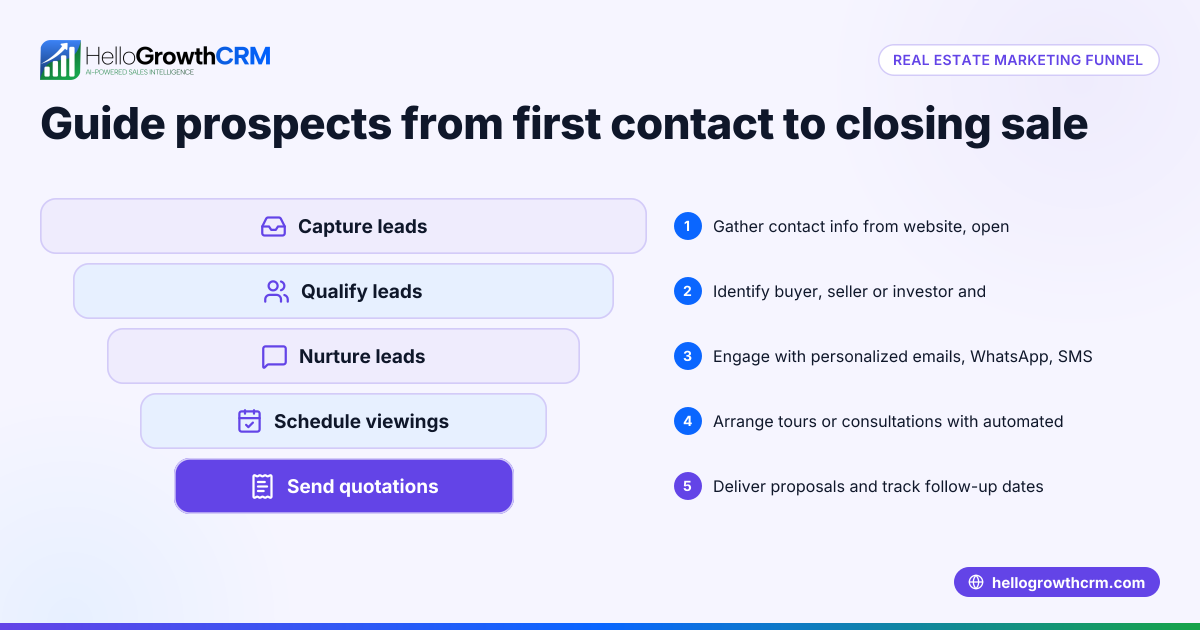
If you want one system to organize lead intake, stage movement, follow-up work, and outbound messaging, HelloGrowthCRM covers the parts most investor teams need first: pipeline management for open opportunities, lead organization and AI lead scoring, built-in calling through its CRM dialer, SMS and WhatsApp messaging, scheduling, and workflow automation. If you are comparing options or testing process changes before a migration, its free CRM gives a practical way to model your stages and records without buying a large implementation upfront.
For a real estate investor in the United States, the right CRM is the one that preserves source, consent, geography, money movement, and deal structure in the same record so your team can act quickly without losing compliance and context.
Ready to put this into practice?
Set up your pipeline, WhatsApp follow-ups, and AI lead scoring in minutes — free, no credit card.
Try HelloGrowthCRM freeGet CRM tips in your inbox
Join thousands of sales professionals who get weekly insights on CRM strategy, AI automation, and pipeline optimization.

The HelloGrowthCRM team publishes guides on CRM strategy, AI sales tools, and revenue operations for small business sales teams.