HelloGrowthCRM software
Built for real small-business sales teams
HelloGrowthCRM helps reps qualify faster, follow up on time, and close more deals—with practical automation in one place.
- AI lead scoring and pipeline visibility
- Built-in dialer, WhatsApp, and email automation
- Sales forecasting and RevOps-ready reporting
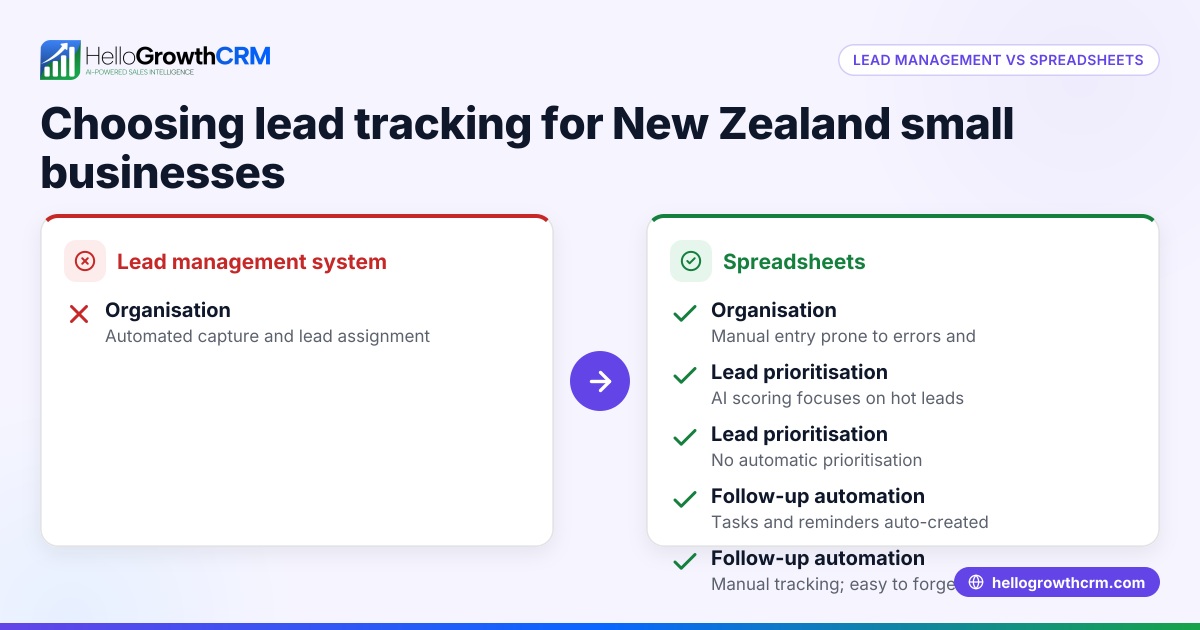
Retail business owners in New Zealand often face the choice between using a CRM or spreadsheets to manage customers, sales, and follow-ups. Spreadsheets are familiar and low-cost but can become unwieldy and error-prone as your business grows. A CRM, designed specifically for sales and customer management, helps organise leads, automate tasks, and improve team collaboration. This article compares these two options on practical criteria to guide your decision.
Why this comes up / what goes wrong
Many small retail shops in New Zealand start by tracking customers and sales in spreadsheets because they are simple and readily available. However, as the number of leads and customers grows, spreadsheets can become difficult to keep updated and share across the team. Slow follow-ups, lost leads, and inconsistent customer records are common problems. Retail owners or accountants may find themselves manually copying data between systems or missing opportunities because the sales process isn’t clear or automated.
Choosing between a CRM and spreadsheets is about balancing cost, complexity, and the ability to scale sales management efficiently. Understanding the strengths and limitations of each helps you pick the right tool for your retail business.
Step-by-step
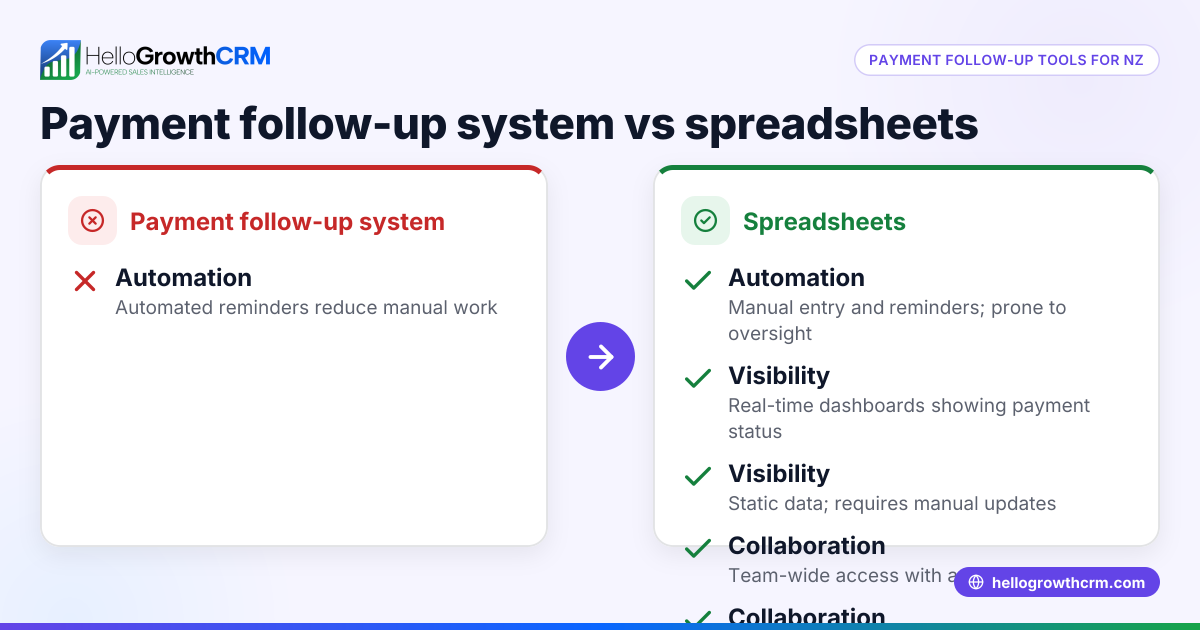
| Criteria | CRM for Retail | Spreadsheets |
|---|---|---|
| Lead & customer management | Centralised, searchable records with communication logs | Manual entry, limited search and update features |
| Sales pipeline tracking | Visual pipeline boards with stages and task reminders | Manual tracking with risk of errors and omissions |
| Communication tools | Built-in WhatsApp, SMS messaging logged on lead records | Separate apps, no automatic logging or reminders |
| Automation | AI agents draft follow-ups; task automation reduces manual work | None; all manual updates and follow-ups needed |
| Team collaboration | Shared access with role permissions and activity tracking | Shared files can cause version conflicts and access issues |
| Scalability | Designed to handle growing leads and sales volume | Becomes cumbersome and error-prone as data grows |
| Cost | Subscription-based, may be higher initially | Low or no direct cost but time-intensive |
Who should pick which?
- Choose a CRM if: You want to improve follow-up speed, automate repetitive tasks, track sales pipelines visually, and support team collaboration as your retail business grows.
- Choose spreadsheets if: Your business is very small, with few leads and customers, and you prefer a simple, low-cost solution without automation needs.
Explore more about how CRMs serve retail shops in New Zealand on our Retail shops page.
Example (fictional figures)
Hamilton-based dairy equipment supplier “DairyTech NZ” tracks 500 leads and 200 customers annually. They currently use spreadsheets but struggle with missed follow-ups.
- Average sale value per customer: NZ$4,000
- Leads converted monthly: 15
- Lost sales due to slow follow-up: 20% (3 leads/month)
Current revenue lost monthly: NZ$4,000 × 3 = NZ$12,000
Potential revenue recovered with CRM follow-up automation (assume 50% recovery): NZ$12,000 × 50% = NZ$6,000
Annual recovered revenue: NZ$6,000 × 12 = NZ$72,000
This recovered revenue can justify the CRM subscription cost and improve sales forecasting accuracy.
Common mistakes
- Underestimating data complexity – Retail owners may start with spreadsheets but underestimate how quickly data grows. Prevent by regularly reviewing if your current system meets your sales tracking needs.
- Ignoring follow-up speed – Slow follow-up leads to lost sales. Use automated reminders or AI-assisted follow-ups to stay responsive.
- Not training the team – Even the best CRM fails if the team doesn’t use it properly. Invest time in training and assign a lead to manage the CRM.
- Overcomplicating spreadsheets – Adding too many formulas and tabs can make spreadsheets fragile. Keep them simple or switch to a CRM designed for sales.
- Failing to centralise communications – Using multiple apps without logging conversations causes lost context. Choose a CRM that logs WhatsApp and SMS conversations on lead records.
Learn more about how to avoid these pitfalls on our compare CRMs page.
Doing this in HelloGrowthCRM
HelloGrowthCRM supports retail teams by logging WhatsApp conversations with leads directly on their records, making follow-ups easier and more organised. Its AI agents draft follow-up messages after calls, so sales reps only review and send, saving time. For founders without a sales manager, HelloGrowthCRM offers Managed RevOps, where a specialist works the follow-up queue weekly to keep sales moving. To explore these features, see HelloGrowthCRM for New Zealand.
Frequently asked questions
Is a CRM necessary for small retail shops? A CRM is not always necessary for very small shops with few customers. However, it becomes essential as your leads and sales volume grow to maintain organisation and speed up follow-ups.
Can I use WhatsApp and SMS within a CRM? Yes, some CRMs including HelloGrowthCRM integrate WhatsApp and SMS, logging conversations on lead records and enabling you to send follow-ups directly from the system.
How does a CRM improve sales follow-up? CRMs automate reminders, track communication history, and some use AI to draft messages, reducing manual work and improving response times.
Are spreadsheets cheaper than CRMs? Spreadsheets often have no direct cost but require more manual effort, which can cost time and lead to lost sales. CRMs have subscription fees but can save money by improving sales efficiency.
Can a retail team collaborate better with a CRM? Yes, CRMs provide shared access with role permissions, so teams can update records, track tasks, and see communication history without version conflicts common with shared spreadsheets.
Key takeaways
- CRMs centralise customer data and automate sales follow-ups, unlike spreadsheets.
- Spreadsheets suit very small retail businesses with low sales volume.
- CRMs improve team collaboration and scale with your retail business.
- Automation and communication logging reduce lost leads and speed up sales.
- HelloGrowthCRM offers WhatsApp and SMS integration, AI follow-up drafting, and Managed RevOps support.
Start organising your retail sales better by trying HelloGrowthCRM. Start on the Free Forever plan (200 leads, no credit card).
Ready to put this into practice?
Set up your pipeline, WhatsApp follow-ups, and AI lead scoring in minutes — free, no credit card.
Try HelloGrowthCRM freeGet CRM tips in your inbox
Join thousands of sales professionals who get weekly insights on CRM strategy, AI automation, and pipeline optimization.

The HelloGrowthCRM team publishes guides on CRM strategy, AI sales tools, and revenue operations for small business sales teams.