HelloGrowthCRM software
Built for real small-business sales teams
HelloGrowthCRM helps reps qualify faster, follow up on time, and close more deals—with practical automation in one place.
- AI lead scoring and pipeline visibility
- Built-in dialer, WhatsApp, and email automation
- Sales forecasting and RevOps-ready reporting
A CRM forecast hygiene checklist is a practical pre-review standard for checking whether pipeline data is current, consistent, and evidence-based across stage definitions, close dates, next steps, and forecast categories so B2B sales teams can trust quarterly projections and act on gaps before leadership meetings.
Key Takeaways
- Forecast accuracy usually breaks because CRM execution is weak, not because the market is unpredictable.
- The fastest fixes are stage exit criteria, realistic close dates, required next steps, and tighter forecast category rules.
- A good forecast hygiene review should happen weekly, not only before quarterly pipeline reviews.
- Managers need both rep accountability and system enforcement through automation, validation, and reporting.
- HelloGrowthCRM combines AI CRM workflows with Managed RevOps support to keep pipeline data clean between reviews.
Why CRM forecast hygiene matters before quarterly pipeline reviews
CRM forecast hygiene matters before quarterly pipeline reviews because leadership can only trust projections when the underlying opportunity data is complete, recent, and governed by clear rules. If stages, dates, next steps, and categories drift, the review becomes a debate about CRM quality instead of a decision-making meeting.
Quarterly pipeline reviews often fail for a simple reason. The CRM reflects seller optimism, not buyer reality.
I have seen this in many RevOps audits. Leaders ask why forecast miss rates are rising, but the root problem is usually basic pipeline discipline. Deals sit in the wrong stage. Close dates roll forward every week. “Next step” fields contain vague notes like “follow up.” Forecast categories mean different things to each manager.
When that happens, forecast math looks precise but is operationally weak.
In one rollout we did with a 12-person sales team, nearly one-third of late-stage deals had no customer-confirmed meeting on the calendar. Those deals still showed as likely to close that quarter. Once we enforced meeting-based exit criteria and date validation, forecast conversations became much shorter and more accurate.
Poor hygiene creates four business problems:
- Leaders overestimate quarter-end coverage
- Reps waste time on stalled deals
- Managers coach the wrong risks
- Finance loses confidence in sales forecasts
According to Gartner’s CRM topic overview, CRM effectiveness depends heavily on process adoption, data quality, and execution discipline. That is exactly why forecast hygiene is a RevOps issue, not just a sales management issue.
The signs your forecast is built on weak CRM data
You do not need a complex model to spot forecast hygiene issues. Look for these patterns:
- Many deals with close dates inside 30 days but no scheduled next meeting
- Stage aging that is far above average for the segment
- Forecast categories that do not match deal evidence
- Opportunities with no activity logged in the last 14 days
- Large pipeline jumps in the final two weeks of the quarter
- Manager overrides without clear rationale
If those patterns are common, your pipeline review is likely to expose data problems, not help you solve them.
What should be on a CRM forecast hygiene checklist?
A CRM forecast hygiene checklist should include the minimum fields and behaviors that make a forecast believable: correct stage, validated close date, documented next step, current activity, consistent forecast category, and clear deal ownership. These checks turn pipeline reviews from opinion-driven updates into evidence-based inspections.
The best checklist is short enough to use every week. It should also be strict enough to catch bias.
Here is the checklist I recommend for B2B sales teams before any quarterly pipeline review.
1. Stage definitions are clear and enforced
Every opportunity stage should have:
- A buyer-based entry trigger
- A buyer-based exit criterion
- Required fields before stage progression
- Maximum stage aging thresholds by segment
For example, “Proposal” should not mean “we sent pricing.” It should mean the buyer has reviewed a formal proposal, key stakeholders are known, and a commercial discussion is active. If you need a structured way to score deal readiness, Pipeline Health Score can help teams quantify risk.
2. Close dates reflect buyer reality
Close dates should be based on a confirmed buyer event, not rep hope. Good evidence includes:
- Procurement timeline
- Decision meeting date
- Security review milestone
- Legal redline status
- Executive sign-off target
When I have audited pipelines like this, the biggest forecast inflation usually comes from close dates that were never requalified after discovery. A close date should answer one question: what buyer event makes this date credible?
3. Next steps are specific and two-sided
A usable next step includes:
- A clear action
- An owner
- A due date
- Buyer involvement where possible
“Send follow-up email” is not a next step. “Buyer to confirm legal reviewer by Thursday” is a next step. In HelloGrowthCRM, Sales Task Boards, Meeting Scheduler, and Smart Inbox help enforce this level of detail.
4. Forecast categories follow strict rules
Teams often misuse categories like Commit, Best Case, and Pipeline. Define them with evidence, not gut feel.
| Forecast Category | Minimum evidence required | Common misuse | Review action |
|---|---|---|---|
| Commit | Confirmed buying process, active next meeting, no major blocker, close date validated | Rep confidence only | Manager validates evidence |
| Best Case | Real opportunity with progress, but one key risk remains | Late-stage stall labeled as possible win | Reclassify if no movement |
| Pipeline | Early or mid-stage deal without enough evidence for near-term close | Used as catch-all | Keep active, not forecasted |
| Omitted | No recent activity, unclear owner, or date not credible | Left in active forecast | Remove or push out |
This is where AI Pipeline Management and AI Deal Insights are useful. They flag deals whose activity pattern does not match the forecast label.
Which CRM data issues cause the biggest forecast errors?
The CRM data issues that cause the biggest forecast errors are stage inflation, rolled close dates, missing next steps, stale activity, and loose forecast categories. Each one weakens the link between actual buyer progress and reported pipeline value, which leads leaders to trust opportunities that are not truly closeable.
Not all hygiene problems matter equally. Some create much bigger forecast bias than others.
Stage inflation
Stage inflation happens when reps move a deal forward before the buyer has actually advanced. This often comes from loose definitions or manager pressure. The result is inflated pipeline coverage and false late-stage confidence.
Rolled close dates
A close date rolled more than twice without new buyer evidence should trigger review. Repeated date movement is one of the clearest signs that the deal is not forecast-ready.
Missing or weak next steps
If there is no dated next step, there is no near-term control. In practice, a missing next step usually means the buyer has gone cold or the rep does not know how to advance the deal.
Stale activity
No recent activity means the deal is not being worked or the CRM is not being updated. Both are forecast risks.
Harvard Business Review has repeatedly emphasized that sales execution quality and frontline management discipline drive performance more than heroic end-of-quarter efforts. Forecast hygiene is a direct application of that principle.
Category drift across managers
One manager’s “Commit” cannot be another manager’s “Best Case.” If your category logic changes by team, your roll-up forecast becomes inconsistent.
This is one reason global teams often need common workflows and system rules. HelloGrowthCRM can standardize this with required fields, playbooks, Sales Forecasting, and custom automations connected through All Integrations.
How to build a CRM forecast hygiene checklist into your operating rhythm
To build a CRM forecast hygiene checklist into your operating rhythm, make it a weekly inspection process with system rules, manager reviews, and rep accountability instead of a one-time cleanup. Forecast quality improves when hygiene checks happen continuously and exceptions are visible before quarter-end pressure rises.
The biggest mistake I see is treating hygiene as a quarterly project. Cleanups done the day before a review help presentation quality, but they do not fix the operating system.
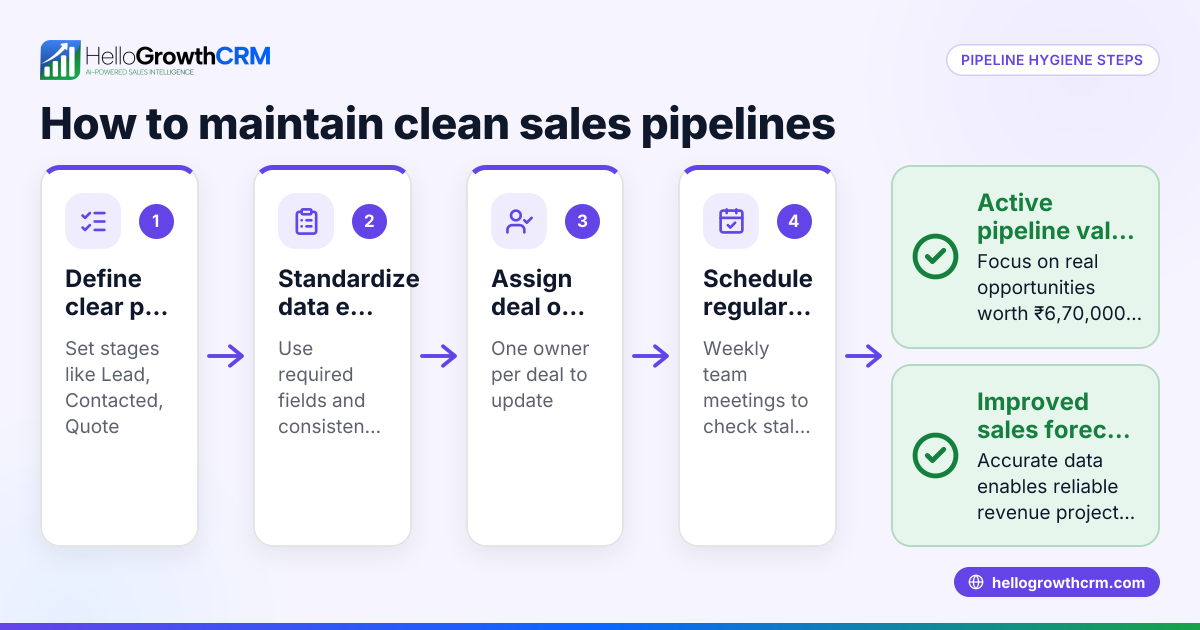
Weekly review cadence works better than quarterly cleanup
A simple cadence works well for teams under 50 reps:
- Weekly rep self-check on top deals
- Weekly manager inspection on commit and best case deals
- Biweekly RevOps exception report
- Monthly leadership calibration on category rules
For larger teams, you may need territory-specific thresholds, especially if sales cycles differ by region or ACV. If you run a distributed team, Territory Management helps keep ownership and coverage clear.
What to automate vs what to coach
Automate these checks:
- Required next step before stage advancement
- Activity recency alerts
- Close date change tracking
- Forecast category validation rules
- Missing field reminders via Slack or Gmail
Coach these behaviors:
- Buyer-based qualification
- MEDDPICC evidence quality
- Risk identification
- Deal strategy for stalled opportunities
That mix matters. Systems should catch missing data. Managers should improve judgment. If you only coach, data decays. If you only automate, reps work around the system.
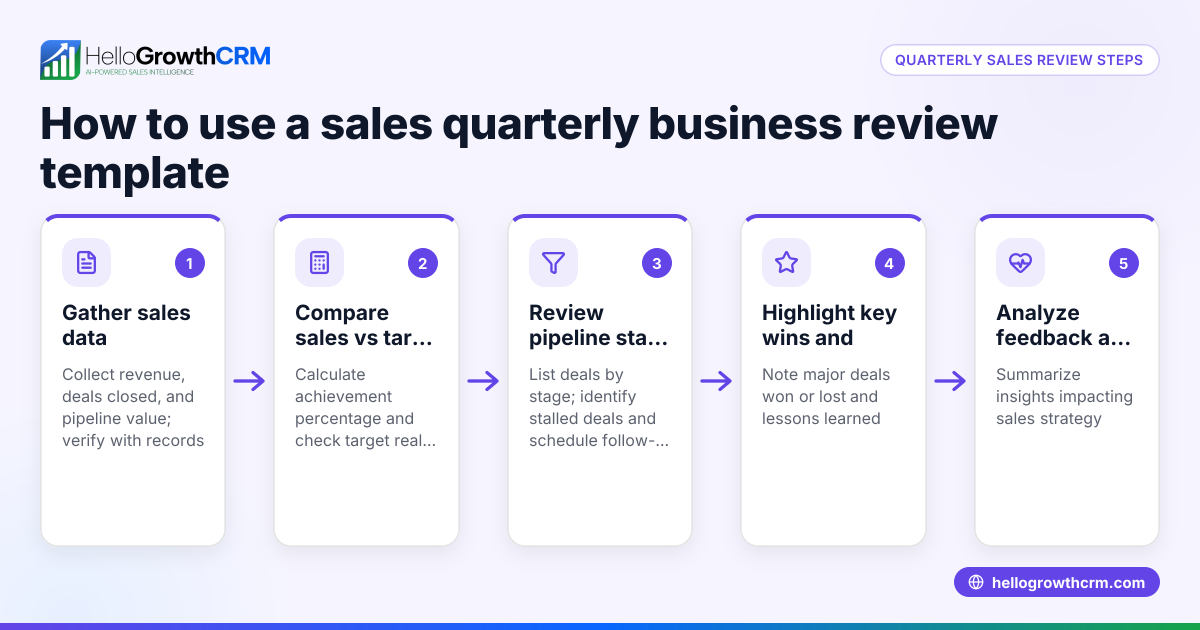
How to use a CRM forecast hygiene checklist: Step-by-Step
Using a CRM forecast hygiene checklist step by step means inspecting the same core fields in the same order before a quarterly review, then correcting weak opportunities, downgrading unsupported deals, and escalating true risks so the final forecast reflects buyer evidence rather than seller optimism.
- Pull the in-scope pipeline
Export or filter all open opportunities expected to close this quarter. Segment by owner, region, and forecast category. - Validate stage against exit criteria
Check whether each deal meets the exact stage definition. Move deals backward if buyer evidence is missing. - Review close date credibility
Ask what buyer event supports the date. Push out any opportunity without a confirmed milestone. - Inspect next steps and activity
Confirm there is a dated next step with an owner. Flag deals with no recent activity or one-sided rep-only actions. - Reclassify forecast categories
Compare each deal’s evidence to your category rules. Downgrade unsupported Commit deals first. - Check aging and momentum signals
Look at stage-velocity in days, meeting frequency, and response gaps. Use AI Lead Scoring and AI Sales Copilot where relevant to prioritize risk review. - Assign fixes and deadlines
Every flagged deal should have a clear corrective action, owner, and due date before the leadership review. - Review exception reports with managers
Summarize hygiene failures by rep and team. This helps coaching and reveals where process rules are unclear.
A simple pre-review scorecard
You can score each opportunity on five checks:
- Stage valid: Yes or No
- Close date validated: Yes or No
- Next step documented: Yes or No
- Activity in last 14 days: Yes or No
- Forecast category supported: Yes or No
Any deal scoring 3 out of 5 or lower should not stay in Commit.
If you want to quantify the business case for better hygiene, CRM ROI Calculator and RevOps Maturity Assessment can help frame the impact.
How HelloGrowthCRM helps enforce forecast hygiene at scale
HelloGrowthCRM helps enforce forecast hygiene at scale by combining workflow automation, AI-driven deal inspection, and hands-on RevOps support so teams do not rely on manual cleanup before quarterly reviews. It turns forecast hygiene from a spreadsheet exercise into an always-on operating discipline.
This is where HelloGrowthCRM is different from a generic CRM. We are not only a system of record. We are built to support pipeline discipline in live selling environments.
With HelloGrowthCRM, teams can use Features like required field validation, Email Automation, activity capture, and guided workflows to keep deal records current. The AI CRM layer can spot risk patterns such as inactive late-stage deals, mismatched forecast categories, and stalled next steps. For teams that need process design help, Managed RevOps adds expert support to define stages, rebuild forecasting rules, and maintain governance.
That matters because tools alone do not fix operating habits.
In one cleanup project I led, a sales org had three different meanings for “Commit” across regions. We aligned the category criteria, added mandatory next-step logic, and built manager alerts for stale late-stage deals. Within one quarter, forecast review time dropped because leaders were discussing real risks instead of arguing about CRM trust.
This approach works especially well for small and mid-sized B2B teams. For very large enterprises, expect more change management, regional calibration, and integration planning. If you want to see how it fits your stack, you can book a Demo, explore Pricing, or start a Free Trial.
If your team is heading into a quarterly pipeline review and you do not trust the forecast, now is the right time to fix the operating basics. Try HelloGrowthCRM to standardize stage rules, enforce clean next steps, and turn your CRM into a forecast system leaders can trust.
About the author
Rohan Mehta is a Sales Operations Lead at HelloGrowthCRM with 10 years of experience in B2B SaaS revenue operations, forecasting, and CRM process design. He has led CRM cleanup and forecasting redesign projects for growth-stage sales teams across SaaS and services businesses. One project that informed this article involved rebuilding stage criteria, forecast categories, and manager inspection workflows for a 12-person account executive team before a board-level quarterly review. He writes from direct RevOps implementation experience inside HelloGrowthCRM.
Frequently Asked Questions
Q: What is a CRM forecast hygiene checklist?
A: A CRM forecast hygiene checklist is a standard review list used to verify that opportunity data is accurate, current, and supported by buyer evidence before a forecast is shared. It usually covers stages, close dates, next steps, activity, ownership, and forecast categories.
Q: How often should B2B sales teams review forecast hygiene?
A: B2B sales teams should review forecast hygiene weekly, not just before quarterly pipeline reviews. Weekly checks catch rolled dates, stale deals, and category drift early, which makes quarter-end forecasts much more reliable.
Q: Which fields matter most for forecast accuracy in a CRM?
A: The fields that matter most for forecast accuracy in a CRM are stage, close date, next step, recent activity, and forecast category. If any of those fields are weak or outdated, the reported forecast can become misleading very quickly.
Q: Why do close dates keep slipping in CRM forecasts?
A: Close dates keep slipping in CRM forecasts because many teams set them based on rep optimism instead of confirmed buyer milestones. Without a decision event, legal checkpoint, or procurement timeline, the date is usually just a placeholder.
Q: Should managers override rep forecast categories?
A: Managers should override rep forecast categories when the CRM evidence does not support the rep’s classification. Overrides should follow a shared rule set, though, or the process creates more inconsistency instead of better accuracy.
Q: How can AI help improve CRM forecast hygiene?
Frequently Asked Questions
Ready to put this into practice?
Set up your pipeline, WhatsApp follow-ups, and AI lead scoring in minutes — free, no credit card.
Try HelloGrowthCRM freeGet CRM tips in your inbox
Join thousands of sales professionals who get weekly insights on CRM strategy, AI automation, and pipeline optimization.

The HelloGrowthCRM team publishes guides on CRM strategy, AI sales tools, and revenue operations for small business sales teams.