HelloGrowthCRM software
Built for real small-business sales teams
HelloGrowthCRM helps reps qualify faster, follow up on time, and close more deals—with practical automation in one place.
- AI lead scoring and pipeline visibility
- Built-in dialer, WhatsApp, and email automation
- Sales forecasting and RevOps-ready reporting
CRM pipeline stages are the defined steps that a sales opportunity moves through from initial contact to closing the deal. These stages help sales teams track progress, prioritise follow-ups, and forecast revenue. This article explains why pipeline stages matter, how to set them up step-by-step, common pitfalls to avoid, and how HelloGrowthCRM supports pipeline management for Indian SMBs.
Why this comes up / what goes wrong
Small business owners and sales leaders in India often struggle to keep track of leads and deals because they run sales on WhatsApp chats, Excel sheets, or scattered notes. Without clear pipeline stages, leads can stall unnoticed, follow-ups get missed, and forecasting revenue becomes guesswork. This leads to lost opportunities and unpredictable sales cycles. Choosing the right CRM with well-defined pipeline stages helps organise sales processes, making it easier for telecalling teams and founders to see exactly where each deal stands.
Step-by-step
- Define your sales process stages clearly: Identify the key milestones your deals typically pass through. Common stages include "Lead Captured," "Contacted," "Qualified," "Quote Sent," "Negotiation," and "Closed Won/Lost." Make sure each stage reflects a meaningful step in your sales cycle.
- Assign criteria for moving deals between stages: Decide what action or information moves a deal forward. For example, a lead becomes "Qualified" after confirming budget and need. This avoids subjective judgement and keeps the pipeline consistent.
- Set follow-up dates and reminders for each stage: To prevent deals from stalling, assign a follow-up date as soon as a deal enters a stage. This ensures timely engagement and reduces lead drop-off.
- Track deal value and probability at each stage: Attach an expected deal value and a probability percentage to each stage to help with revenue forecasting. For example, a "Quote Sent" stage might have a 60% probability.
- Regularly review pipeline health: Check for deals stuck too long in any stage and investigate why. This helps identify bottlenecks or training needs.
- Use pipeline reporting tools to forecast sales: Leverage CRM features that aggregate deal values and probabilities to project expected revenue for the month or quarter.
- Train your team on pipeline discipline: Ensure telecalling teams and sales reps understand the stages and criteria, and update deal status promptly.
Example (fictional figures)
Consider "ABC Electronics," a Mumbai-based small business selling industrial components. They use a CRM pipeline with these stages and assumed probabilities:
- Lead Captured (₹0, 10%)
- Contacted (₹0, 30%)
- Qualified (₹1,00,000, 50%)
- Quote Sent (₹1,00,000, 70%)
- Negotiation (₹1,00,000, 90%)
- Closed Won (₹1,00,000, 100%)
On 01/06/2024, ABC Electronics has 3 deals in the pipeline:
- Deal A at "Qualified" stage worth ₹1,00,000
- Deal B at "Quote Sent" stage worth ₹1,00,000
- Deal C at "Negotiation" stage worth ₹1,00,000
Forecasted revenue calculation:
Deal A: ₹1,00,000 × 50% = ₹50,000
Deal B: ₹1,00,000 × 70% = ₹70,000
Deal C: ₹1,00,000 × 90% = ₹90,000
Total forecasted revenue = ₹50,000 + ₹70,000 + ₹90,000 = ₹2,10,000
This forecast helps ABC Electronics plan inventory and cash flow.
Common mistakes
- Too many or too few stages: Having an overly complex pipeline confuses teams; too few stages miss important checkpoints. Prevent this by mapping your actual sales process and keeping stages meaningful.
- Not defining clear criteria for stage movement: Without clear rules, deals can be misclassified. Set objective criteria for each stage to maintain pipeline accuracy.
- Ignoring follow-up dates: Deals stall if no follow-up is scheduled. Use reminders and task boards to keep deals moving.
- Failing to update deal status promptly: Outdated pipeline data leads to poor forecasting. Train your team to update deals immediately after interactions.
- Neglecting pipeline review meetings: Regular reviews catch bottlenecks early. Schedule weekly pipeline reviews with your sales team.
- Running sales only on WhatsApp or spreadsheets: This fragments data and makes tracking difficult. Use a CRM that integrates messaging and pipeline management.
Doing this in HelloGrowthCRM
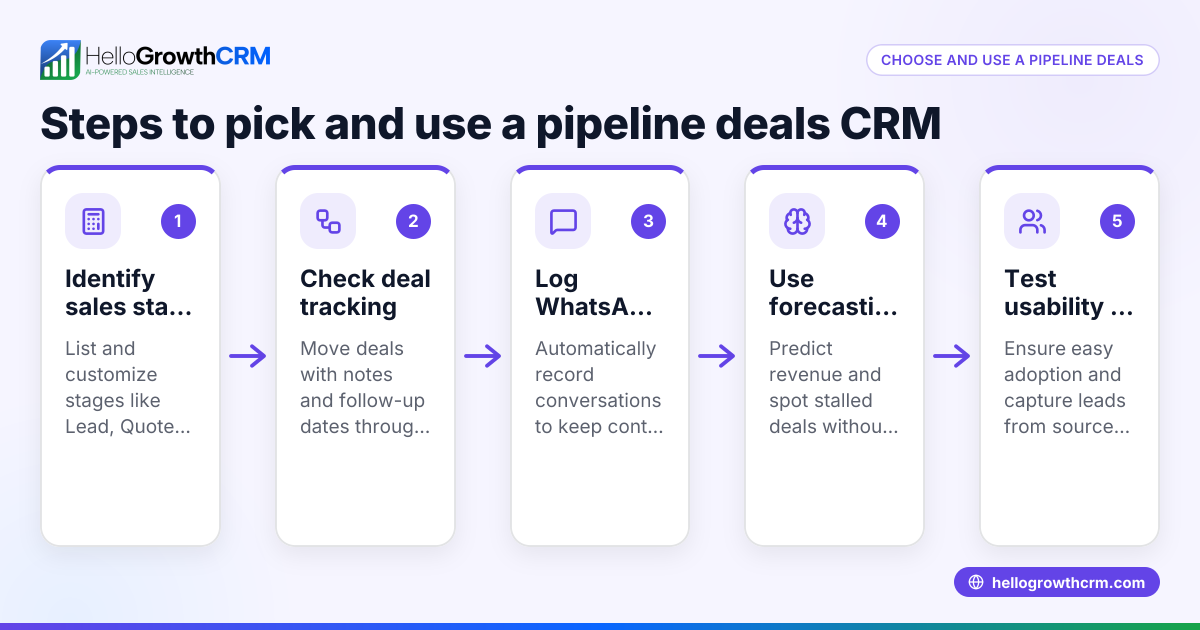
HelloGrowthCRM offers a Deals (pipeline) feature where quotations sent last week appear as deals at the "quote sent" stage with a follow-up date, ensuring no deal is forgotten. WhatsApp and SMS conversations with leads are logged directly on the lead record, and follow-ups can be sent as messages, keeping communication organised. The pipeline forecast and AI insights feature shows which deals are stalling in each stage without needing spreadsheets, helping owners focus on closing more sales. Learn more about HelloGrowthCRM's AI CRM and sales forecasting capabilities designed for Indian SMBs.
Frequently asked questions
What are the typical CRM pipeline stages for small businesses? Typical stages include Lead Captured, Contacted, Qualified, Quote Sent, Negotiation, and Closed Won or Lost. These stages reflect the progress of a deal from first contact to closure.
How do I choose the right number of pipeline stages? Choose enough stages to capture key sales milestones without making the process complicated. Usually, 5 to 7 stages work well for most small businesses.
How does pipeline stage management improve sales forecasting? By assigning probabilities and expected values to each stage, you can calculate a weighted forecast of revenue. This helps predict cash flow and plan resources.
Can I manage WhatsApp conversations within a CRM pipeline? Yes, some CRMs like HelloGrowthCRM log WhatsApp chats on lead records and allow follow-ups via WhatsApp or SMS, streamlining communication.
How often should I review my sales pipeline? Weekly reviews help identify stalled deals and update forecasts, ensuring the pipeline reflects current sales reality.
What mistakes should I avoid when setting pipeline stages? Avoid too many stages, unclear criteria, ignoring follow-ups, and outdated data. Training your team and regular reviews prevent these issues. For more on managing sales processes effectively, see HelloGrowthCRM for India.
Key takeaways
- CRM pipeline stages are essential to track sales progress and forecast revenue accurately.
- Define clear, meaningful stages with objective criteria to move deals forward.
- Schedule follow-ups and update deal status promptly to avoid stalled sales.
- Use pipeline reporting and AI insights to identify bottlenecks without manual spreadsheets.
- Integrate communication channels like WhatsApp within your CRM for seamless follow-ups.
- Regular pipeline reviews keep your sales process on track and improve forecasting.
Start organising your sales pipeline today with HelloGrowthCRM. Start on the Free Forever plan (200 leads, no credit card).
Ready to put this into practice?
Set up your pipeline, WhatsApp follow-ups, and AI lead scoring in minutes — free, no credit card.
Try HelloGrowthCRM freeGet CRM tips in your inbox
Join thousands of sales professionals who get weekly insights on CRM strategy, AI automation, and pipeline optimization.

The HelloGrowthCRM team publishes guides on CRM strategy, AI sales tools, and revenue operations for small business sales teams.