HelloGrowthCRM software
Built for real small-business sales teams
HelloGrowthCRM helps reps qualify faster, follow up on time, and close more deals—with practical automation in one place.
- AI lead scoring and pipeline visibility
- Built-in dialer, WhatsApp, and email automation
- Sales forecasting and RevOps-ready reporting
In Singapore, a CRM trial is worth running only if you use it to test the real frictions your business faces: PDPA consent, GST timing, PayNow reconciliation, multilingual enquiries, and the way local customers actually book and reply.
That means resisting the usual demo-script approach. A polished pipeline view tells you very little if your team still copies WhatsApp leads by hand, sends messages without a clean consent record, or loses track of deposits received by bank transfer. A useful trial should answer one practical question: if you switch this on for live enquiries next month, what work becomes easier, what risk appears, and what still needs a manual process?
For a Singapore business, those answers are country-specific. The right setup for a logistics broker near Changi is not the same as one for a dental practice in Novena or a tuition centre in Tampines. But the test method can still be disciplined.
PDPA and Do Not Call checks belong inside the trial, not after purchase
If your trial ignores consent and outreach rules, you are testing a toy, not an operating system. Singapore's Personal Data Protection Act and the Do Not Call provisions administered by the Personal Data Protection Commission matter as soon as a lead enters your database. The legal duty to check the relevant Do Not Call Registry before sending specified messages to Singapore numbers sits with the sender, not with the CRM vendor.
So during the trial, create fields and workflows that reflect how your team really contacts people. Separate enquiry consent from marketing consent. Keep source evidence, such as a web form submission or a WhatsApp opt-in message. Distinguish clearly between service messages and promotional outreach, because PDPA guidance treats them differently. If the system cannot show who consented, to what, and through which channel, it is not ready for live use.
This is also the moment to remove bad data habits. Many Singapore forms still ask for NRIC by default even when there is no operational need. PDPC guidance is clear that collection of NRIC numbers is restricted. In a CRM trial, that should trigger a design review: what minimum information do you actually need to quote, book, or call back? Usually it is far less than teams think.
If your business is regulated beyond PDPA, fold that in now. Aesthetic clinics, dental practices and other licensed healthcare providers also need to consider communication and advertising rules from the Ministry of Health and professional boards. A CRM can store and route leads, but your trial should test whether templates, booking confirmations and follow-up messages can be controlled tightly enough for your sector.
Deposits and GST timing should shape your invoice and payment test
Many CRM trials fail in Singapore because they test only quotation and closing, not the messy middle where money arrives. If you take booking deposits, advance payments or retainers, your workflow should reflect how GST works in practice. For a taxable supply, the obligation can be triggered at the earlier of invoice or payment, so a deposit can matter on the day it arrives. The current GST rules, registration guidance and published figures sit with IRAS, and you should confirm the latest position there before going live.
That matters even if your CRM is not your accounting system. The trial should show whether staff can record the date money was received, link it to the right customer record, and pass the correct information downstream. If a front-desk team in Orchard collects a deposit for a treatment package and the finance team sees it only days later in a different inbox, the software has not solved the real problem.
Use the trial to walk a live scenario from quote to payment receipt to cancellation or reschedule. Ask whether the record shows enough context for finance and operations to agree on what happened. Check whether your invoice wording, receipt timing and notes fields are robust enough for an IRAS review. Do not rely on memory.
The arithmetic below is illustrative; the figures are made up to show the shape of the decision. An air-conditioning service firm in Jurong quotes S$1,800 for a commercial job and collects a S$300 booking deposit by PayNow. The team then orders parts costing S$420 and allocates a technician half a day. If the customer postpones twice and finally cancels, the business needs one place showing the quote, the deposit receipt date, the later cancellation note, and whether any amount was refunded or applied elsewhere. What this leaves out: GST treatment details, contract wording, supplier terms, and any industry-specific consumer law issue. The point of the trial is to see whether those facts stay attached to one record rather than scattered across chat, email and banking screenshots.
PayNow, FAST and bank transfers expose weak CRM trials quickly
Singapore customers and businesses do not pay only by card, and your CRM trial should reflect that. PayNow, SGQR, GIRO, FAST, NETS, credit card and ordinary bank transfer all appear in real operations, often within the same week. The problem is not payment acceptance alone; it is reconciliation and visibility.
PayNow and bank transfers do not appear inside a card processor's dashboard, so staff often need to record them manually against the right record. A CRM trial should therefore test the handoff between the person who receives the payment notification and the person who updates the customer file. If your team has to search by payer name and guess which open deal it belongs to, your data model is too loose.
This is one area where a product test should be very literal. Use a small set of real payment methods, not demo data. Check whether quotes, invoices and payments received can stay tied to the same deal record. Check whether notes explain exceptions clearly, such as split payments or amounts paid from a corporate account under a different legal name. A B2B firm that sells to procurement teams through GeBIZ will care about this for different reasons than a tuition centre collecting family payments, but both need traceability.
If you want to see whether the workflow is even viable, put it under mild stress for a week: several open quotes, at least one partial payment, one transfer with no reference, and one payment that reaches the business after office hours. Weak setups break immediately under those conditions.
Lead source attribution in Singapore starts with where people actually message you
A Singapore lead rarely arrives through a neat web form alone. It may start on Google Business Profile, Carousell, WhatsApp, Instagram, Facebook, LinkedIn, GeBIZ, or a plain referral from an existing customer. A CRM trial should therefore test whether source capture matches the first real contact point, not the channel your team prefers to report on.
For local service businesses, this matters because buyer intent differs sharply by source. A Google Business Profile enquiry is often urgent and local. A Carousell lead may be price-sensitive and chat-heavy. A LinkedIn lead for B2B services usually needs cleaner account-level context. Public sector opportunities through GeBIZ involve a different buying path entirely. If the CRM collapses all of these into a single generic source field, reports become decorative rather than useful.
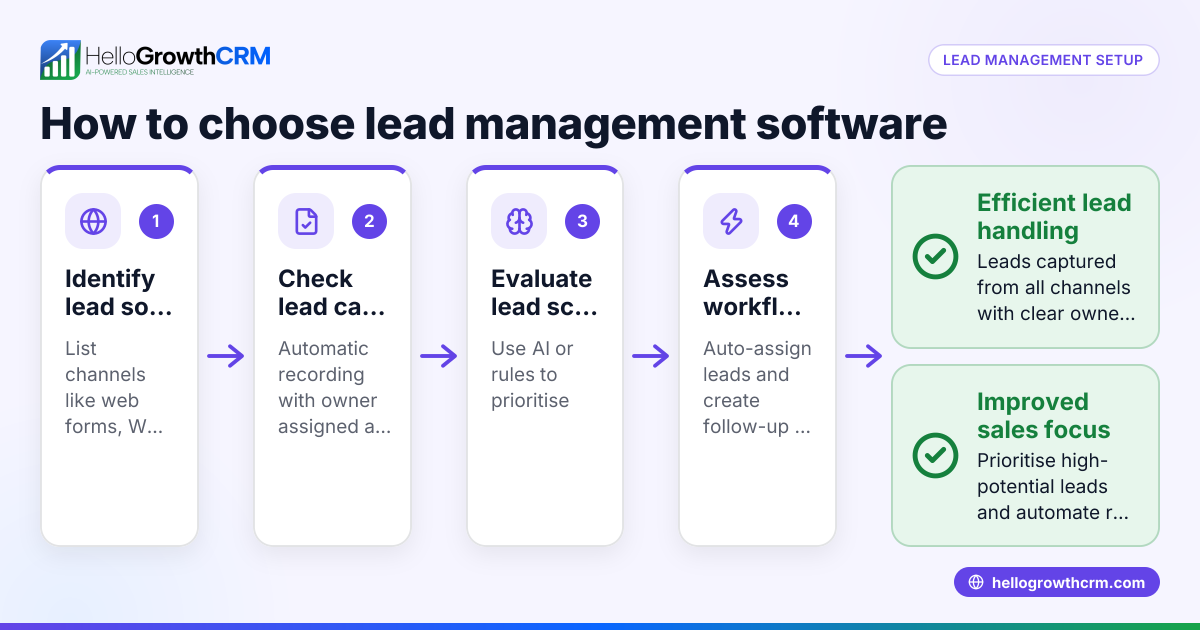
In the trial, map source, first response channel and conversion path separately. That lets you see whether the customer came from Instagram but converted after a WhatsApp exchange, or whether a referral produced a quote without any marketing touch at all. If you are evaluating lead capture and qualification tools, this is the test that makes them meaningful: can the system keep new enquiries organised without flattening the context that explains why some leads close faster than others?
Language also belongs here. English is the working language in Singapore, but customer-facing copy in Mandarin or Malay may lift response quality for certain segments. During the trial, check whether your forms, templates and notes can preserve that context cleanly instead of forcing every interaction into one default script.
Scheduling should reflect lunch crowds, public holidays and CBD versus heartland demand
Booking logic in Singapore is not generic calendar logic. Public holidays span several communities, and some move each year because they follow lunar or Islamic calendars. Demand is also uneven across the day. Lunch-hour slots and post-work appointments often fill faster than mid-morning, while a heartland location may behave differently from a CBD site.
A CRM trial should test those patterns directly. If you run a tuition centre in Tampines, a family may prefer after-school and weekend timing. If you operate a dental practice in Novena, office workers may ask for lunch slots and fast confirmations. If your sales team covers ASEAN accounts from Singapore, the country has one time zone but your customers do not, so booking pages and reminders need to avoid accidental misalignment.
This is where a bare-bones scheduler can create hidden admin work. Before you commit, try real rules: blocked times on public holidays, different slot lengths by meeting type, travel buffers for field visits, and routing that reflects territory ownership. If your process relies on manual back-and-forth to fix calendar mistakes, the trial has already given you the answer.
For businesses that depend heavily on appointment conversion, test a proper meeting scheduling and booking flow with live staff calendars and actual reminder language. The key question is not whether someone can book. It is whether the booking arrives in the right pipeline with enough context for the next person to act.
The best trial users are the staff who fix exceptions all day
Senior managers often drive CRM selection, but in Singapore the people who expose a weak setup fastest are usually front-desk staff, coordinators, inside sales reps and operations executives. They are the ones who chase missing references, translate shorthand from WhatsApp, and decide whether an enquiry is genuine, duplicate or urgent.
So give the trial to the people who handle exceptions. Ask them to work from live enquiries for a limited period and capture every point where they leave the system to finish the job elsewhere. You need friction notes, not opinions.
- Can they tell, at a glance, whether a Singapore mobile number may be contacted for marketing or only for service updates?
- When a customer pays by PayNow or bank transfer, can they mark the record correctly without waiting for finance?
- Do duplicate leads from Google Business Profile, WhatsApp and referrals merge cleanly enough to avoid double follow-up?
- Can they book around moving public holidays and location-specific staff availability without a side spreadsheet?
- Does the record show enough history for a colleague to take over during leave or shift changes?
This kind of testing produces better answers than a feature tour because it measures effort. If the team spends too much time cleaning up after the system, adoption will fade even if management likes the dashboard.
Use the trial to measure record hygiene, not just closing speed
Most companies judge a CRM trial by how fast a lead can be created or a deal can be moved. In practice, the stronger test is record hygiene after ordinary use. Can the system hold a usable history after calls, missed calls, WhatsApp messages, reschedules, quotations and notes from more than one colleague?
That matters in Singapore because many businesses run lean teams, and handoffs happen constantly across sales, admin and operations. Staff leave for annual leave during school holidays. Customers reply outside office hours. A contact may first message the business, then call, then pay by transfer, then ask for a different branch. If the history fractures, service quality falls quickly.
During the trial, inspect ten records after a few days of live use. If they already contain vague notes, inconsistent statuses and missing next steps, the issue is not discipline alone; the workflow may be too easy to bypass. A stronger setup uses structured stages, visible activities and task ownership to reduce ambiguity. That is where task boards and activity logging help: not as decoration, but as a way to keep each follow-up, meeting and note tied to the same record.
If you need forecasting, be cautious. Pipeline views and expected values can be useful, but only after stage definitions match your actual buying journey. Otherwise any projection is built on noise. A trial should earn your confidence at the record level before you care about aggregate charts.
Test integrations against SingPass, Corppass and the tools you already use
Singapore businesses live inside connected systems. Government services often rely on SingPass or Corppass for authentication. Company records are shaped by ACRA data. Finance and operations may sit in separate apps. The value of a CRM trial therefore depends partly on whether it can fit into the stack you already have, not whether it can replace everything.
Use the trial to identify where data must move and where it should not. A lead source from Meta ads may need to enter the CRM quickly. A quote may need to trigger an internal notification. A customer status may need to sync to another system. But sensitive identifiers and regulated information may require tighter handling, especially under PDPA. The question is not “does it integrate?” but “which fields move, who owns them, and what breaks if sync fails?”
If you are comparing options, review integration capabilities with one live use case in mind rather than a broad wishlist. And if vendor security review matters in your procurement process, especially for larger firms or regulated sectors, check the available security information early so legal and IT are not brought in only at the end.
Where HelloGrowthCRM fits in a Singapore trial
If you are trialling HelloGrowthCRM, keep the test narrow and local. Start with lead capture and pipeline entry, then add one communication channel and one booking or payment workflow. Its core tools for leads, pipeline management, tasks, scheduling, messaging, quotes and payment reconciliation are enough to run a realistic Singapore pilot without pretending every process is solved on day one. If your team needs a no-cost sandbox first, the free CRM plan gives you a contained place to test live habits before you expand.
A good CRM trial in Singapore is not the one with the smoothest demo; it is the one that still makes sense after PDPA checks, GST timing, local payment rails and real staff behaviour are all placed on top of it.
Ready to put this into practice?
Set up your pipeline, WhatsApp follow-ups, and AI lead scoring in minutes — free, no credit card.
Try HelloGrowthCRM freeGet CRM tips in your inbox
Join thousands of sales professionals who get weekly insights on CRM strategy, AI automation, and pipeline optimization.

The HelloGrowthCRM team publishes guides on CRM strategy, AI sales tools, and revenue operations for small business sales teams.