HelloGrowthCRM software
Built for real small-business sales teams
HelloGrowthCRM helps reps qualify faster, follow up on time, and close more deals—with practical automation in one place.
- AI lead scoring and pipeline visibility
- Built-in dialer, WhatsApp, and email automation
- Sales forecasting and RevOps-ready reporting
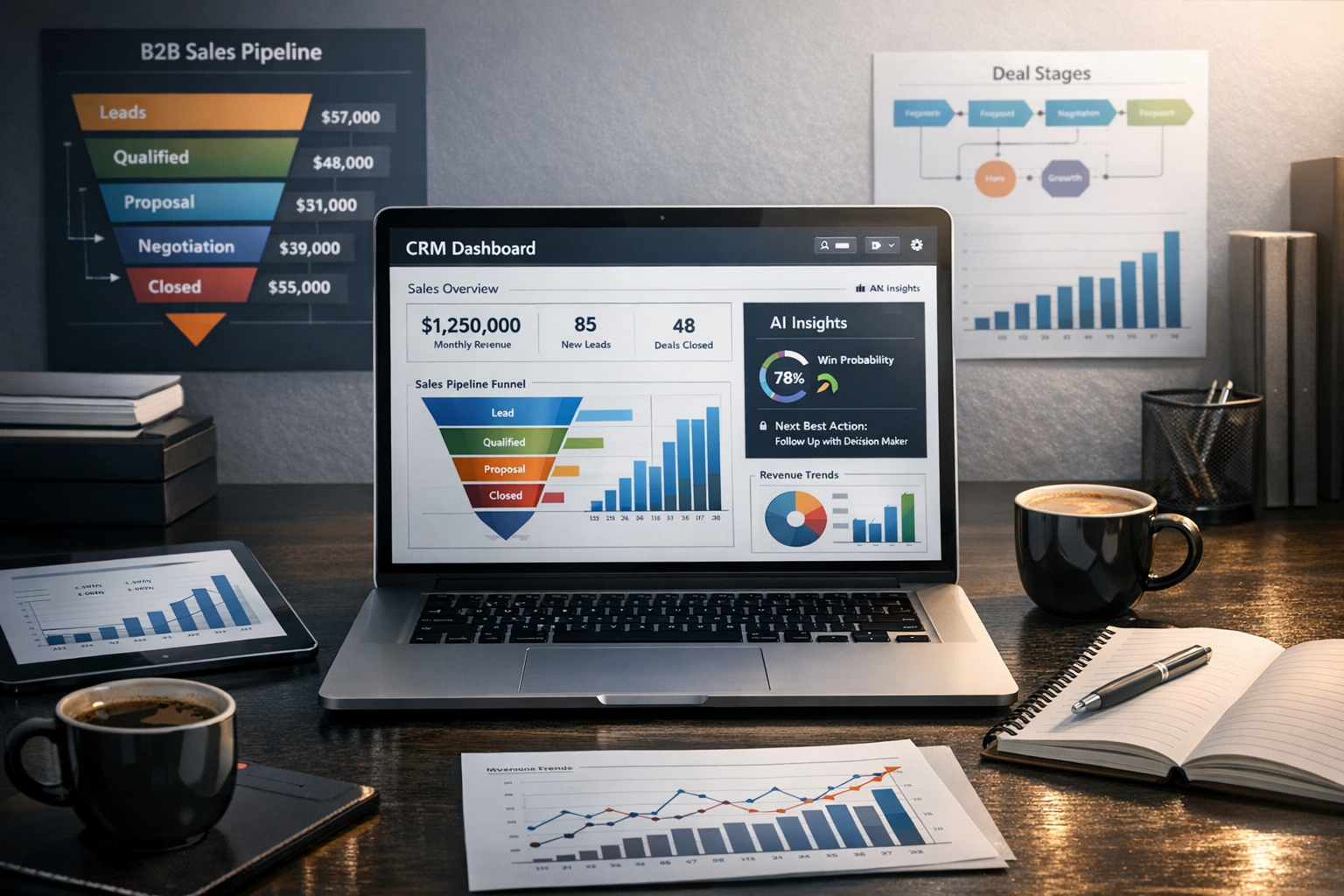
A CRM with revenue forecasting and insights helps small businesses predict future sales and understand their pipeline health without manual spreadsheets. This article covers why Indian SMBs need this, step-by-step evaluation tips, a realistic example, common pitfalls, and how HelloGrowthCRM supports forecasting with AI insights.
Why this comes up / what goes wrong
Small and mid-sized business owners in India often lose leads or miss sales targets because they rely on WhatsApp, Excel, or manual notes to track prospects. Without clear visibility into which deals are likely to close and when, forecasting revenue becomes guesswork. Sales managers struggle to identify bottlenecks or underperforming team members because data is scattered or outdated. This leads to missed follow-ups, inaccurate revenue projections, and difficulty planning inventory or cash flow.
Business owners searching for a CRM with revenue forecasting and insights want a solution that provides real-time pipeline visibility, highlights stalled deals, and helps prioritize follow-ups. They want to avoid building complex spreadsheets or juggling multiple tools.
Step-by-step
- List your sales stages clearly: Define your sales process stages (e.g., inquiry, demo, negotiation, closed won/lost). Check if the CRM lets you customize these stages easily.
- Check forecasting features: Look for AI or automated revenue forecasting that estimates expected close amounts based on your pipeline and past conversion rates. Confirm if the CRM shows which stages deals stall in.
- Evaluate lead and activity tracking: Ensure the CRM logs communications like WhatsApp messages and SMS on each lead record, so your team’s follow-ups are tracked and visible.
- Review task and activity management: The CRM should convert follow-ups into tasks with due dates and present daily call or follow-up lists to avoid missing actions.
- Test reporting and insights: See if the CRM provides AI-generated analysis of pipeline health, sales rep performance, and revenue signals without extra manual work.
- Consider integration and usability: Verify the CRM works well with your current lead sources like IndiaMART or JustDial and is easy for your telecalling team to adopt.
- Compare pricing and plans: Understand which features come on which plans and whether you can start free or with a trial.
For more on sales forecasting, see sales forecasting. To understand AI-driven features, visit AI CRM.
Example (fictional figures)
Consider "ABC Electronics," a Mumbai-based small business tracking 10 active deals on 01/06/2024.
- Stage 1 (Inquiry): 3 deals, average expected value ₹50,000 each
- Stage 2 (Demo): 4 deals, average expected value ₹1,00,000 each
- Stage 3 (Negotiation): 2 deals, average expected value ₹2,00,000 each
- Stage 4 (Closed Won): 1 deal, value ₹3,00,000
Assuming an illustrative conversion rate from each stage to Closed Won:
- Inquiry to Closed Won: 20%
- Demo to Closed Won: 50%
- Negotiation to Closed Won: 80%
Calculations:
Inquiry forecast = 3 × ₹50,000 × 20% = ₹30,000 Demo forecast = 4 × ₹1,00,000 × 50% = ₹2,00,000 Negotiation forecast = 2 × ₹2,00,000 × 80% = ₹3,20,000 Closed Won = ₹3,00,000
Total forecasted revenue = ₹30,000 + ₹2,00,000 + ₹3,20,000 + ₹3,00,000 = ₹8,50,000
This forecast helps ABC Electronics plan inventory and cash flow for the month.
Common mistakes
- Ignoring pipeline stages customization: Using default stages that don’t match your sales process can give misleading forecasts. Prevent by customizing stages to your workflow.
- Relying on manual data entry: Manual updates cause delays and errors. Use a CRM that automatically logs WhatsApp and SMS conversations to keep data current.
- Not setting task reminders: Without task boards or due dates, follow-ups get missed. Choose a CRM that converts follow-ups into tasks with deadlines.
- Overcomplicating reports: Complex spreadsheets discourage regular use. Prefer a CRM with built-in AI insights and easy-to-understand dashboards.
- Ignoring team adoption: A powerful CRM is useless if your sales team doesn’t use it. Select a WhatsApp-native CRM that fits naturally into your team’s communication habits.
For tips on task management, see HelloGrowthCRM for India.
Doing this in HelloGrowthCRM
HelloGrowthCRM offers pipeline forecast and AI insights that show expected revenue and highlight which sales stages are causing delays, all without building spreadsheets. WhatsApp and SMS conversations with leads are logged on each lead record, ensuring your team’s follow-ups are tracked. Activities and task boards convert follow-ups into tasks with due dates, presenting daily call lists so your team never misses a lead. Learn more about these features at sales forecasting, WhatsApp and SMS CRM, and sales task boards.
Frequently asked questions
What is revenue forecasting in a CRM? Revenue forecasting estimates the sales your business expects to close in a future period based on your current pipeline and historical data. It helps plan resources, inventory, and cash flow.
How does AI improve sales forecasting? AI analyses patterns in your sales pipeline, deal velocity, and past conversions to provide more accurate forecasts and highlight pipeline bottlenecks without manual spreadsheets.
Can I track WhatsApp conversations in a CRM? HelloGrowthCRM logs WhatsApp and SMS conversations with leads on each lead record, helping sales teams keep all communication in one place.
What should I check before choosing a CRM for forecasting? Check if it supports customizable sales stages, AI forecasting, activity tracking, task management, and integrates with your lead sources. Also, consider user-friendliness for your team.
Is it necessary to use AI forecasting for small businesses? While not mandatory, AI forecasting saves time and improves accuracy, especially as your sales volume grows, helping avoid missed revenue opportunities.
Key takeaways
- A CRM with revenue forecasting helps predict future sales and identify pipeline bottlenecks.
- Look for AI-powered forecasting, customizable sales stages, and automatic communication logging.
- Task boards and activity tracking ensure no follow-ups are missed.
- Avoid manual spreadsheets by choosing a CRM with built-in insights.
- HelloGrowthCRM offers these features tailored to Indian SMBs’ needs.
Start managing your sales pipeline and revenue forecasts effectively. Start on the Free Forever plan (200 leads, no credit card).
Ready to put this into practice?
Set up your pipeline, WhatsApp follow-ups, and AI lead scoring in minutes — free, no credit card.
Try HelloGrowthCRM freeGet CRM tips in your inbox
Join thousands of sales professionals who get weekly insights on CRM strategy, AI automation, and pipeline optimization.

The HelloGrowthCRM team publishes guides on CRM strategy, AI sales tools, and revenue operations for small business sales teams.