HelloGrowthCRM software
Built for real small-business sales teams
HelloGrowthCRM helps reps qualify faster, follow up on time, and close more deals—with practical automation in one place.
- AI lead scoring and pipeline visibility
- Built-in dialer, WhatsApp, and email automation
- Sales forecasting and RevOps-ready reporting
A CRM with ticket management helps support managers in Canadian small businesses track customer service requests alongside sales data, ensuring no issue slips through the cracks. This article explains why support managers need ticket management in their CRM, outlines a step-by-step evaluation process, highlights common mistakes to avoid, and shows how HelloGrowthCRM supports these needs.
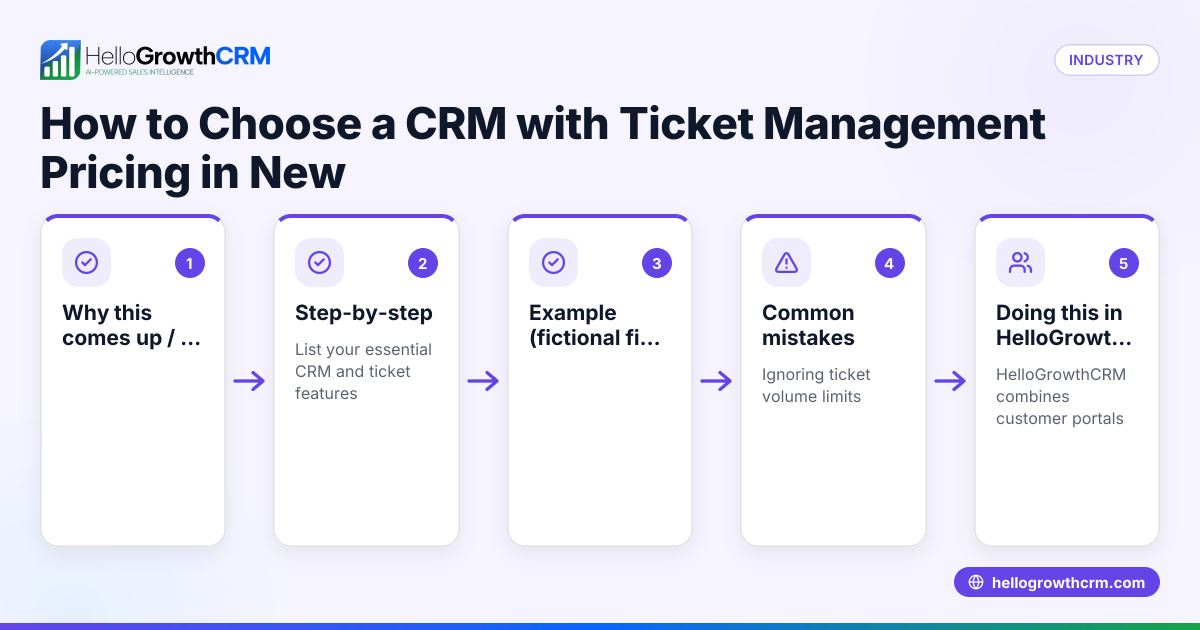
Why this comes up / what goes wrong
Small and mid-sized Canadian businesses often struggle to keep customer support organized when using separate tools for sales and service. Support managers find it hard to track tickets when requests come via email, phone, WhatsApp, or text messages, often losing context and follow-up details. Without a unified CRM that includes ticket management, service requests may be logged in spreadsheets or notebooks, causing delays and unhappy customers. Support managers need a system that links tickets to customer records and sales deals, enabling efficient resolution and better customer experience.
Step-by-step
- Identify your support channels: List all ways customers contact your support team, such as email, phone, WhatsApp, SMS, or web forms. Check if the CRM can capture tickets from these channels.
- Check ticket management features: Confirm the CRM offers ticket tracking, status updates, assignment to team members, and priority or SLA (Service Level Agreement) policies.
- Look for integration with customer records: Ensure tickets stay linked to the same customer record as sales deals to provide full context.
- Evaluate automation and notifications: See if the CRM supports automated ticket assignment, reminders, and notifications to avoid dropped requests.
- Assess reporting and analytics: Choose a CRM that provides reports on ticket volume, resolution times, and customer satisfaction metrics.
- Test ease of use: The CRM should be simple for support managers and agents to use daily, avoiding complex workflows.
- Consider communication channels: Check if the CRM logs WhatsApp and SMS conversations on the customer or lead record and supports follow-up messaging (/product/whatsapp-sms-crm).
- Review customer self-service options: A branded customer portal can reduce support workload by letting customers track tickets and find answers (/product/customer-health-score).
Example (fictional figures)
A staffing agency in Halifax, Nova Scotia, receives about 500 support requests per month via email, phone, and WhatsApp. They want to implement a CRM with ticket management to improve response times.
- Current average resolution time: 72 hours
- Goal: reduce to 48 hours
Steps:
- Capture all support requests as tickets in the CRM.
- Assign tickets automatically to support agents based on workload.
- Use WhatsApp and SMS logging to keep communication history.
- Provide customers access to a self-service portal.
Assuming 500 tickets × 72 hours average = 36,000 total hours of customer wait time per month. 500 × 72 = 36,000
Reducing average to 48 hours: 500 tickets × 48 hours = 24,000 total hours 500 × 48 = 24,000
Time saved per month: 36,000 - 24,000 = 12,000 hours
This improvement can increase customer satisfaction and reduce lost business.
Common mistakes
- Using multiple disconnected tools: Prevent by choosing a CRM that integrates ticket management with leads and customer records.
- Ignoring mobile messaging channels: Prevent by selecting a CRM that logs WhatsApp and SMS conversations and supports follow-ups (/product/whatsapp-sms-crm).
- Overlooking customer self-service: Prevent by implementing a branded customer portal to reduce repetitive inquiries (/product/customer-health-score).
- Not setting SLA policies: Prevent by configuring SLA tracking to prioritise urgent tickets and meet response targets.
- Failing to assign ticket ownership: Prevent by automating ticket assignment to avoid tickets being overlooked.
- Neglecting reporting: Prevent by regularly reviewing ticket reports to identify bottlenecks and improve processes.
Doing this in HelloGrowthCRM
HelloGrowthCRM includes support ticket management integrated directly with customer records and deals. After the sale, service requests stay on the same customer record as the deal, providing full context for support managers. The branded customer portal allows customers to submit and track tickets themselves, reducing support workload. WhatsApp and SMS conversations with leads and customers are logged on their records, and follow-ups can be sent as messages, ensuring no communication is lost (/product/whatsapp-sms-crm). Every enquiry from forms, calls, or WhatsApp lands as a lead with an owner and next step, keeping support and sales aligned (/product/ai-lead-scoring). To explore how HelloGrowthCRM supports Canadian businesses, see HelloGrowthCRM for Canada (/canada).
Frequently asked questions
What is ticket management in a CRM? Ticket management is a system within a CRM that tracks customer service requests (tickets) from submission to resolution, including status updates, assignments, and communication logs.
Why do support managers need ticket management integrated with CRM? Integrating ticket management with CRM links support requests to customer and sales data, improving context and allowing faster, more informed responses.
Can WhatsApp and SMS conversations be tracked in a CRM? Yes, some CRMs log WhatsApp and SMS conversations on the customer record and allow follow-up messages, keeping all communication in one place (/product/whatsapp-sms-crm).
What should I look for in a CRM’s ticket management? Look for ticket tracking, SLA policies, automatic assignment, reporting, integration with customer records, and support for your communication channels.
How does a customer portal help support teams? A branded customer portal lets customers submit and track tickets themselves and access a knowledge base, reducing the volume of direct inquiries and speeding up resolution (/product/customer-health-score).
Key takeaways
- Choose a CRM that integrates ticket management with customer and sales records to keep full context.
- Ensure support requests from all channels, including WhatsApp and SMS, are captured and logged.
- Use automation for ticket assignment and SLA tracking to improve response times.
- Implement a branded customer portal to reduce support workload.
- Regularly review ticket reports to identify and fix support bottlenecks.
- HelloGrowthCRM supports these features with tickets, customer portal, and WhatsApp/SMS integration.
Start improving your support management by trying HelloGrowthCRM. You can start on the Free Forever plan (200 leads, no credit card) today.
Ready to put this into practice?
Set up your pipeline, WhatsApp follow-ups, and AI lead scoring in minutes — free, no credit card.
Try HelloGrowthCRM freeGet CRM tips in your inbox
Join thousands of sales professionals who get weekly insights on CRM strategy, AI automation, and pipeline optimization.

The HelloGrowthCRM team publishes guides on CRM strategy, AI sales tools, and revenue operations for small business sales teams.