HelloGrowthCRM software
Built for real small-business sales teams
HelloGrowthCRM helps reps qualify faster, follow up on time, and close more deals—with practical automation in one place.
- AI lead scoring and pipeline visibility
- Built-in dialer, WhatsApp, and email automation
- Sales forecasting and RevOps-ready reporting
Customer clustering is the process of dividing your customers into groups that share similar characteristics like buying habits, location, or industry. This grouping allows small businesses to focus marketing efforts, tailor sales approaches, and improve customer service more effectively.
Why this comes up / what goes wrong
Small-business owners often struggle with managing a diverse customer base using the same sales and marketing tactics for everyone. This can lead to wasted effort on low-value customers, missed opportunities with high-value ones, and generic marketing messages that don’t connect. Without clustering, it’s hard to prioritize leads or personalize communication, which slows down sales follow-up and hurts customer satisfaction. Customer clustering solves this by organizing customers into practical segments that reflect their real differences.
Step-by-step
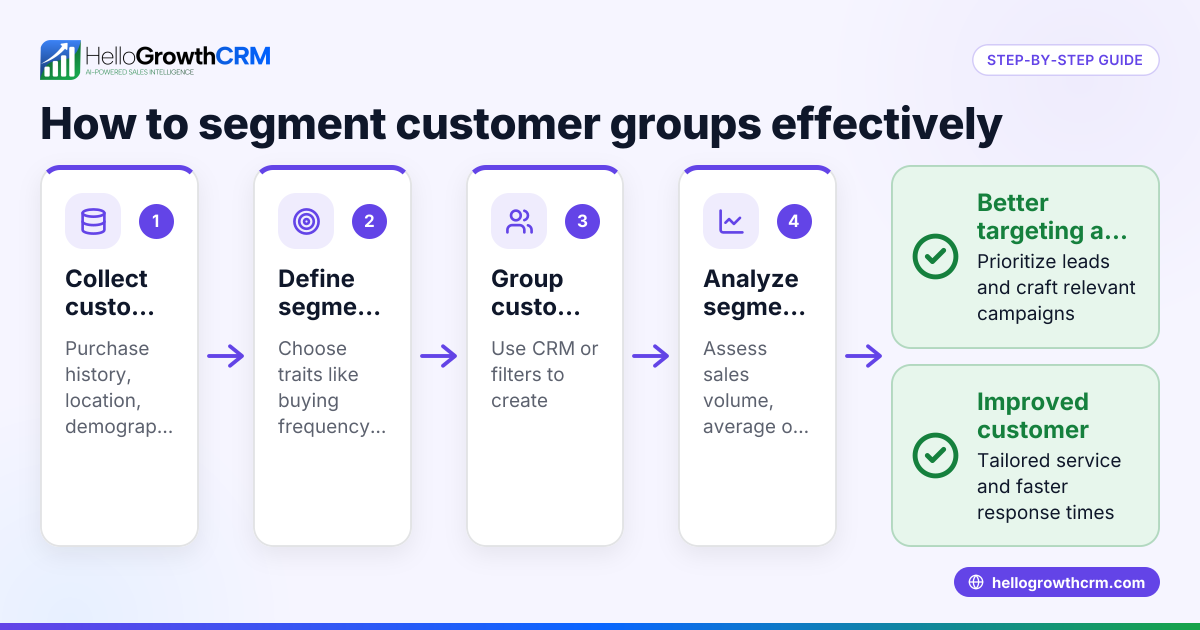
- Collect customer data: Gather information such as purchase history, location, age, industry, and communication preferences. Check the data for accuracy and completeness to avoid mistakes.
- Choose relevant attributes: Pick characteristics that influence buying decisions or service needs. Examples include annual spending, frequency of purchases, business size, or preferred contact methods.
- Select a clustering method: Start simple by grouping customers based on one or two key attributes using spreadsheet filters or basic software. If you have access to more advanced tools, statistical methods like k-means clustering can be used. Make sure the method fits your data size and complexity.
- Create customer segments: Group customers into clusters based on your chosen attributes. Verify each cluster is distinct and actionable for marketing or sales.
- Analyze each cluster: Profile the clusters to understand their needs, value, and behavior. Check if these groups align with your business goals and sales priorities.
- Tailor marketing and sales strategies: Develop campaigns and sales approaches specific to each cluster. Track results and refine your tactics over time.
- Review and update clusters regularly: Customer preferences and behaviors change, so revisit your clusters at least quarterly to keep them relevant.
For tracking ongoing engagement and risk, see customer health score.
Example (fictional figures)
A B2B software reseller in Denver, Colorado has 1,000 customers. They want to group them by annual spending and industry sector to focus marketing.
- Step 1: Collect data showing annual spending and industry for each customer.
- Step 2: Select attributes: annual spending and industry sector (healthcare, retail, manufacturing).
- Step 3: Use spreadsheet filters to create three spending tiers:
- Less than $10,000
- $10,000 to $50,000
- More than $50,000
- Step 4: Combine spending tiers with industries to form clusters, e.g., high-spending healthcare customers.
Cluster sizes:
- 200 customers spend more than $50,000
- 500 customers spend between $10,000 and $50,000
- 300 customers spend less than $10,000
Calculations:
- Revenue from top tier = 200 customers × $60,000 = $12,000,000
- Revenue from mid tier = 500 customers × $25,000 = $12,500,000
- Revenue from low tier = 300 customers × $5,000 = $1,500,000
Total revenue = $12,000,000 + $12,500,000 + $1,500,000 = $26,000,000
The reseller decides to focus marketing on the top two tiers (700 customers) and tailor messaging by industry to maximize revenue.
Common mistakes
- Using incomplete or inaccurate data: Prevent this by regularly cleaning and verifying customer information to ensure clusters are based on reliable data.
- Choosing irrelevant attributes: Focus on characteristics that truly influence buying behavior or service needs to create meaningful clusters.
- Creating too many clusters: Keep the number of groups manageable and actionable to avoid confusion and complexity.
- Ignoring cluster updates: Customer behavior changes over time; review and adjust clusters regularly to keep them useful.
- Not acting on clusters: Use the insights from clustering to tailor marketing, sales, and service strategies rather than just segmenting for data’s sake.
To integrate customer insights into your sales workflow, explore WhatsApp and SMS CRM.
Doing this in HelloGrowthCRM
HelloGrowthCRM helps you manage customers after clustering by linking service requests, referrals, tickets, and knowledge base articles directly to the same customer record as the deal. Its branded self-service customer portal supports ongoing communication and service, ensuring your team can act on cluster insights efficiently. Learn more at HelloGrowthCRM for the United States.
Frequently asked questions
What data should I use for customer clustering? Use data relevant to your sales and marketing goals, such as purchase history, demographics, industry, and communication preferences. Accurate and complete data is essential for effective clustering.
Can I do customer clustering without advanced software? Yes, simple clustering can be done using spreadsheet filters to group customers by key attributes. This is practical for small businesses without specialized tools.
How often should I update customer clusters? Review and update clusters at least quarterly or when you notice significant changes in customer behavior or market conditions to keep them relevant.
How does customer clustering improve sales follow-up? By grouping similar customers, sales teams can prioritize high-value leads, personalize communication, and respond with targeted messaging that resonates with each group.
Is customer clustering the same as customer health scoring? No, clustering groups customers by shared traits, while customer health scoring measures engagement or risk levels of individual customers. Both methods complement each other for better customer management.
Key takeaways
- Customer clustering groups customers by shared traits for focused marketing and sales.
- Start by collecting accurate data and choosing relevant attributes.
- Use simple tools like spreadsheets or basic software to create actionable segments.
- Avoid mistakes like poor data quality, irrelevant attributes, and too many clusters.
- Update clusters regularly to reflect changing customer behavior.
- HelloGrowthCRM supports ongoing customer management by linking service and sales data on one record.
Start organizing your customers better today. Start on the Free Forever plan (200 leads, no credit card).
Ready to put this into practice?
Set up your pipeline, WhatsApp follow-ups, and AI lead scoring in minutes — free, no credit card.
Try HelloGrowthCRM freeGet CRM tips in your inbox
Join thousands of sales professionals who get weekly insights on CRM strategy, AI automation, and pipeline optimization.

The HelloGrowthCRM team publishes guides on CRM strategy, AI sales tools, and revenue operations for small business sales teams.