HelloGrowthCRM software
Built for real small-business sales teams
HelloGrowthCRM helps reps qualify faster, follow up on time, and close more deals—with practical automation in one place.
- AI lead scoring and pipeline visibility
- Built-in dialer, WhatsApp, and email automation
- Sales forecasting and RevOps-ready reporting
A customer data platform (CDP) helps small and mid-sized businesses unify customer information from multiple sources into one place. This improves lead follow-up, personalizes communication, and enhances sales and service efficiency. This article explains why CDPs matter, how to evaluate them step-by-step, common pitfalls to avoid, and how HelloGrowthCRM supports customer data management after the sale.
Why this comes up / what goes wrong
Small business owners often struggle with scattered customer information across emails, spreadsheets, text messages, and different apps. This fragmentation causes slow lead follow-up, lost sales opportunities, and inconsistent customer experiences. Without a central system, sales teams waste time searching for data or repeating outreach. A customer data platform addresses these issues by consolidating data, enabling better segmentation, and automating communication sequences. Understanding the benefits helps owners decide if a CDP fits their business and what features to prioritize.
Step-by-step
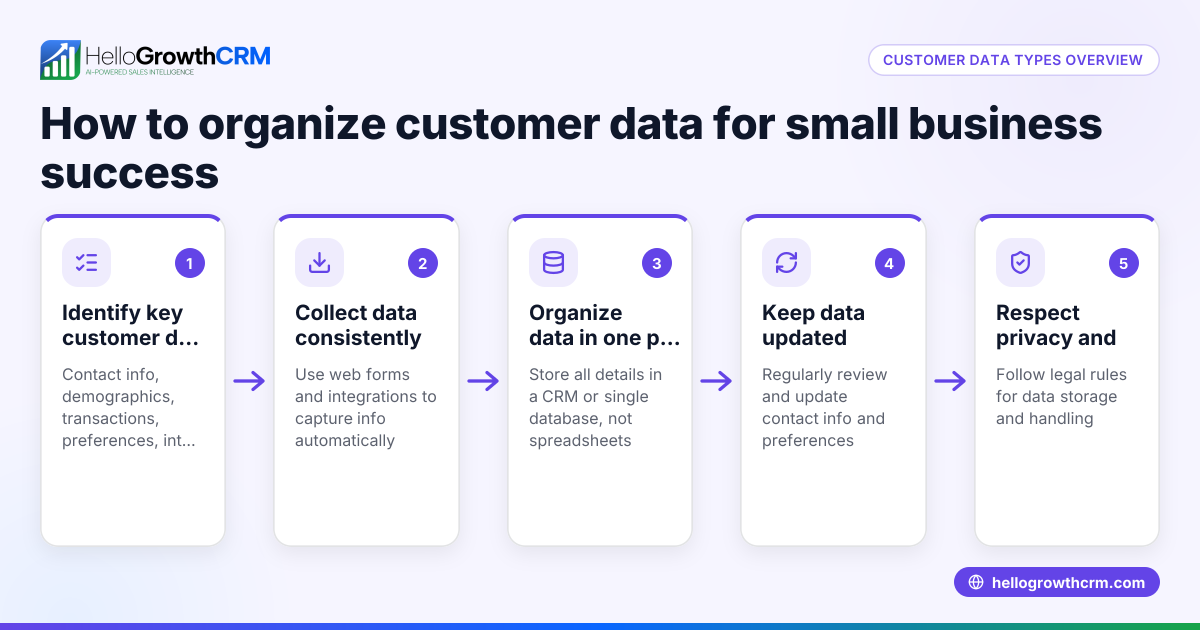
- Identify your data sources and needs: List where customer data currently lives (e.g., web forms, email, WhatsApp, SMS). Check if the platform can capture and unify data from these sources.
- Check data unification and accessibility: Confirm the CDP merges data into a single customer profile accessible to sales and service teams without switching apps.
- Evaluate automation capabilities: Look for features like lead scoring, email or SMS sequences, and task boards to speed up follow-up and prioritize leads.
- Assess compliance and security: Verify if the CDP supports data residency requirements and privacy laws relevant to your business.
- Consider post-sale support features: Ensure the platform tracks service requests, referrals, and knowledge bases linked to customer records for seamless support.
- Test user experience and adoption: Choose a system your team will actually use daily, avoiding complex or disconnected tools.
- Review reporting and forecasting: Confirm it provides sales pipeline visibility and forecasting to guide decision-making.
- Compare costs and scalability: Understand pricing and how the platform can grow with your business.
Example (fictional figures)
A B2B software reseller in Denver, Colorado, wants to improve lead follow-up and customer support. They currently track leads in spreadsheets and communicate by email and WhatsApp.
- Monthly leads: 300
- Average deal size: $4,000
- Current conversion rate: 15%
They invest in a CDP that automates lead capture from web forms and WhatsApp, scores leads with AI, and sequences follow-up messages.
Expected improvements:
- Conversion rate increases to 20%
- Sales cycle shortens by 10%
Calculations:
Leads per month = 300
Current monthly sales = 300 × 15% = 45 deals
Current monthly revenue = 45 × $4,000 = $180,000
New monthly sales = 300 × 20% = 60 deals
New monthly revenue = 60 × $4,000 = $240,000
Increase in revenue = $240,000 - $180,000 = $60,000
Shorter sales cycle means faster cash flow and less sales effort per deal.
This example shows how a CDP can directly impact revenue and efficiency.
Common mistakes
- Ignoring data integration needs: Choosing a CDP that doesn’t connect to key channels like WhatsApp or email causes data gaps. Prevent this by mapping all data sources first.
- Overlooking user adoption: Complex platforms that sales teams avoid lead to wasted investment. Choose tools with intuitive interfaces and relevant automation like task boards.
- Neglecting compliance: Not verifying data residency or privacy compliance risks legal issues. Check features like data residency options and privacy law support.
- Focusing only on acquisition: Not using the CDP for post-sale customer service misses opportunities to retain and upsell. Ensure the platform supports tickets and customer portals on the same record.
- Skipping reporting evaluation: Without sales forecasting and pipeline reports, it’s hard to measure ROI. Confirm the CDP offers clear reporting.
- Underestimating scalability: A platform that fits today but can’t grow with your business causes costly migrations later. Evaluate long-term needs.
Doing this in HelloGrowthCRM
HelloGrowthCRM has completed a SOC 2 Type II examination and supports CCPA data-subject rights. After the sale, service requests, referrals, and support tickets stay linked on the same customer record as the deal, ensuring seamless customer service and follow-up. Learn more about these features in the customer health score section and how HelloGrowthCRM integrates WhatsApp and SMS for sales teams in the WhatsApp and SMS CRM overview. For US businesses, details are available at HelloGrowthCRM for the United States.
Frequently asked questions
What is the main benefit of a customer data platform? A CDP centralizes customer data from multiple sources into unified profiles. This enables faster, more personalized sales and support, reducing lost leads and improving conversion rates.
How does a CDP improve sales follow-up? By automating lead capture, scoring, and communication sequences across channels like email, WhatsApp, and SMS, a CDP helps sales teams prioritize and engage leads quickly without manual tracking.
Can a CDP help with customer service after the sale? Yes. Some CDPs, like HelloGrowthCRM, keep service tickets, referrals, and knowledge bases linked to the customer record, so support teams have full context and can resolve issues efficiently.
What compliance features should I look for in a CDP? Check for data residency options if your business has local storage requirements, and support for privacy laws like CCPA or GDPR to protect customer rights.
Is a CDP suitable for small businesses? Yes, especially those with multiple communication channels and growing sales teams. A CDP streamlines data management and automates repetitive tasks, saving time and reducing errors.
Key takeaways
- A customer data platform unifies scattered customer data to improve sales and service.
- Evaluate CDPs based on data integration, automation, compliance, and user adoption.
- Avoid common mistakes like ignoring post-sale support and compliance needs.
- HelloGrowthCRM offers secure data residency and keeps service requests linked to deals.
- Use reporting and forecasting features to track CDP impact on your business.
Start managing your customer data effectively with a system designed for your sales and service teams. Start on the Free Forever plan (200 leads, no credit card) today.
Ready to put this into practice?
Set up your pipeline, WhatsApp follow-ups, and AI lead scoring in minutes — free, no credit card.
Try HelloGrowthCRM freeGet CRM tips in your inbox
Join thousands of sales professionals who get weekly insights on CRM strategy, AI automation, and pipeline optimization.

The HelloGrowthCRM team publishes guides on CRM strategy, AI sales tools, and revenue operations for small business sales teams.