HelloGrowthCRM software
Built for real small-business sales teams
HelloGrowthCRM helps reps qualify faster, follow up on time, and close more deals—with practical automation in one place.
- AI lead scoring and pipeline visibility
- Built-in dialer, WhatsApp, and email automation
- Sales forecasting and RevOps-ready reporting
A customer messaging platform is software that lets your business communicate with customers efficiently through channels like WhatsApp, SMS, and email. This article covers why small businesses need one, step-by-step selection tips, common pitfalls, a practical example, and how HelloGrowthCRM supports customer messaging after the sale.
Why this comes up / what goes wrong
Small-business owners often find themselves juggling customer communication across multiple tools: text messages, email threads, spreadsheets, and even phone calls. This scattered approach leads to slow follow-up, lost leads, and difficulty tracking customer history. When customers ask questions or request support, teams waste time searching for previous conversations or switching apps. As a result, sales opportunities slip away and customer satisfaction drops.
Evaluating a customer messaging platform comes up because business owners want to centralize communication, speed up responses, and keep a clear record of every interaction in one place. They want a system their team will actually use daily without adding complexity.
Step-by-step
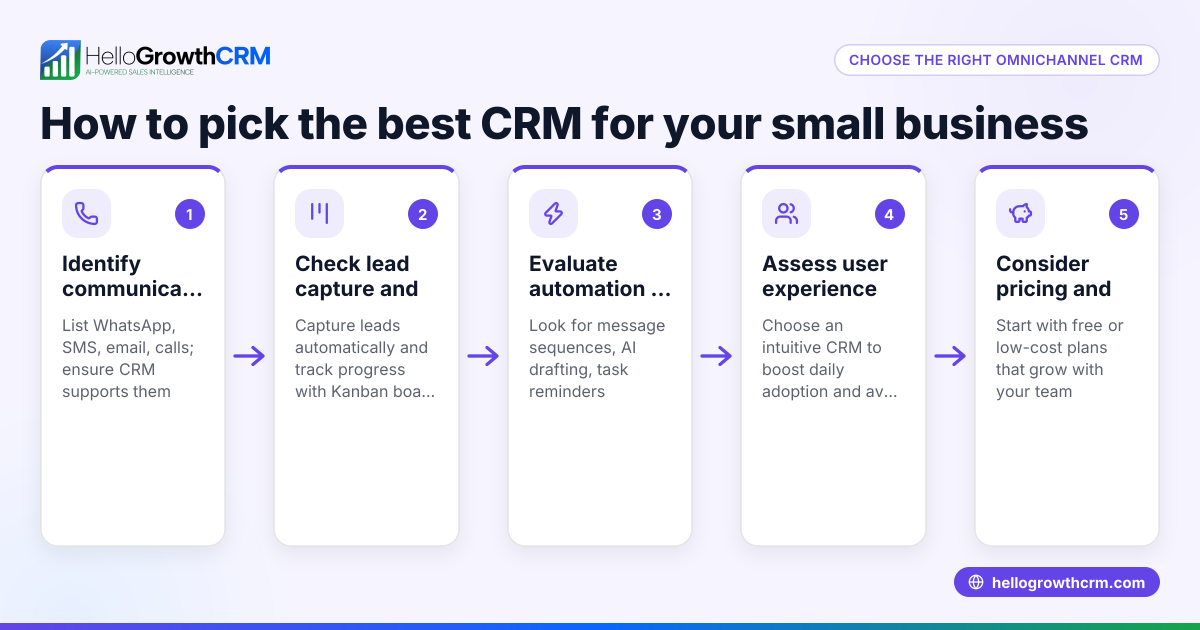
- Identify your communication channels: List where your customers prefer to reach you — WhatsApp, SMS, email, phone calls, or others. Check if the platform supports these channels directly or via integrations.
- Check for unified inbox and message history: Ensure the platform consolidates all messages from different channels in one inbox with easy access to past conversations. This prevents lost context.
- Evaluate automation features: Look for tools like message sequences, chatbots, or AI lead scoring to automate follow-ups and prioritize hot leads.
- Assess team collaboration tools: Confirm the platform allows multiple users to manage conversations, assign tickets, and share notes internally.
- Verify customer data integration: The platform should link messaging with customer records, deals, and support tickets to maintain a complete view of customer interactions.
- Test ease of use and adoption: Choose a solution with a simple interface that your team can learn quickly to avoid poor adoption.
- Review reporting and forecasting: Sales and support reporting features help you track response times, message volumes, and forecast sales pipeline health.
- Consider scalability and pricing: Pick a platform that fits your current team size and can grow as your business expands.
For more on tracking customer status, see customer health score.
Example (fictional figures)
A plumbing company in Austin, Texas, wants to improve customer messaging. Currently, they lose about 15% of leads due to slow responses.
- Monthly leads: 200
- Average sale value: $1,200
- Conversion rate before platform: 40%
They adopt a messaging platform to speed follow-up and automate reminders.
After implementation:
- Conversion rate increases to 50%
- Sales increase = (200 leads × 50% conversion) × $1,200 = $120,000
- Previous sales = (200 leads × 40% conversion) × $1,200 = $96,000
- Sales uplift = $120,000 - $96,000 = $24,000
This $24,000 monthly increase justifies the platform investment.
Common mistakes
- Choosing a platform that doesn’t support key channels: Prevent by confirming channel support upfront.
- Ignoring team collaboration features: Prevent by testing multi-user capabilities to avoid message overlaps.
- Overlooking integration with customer records: Prevent by verifying if service requests and communication stay linked to the same customer record, like in HelloGrowthCRM.
- Selecting complex software with poor usability: Prevent by involving your team in trials and choosing simple interfaces.
- Not planning for growth: Prevent by choosing scalable solutions that fit your business size now and later.
- Failing to review reporting tools: Prevent by checking available metrics to track messaging effectiveness and sales forecasting.
Learn more about messaging on WhatsApp and SMS with WhatsApp and SMS CRM.
Doing this in HelloGrowthCRM
HelloGrowthCRM offers a branded self-service customer portal, referral program tracking, support tickets, and a knowledge base. After the sale, service requests stay on the same customer record as the deal, keeping all communication and history unified. This helps sales and support teams respond faster and keep customers satisfied. Learn more at HelloGrowthCRM for the United States.
Frequently asked questions
What is a customer messaging platform? A customer messaging platform is software that centralizes communication between a business and its customers across channels like WhatsApp, SMS, and email. It helps manage conversations, automate follow-ups, and keep customer history in one place.
How does a messaging platform improve sales? By speeding up follow-up and automating message sequences, a platform reduces lost leads and increases conversion rates. It also provides insights through reporting to optimize sales efforts.
Can small businesses afford customer messaging platforms? Many platforms offer scalable pricing and free plans suitable for small businesses. It's important to evaluate features that improve efficiency and customer satisfaction to justify the cost.
Why is integration with customer records important? Integration ensures all communications and support requests are linked to the same customer profile. This gives your team full context and avoids duplicated efforts or missed information.
What should I look for in customer messaging software? Look for channel support, unified inbox, automation, team collaboration, customer data integration, ease of use, and reporting features. Testing the software before buying is crucial.
Key takeaways
- A customer messaging platform centralizes communication on channels your customers use.
- Choose platforms that unify messages, automate follow-up, and integrate with customer records.
- Avoid platforms that lack team collaboration or are too complex to adopt.
- Evaluate scalability and reporting features to support growth and track performance.
- HelloGrowthCRM keeps service requests and messaging linked on the same customer record for better customer care.
Start your customer messaging journey with confidence. Start on the Free Forever plan (200 leads, no credit card) to see how HelloGrowthCRM can help.
Ready to put this into practice?
Set up your pipeline, WhatsApp follow-ups, and AI lead scoring in minutes — free, no credit card.
Try HelloGrowthCRM freeGet CRM tips in your inbox
Join thousands of sales professionals who get weekly insights on CRM strategy, AI automation, and pipeline optimization.

The HelloGrowthCRM team publishes guides on CRM strategy, AI sales tools, and revenue operations for small business sales teams.