HelloGrowthCRM software
Built for real small-business sales teams
HelloGrowthCRM helps reps qualify faster, follow up on time, and close more deals—with practical automation in one place.
- AI lead scoring and pipeline visibility
- Built-in dialer, WhatsApp, and email automation
- Sales forecasting and RevOps-ready reporting
A customer statement is a financial summary document sent to a customer that details all transactions between them and your business within a specific period. It includes invoices issued, payments received, credit notes, and the resulting balance owed or in credit. Sending customer statements helps clarify accounts, reduce payment delays, and improve cash flow visibility for your business.
Why this comes up / what goes wrong
Many small and mid-sized UK businesses struggle with managing customer payments and outstanding balances. When sales are run through multiple channels like WhatsApp, email, and spreadsheets, it becomes difficult to keep accurate, consolidated records. Customers may forget invoices or dispute amounts if they lack clear statements. Without regular statements, payment delays and errors become common, affecting your cash flow.
A customer statement provides a clear overview of the customer's account activity, helping both parties verify transactions and outstanding balances. It supports better communication and reduces the risk of disputes or missed payments.
Step-by-step
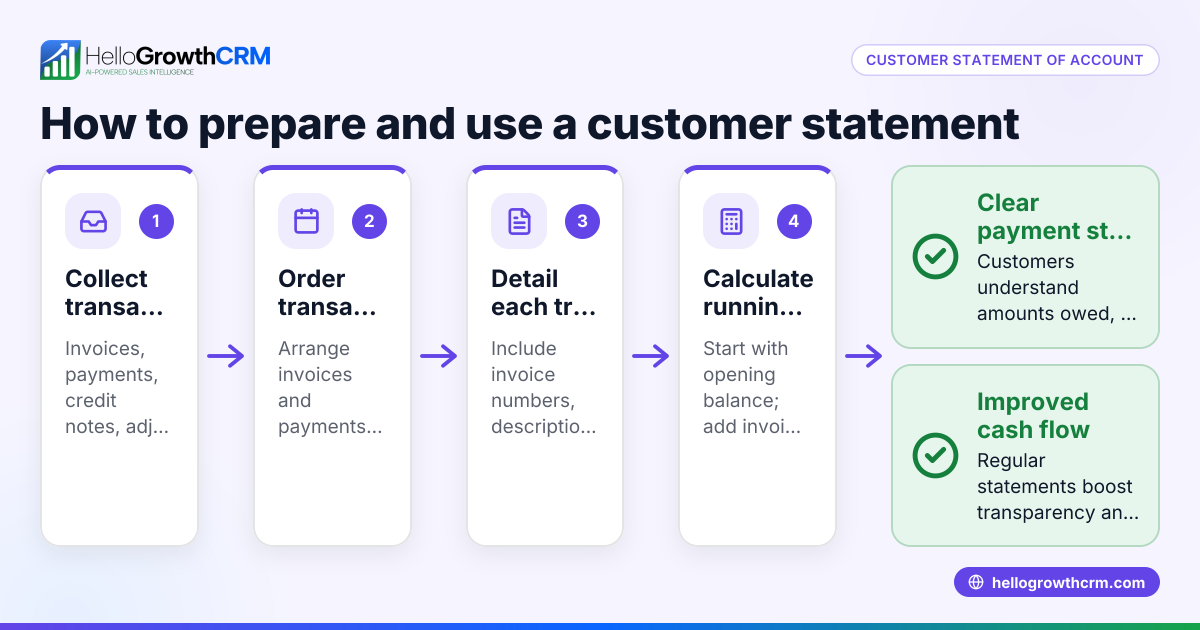
- Collect all transaction data: Gather every invoice, payment, credit note, and adjustment related to the customer within the chosen statement period. Check your records carefully to ensure no transactions are missing.
- Define the statement period: Decide the date range the statement will cover, such as monthly or quarterly. Consistency helps customers anticipate and understand the statements.
- List all invoices issued: Include invoice numbers, issue dates, due dates, and amounts. This transparency helps customers match payments to invoices.
- List all payments received: Show payment dates and amounts credited against invoices. Include any partial payments and credit notes.
- Calculate the opening balance: Determine the amount owed or credited before the statement period starts. This sets the starting point for the statement.
- Calculate the closing balance: Add the total of invoices issued during the period to the opening balance, then subtract payments received. This shows the current amount owed or in credit.
- Check for accuracy: Verify that all transactions are included and totals are correct. Double-check dates and amounts against your accounting records.
- Send the statement: Deliver it to your customer by email or their preferred communication method. Electronic delivery is common and efficient.
- Follow up on outstanding amounts: Use the statement to send payment reminders or discuss any issues. Prompt follow-up helps reduce overdue payments.
For more on managing customer interactions and tracking their status, see customer health score.
Example (fictional figures)
A kitchen-fitting company in Leeds wants to send a customer statement covering 01/03/2026 to 31/03/2026.
- Opening balance on 01/03/2026: £1,200 owed
- Invoice 101 issued 05/03/2026: £3,500
- Invoice 102 issued 20/03/2026: £1,800
- Payment received 25/03/2026: £2,000
Calculations:
Opening balance = £1,200 Invoice 101 = £3,500 Invoice 102 = £1,800 Total invoices = £3,500 + £1,800 = £5,300 Payments received = £2,000 Closing balance = Opening balance + Total invoices - Payments received Closing balance = £1,200 + £5,300 - £2,000 = £4,500
The statement will show these transactions and the closing balance of £4,500 owed.
Common mistakes
- Missing transactions: Forgetting to include all invoices or payments leads to inaccurate balances. Prevent this by reconciling your records before preparing the statement.
- Incorrect dates: Using wrong invoice or payment dates confuses customers. Always verify dates against your accounting records.
- Not following up: Sending statements without follow-up reduces their effectiveness. Use reminders or calls to chase overdue payments.
- Using multiple unconnected tools: Managing sales via WhatsApp, email, and spreadsheets causes delays and errors. Consolidate communication and records where possible, for example with a CRM.
- Sending statements irregularly: Infrequent statements may cause confusion and delayed payments. Set a regular schedule, such as monthly or quarterly.
- Ignoring customer disputes: Failing to address disputes quickly can damage relationships. Use support tickets or direct communication to resolve issues.
To avoid these, consider tools like WhatsApp and SMS CRM to keep all customer communication and transactions in one place.
Doing this in HelloGrowthCRM
HelloGrowthCRM provides a branded self-service customer portal that allows customers to view their transaction history and service requests. After the sale, service requests and support tickets stay linked on the same customer record as the deal, making it easier to track all interactions and payments in one place. This helps reduce errors and improves customer communication. Learn more about these features at HelloGrowthCRM for the United Kingdom.
Frequently asked questions
What is the difference between a customer statement and an invoice? A customer statement summarises all transactions over a period, including multiple invoices and payments, showing a running balance. An invoice is a single request for payment for specific goods or services.
How often should I send customer statements? Most businesses send statements monthly or quarterly. The frequency depends on your sales volume and customer preferences. Regular statements help keep accounts clear and payments timely.
Can I send customer statements electronically? Yes, electronic statements via email or customer portals are common and efficient. HelloGrowthCRM supports a customer portal where customers can view their transaction history and service requests.
What if a customer disputes a transaction on the statement? Encourage them to raise a support ticket or contact you directly. Keeping all communication and tickets linked to the customer record helps resolve disputes quickly.
How does a customer statement help with cash flow? By clearly showing outstanding balances, statements prompt customers to pay on time, improving your cash flow visibility and reducing overdue debts.
Key takeaways
- A customer statement lists all transactions and the balance owed over a set period.
- Preparing statements requires accurate transaction data and careful review.
- Sending statements regularly improves payment collections and reduces disputes.
- Avoid mistakes by reconciling records and consolidating communication.
- HelloGrowthCRM’s customer portal and ticketing keep all post-sale info on one record.
Start managing your customer statements and records efficiently with HelloGrowthCRM. Start on the Free Forever plan (200 leads, no credit card).
Ready to put this into practice?
Set up your pipeline, WhatsApp follow-ups, and AI lead scoring in minutes — free, no credit card.
Try HelloGrowthCRM freeGet CRM tips in your inbox
Join thousands of sales professionals who get weekly insights on CRM strategy, AI automation, and pipeline optimization.

The HelloGrowthCRM team publishes guides on CRM strategy, AI sales tools, and revenue operations for small business sales teams.