HelloGrowthCRM software
Built for real small-business sales teams
HelloGrowthCRM helps reps qualify faster, follow up on time, and close more deals—with practical automation in one place.
- AI lead scoring and pipeline visibility
- Built-in dialer, WhatsApp, and email automation
- Sales forecasting and RevOps-ready reporting
Dealing with customers means managing interactions to meet their needs, solve problems, and build lasting relationships that support your business growth. This article explains why customer management matters, provides step-by-step actions to handle customers well, highlights common mistakes to avoid, and shows how HelloGrowthCRM can help keep your customer records organized after the sale.
Why this comes up / what goes wrong
Small and mid-sized business owners often face challenges when dealing with customers because they juggle many roles and lack dedicated customer service teams. Common issues include slow response times, losing track of customer requests, and inconsistent follow-up. These problems lead to dissatisfied customers, lost sales, and damaged reputations. Without a clear process, managing customers through text messages, emails, and spreadsheets becomes chaotic, making it hard to provide a smooth experience.
Step-by-step
- Listen carefully and understand the customer’s need: When a customer reaches out, focus fully on their issue or request. Check that you have all the necessary details before responding.
- Respond promptly and clearly: Aim to reply quickly to show you value the customer’s time. Use simple language and confirm you understood their question or concern.
- Record the interaction and next steps: Keep a note of each customer contact and what was agreed upon. Check that you have a system to track these notes, whether digital or manual.
- Follow up as promised: If you need to check something or escalate the issue, set a reminder to follow up by the agreed date. Check that the customer received your update.
- Resolve the issue or fulfill the request: Take the necessary action to solve the problem or deliver the product/service. Verify that the customer is satisfied with the outcome.
- Ask for feedback or referrals: After resolving the customer’s need, invite them to provide feedback or refer others. Check that you have a way to gather and use this feedback for improvement.
- Keep customer data organized: Maintain all customer interactions, service requests, and deals in one place. Regularly review and update records to avoid lost information.
Following these steps helps you build trust, reduce errors, and improve customer retention. For managing customer health and service requests, explore how a customer health score can give you insights.
Example (fictional figures)
A two-location dental practice in Columbus, Ohio, wants to improve how it handles patient inquiries and appointment requests.
- On 03/15/2026, a patient calls to reschedule a cleaning appointment costing $150.
- Step 1: The receptionist notes the patient’s name, original appointment date, and new preferred date.
- Step 2: She responds within 30 minutes confirming availability for 03/22/2026.
- Step 3: She records the change in the appointment system.
- Step 4: She sets a reminder to call the patient on 03/21/2026 to confirm the appointment.
- Step 5: On 03/21/2026, the receptionist calls and confirms the appointment.
- Step 6: After the visit, the dentist’s office sends a feedback survey.
This process ensures no missed appointments and keeps patients satisfied.
Common mistakes
- Ignoring or delaying responses: Prevent by setting response time goals and reminders.
- Scattered customer information: Prevent by centralizing data in one system.
- Overpromising and underdelivering: Prevent by only committing to what you can realistically deliver.
- Not following up: Prevent by using task boards or reminders to track follow-ups.
- Failing to ask for feedback or referrals: Prevent by building this into your customer interaction process.
- Not training staff on customer handling: Prevent by providing clear guidelines and regular training.
Using an AI CRM like HelloGrowthCRM helps avoid these mistakes by organizing customer data and automating follow-ups.
Doing this in HelloGrowthCRM
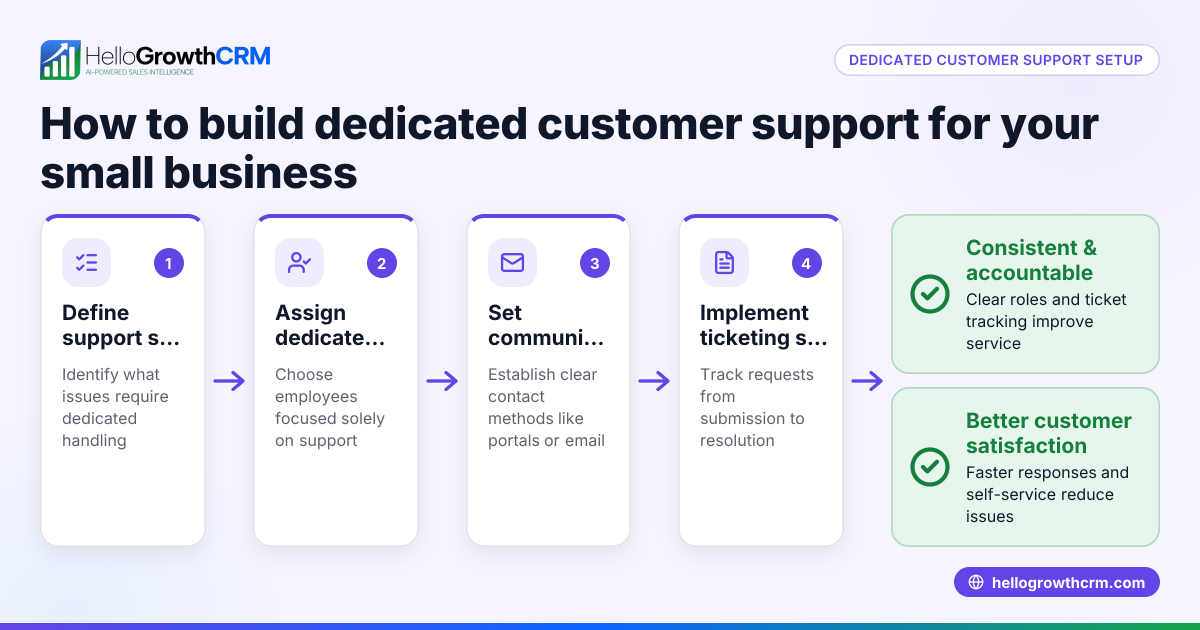
HelloGrowthCRM offers a branded self-service customer portal where customers can submit service requests directly. After the sale, all tickets and service requests stay linked on the same customer record as the deal, making it easy to track history and respond efficiently. The system supports referrals and includes a knowledge base to help customers find answers independently. This centralization reduces lost information and speeds up response times.
Learn more about HelloGrowthCRM for the United States at hellogrowthcrm.com/usa.
Frequently asked questions
How can I improve communication with my customers? Start by responding promptly and clearly. Use consistent channels like email or WhatsApp and keep records of all interactions. Tools like HelloGrowthCRM can help automate and track messages to avoid missed replies.
What is the best way to handle customer complaints? Listen carefully without interrupting, acknowledge the issue, and offer a clear plan to resolve it. Follow up to ensure the customer is satisfied. Document the complaint and resolution for future reference.
How do I keep track of multiple customer requests? Use a centralized system that links all requests to each customer’s profile. This helps you see the full history and current status at a glance. HelloGrowthCRM’s ticket and customer portal features support this.
Why should I ask for customer referrals? Referrals bring in new business with lower marketing costs and often higher trust. After a positive interaction, asking customers for referrals can expand your network effectively.
Can I manage customer service without software? Yes, but it requires disciplined manual tracking using notebooks or spreadsheets. This is prone to errors and lost information. Using a CRM simplifies managing customer data and follow-ups.
Key takeaways
- Listen carefully and respond promptly to customer needs.
- Record and organize all customer interactions in one place.
- Follow up as promised to build trust and satisfaction.
- Avoid common mistakes like delayed responses and scattered data.
- Use tools like HelloGrowthCRM to centralize service requests and referrals.
- Regularly ask for feedback and referrals to grow your business.
Start managing your customers more effectively today. Start on the Free Forever plan (200 leads, no credit card) with HelloGrowthCRM.
Ready to put this into practice?
Set up your pipeline, WhatsApp follow-ups, and AI lead scoring in minutes — free, no credit card.
Try HelloGrowthCRM freeGet CRM tips in your inbox
Join thousands of sales professionals who get weekly insights on CRM strategy, AI automation, and pipeline optimization.

The HelloGrowthCRM team publishes guides on CRM strategy, AI sales tools, and revenue operations for small business sales teams.