HelloGrowthCRM software
Built for real small-business sales teams
HelloGrowthCRM helps reps qualify faster, follow up on time, and close more deals—with practical automation in one place.
- AI lead scoring and pipeline visibility
- Built-in dialer, WhatsApp, and email automation
- Sales forecasting and RevOps-ready reporting
Demand forecasting methods are techniques used to estimate future customer demand for products or services. Common methods include qualitative approaches like expert opinion and quantitative approaches such as time series analysis and causal models. This article explains why demand forecasting matters for small businesses, walks you through practical steps, highlights common mistakes, and shows how HelloGrowthCRM can help with pipeline forecasting and AI insights.
Why this comes up / what goes wrong
Small-business owners often struggle with managing inventory, staffing, and cash flow because they don’t accurately predict how much product or service customers will want. Without a reliable demand forecast, they risk ordering too much stock, leading to excess inventory and tied-up cash, or too little, causing missed sales and unhappy customers. Many rely on gut feeling or past sales alone, which can miss seasonal trends, market changes, or new customer behaviors. This makes demand forecasting methods essential for planning and growth.
Step-by-step
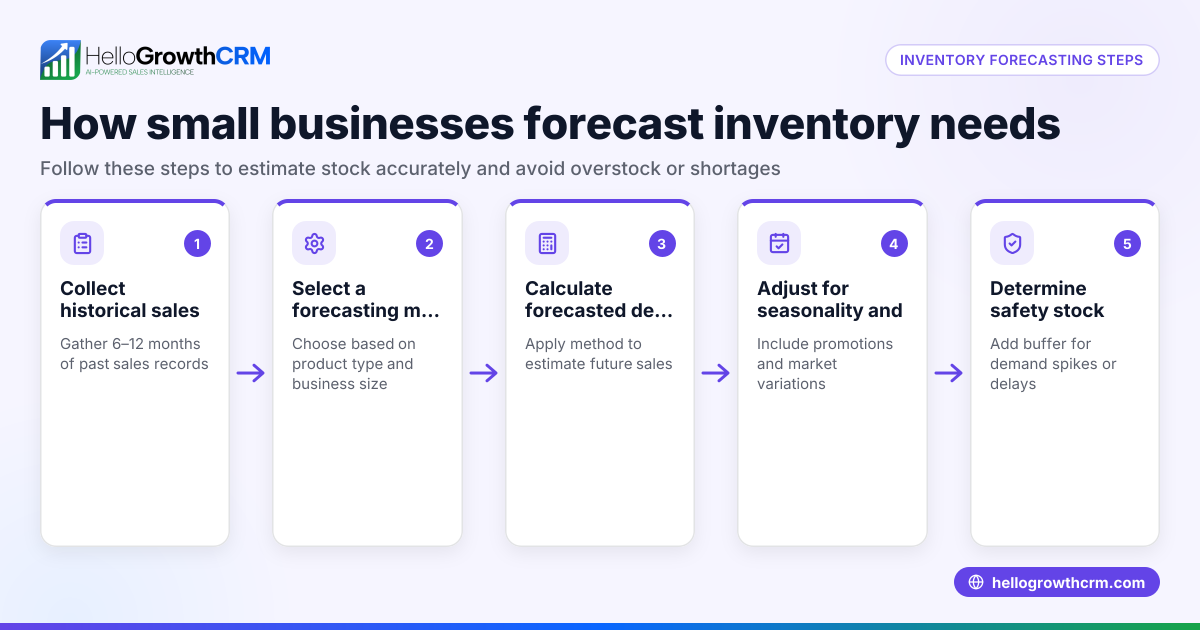
- Collect historical sales data: Gather your past sales records over months or years. Check for completeness and accuracy.
- Choose a forecasting method: Decide between qualitative methods (like expert opinion or customer surveys) or quantitative methods (like time series or causal models).
- Analyze patterns: Look for trends, seasonal spikes, or irregular fluctuations in your sales data.
- Apply the forecasting model: Use chosen formulas or software tools to project future demand based on your data.
- Validate the forecast: Compare predictions against actual sales to check accuracy and adjust your method as needed.
- Incorporate external factors: Consider market changes, promotions, competitor actions, or economic conditions that could affect demand.
- Review and update regularly: Forecasts should be revisited frequently to reflect new information and maintain accuracy.
Example (fictional figures)
A plumbing company in Austin, Texas, wants to forecast demand for drain cleaning services for the next quarter.
- Historical sales for the last quarter (3 months):
- January: 300 jobs
- February: 270 jobs
- March: 330 jobs
- Step 1: Calculate the average monthly demand: 300 + 270 + 330 = 900 900 ÷ 3 = 300 jobs per month
- Step 2: Identify a seasonal trend: March is 10% higher than average.
- Step 3: Forecast for next quarter (April, May, June): Assume April and May are average, June is 10% higher. April forecast = 300 jobs May forecast = 300 jobs June forecast = 300 × 1.10 = 330 jobs
- Step 4: Total forecast for the quarter: 300 + 300 + 330 = 930 jobs
This simple method helps the company plan staffing and inventory for parts.
Common mistakes
- Ignoring seasonality: Prevent by analyzing data month-by-month to spot patterns.
- Overreliance on past data without adjustment: Prevent by including market or economic changes.
- Using overly complex models without enough data: Prevent by choosing methods appropriate to your data size.
- Failing to validate forecasts regularly: Prevent by comparing forecasts to actual sales and adjusting.
- Neglecting qualitative insights: Prevent by combining data analysis with expert opinions or customer feedback.
Doing this in HelloGrowthCRM
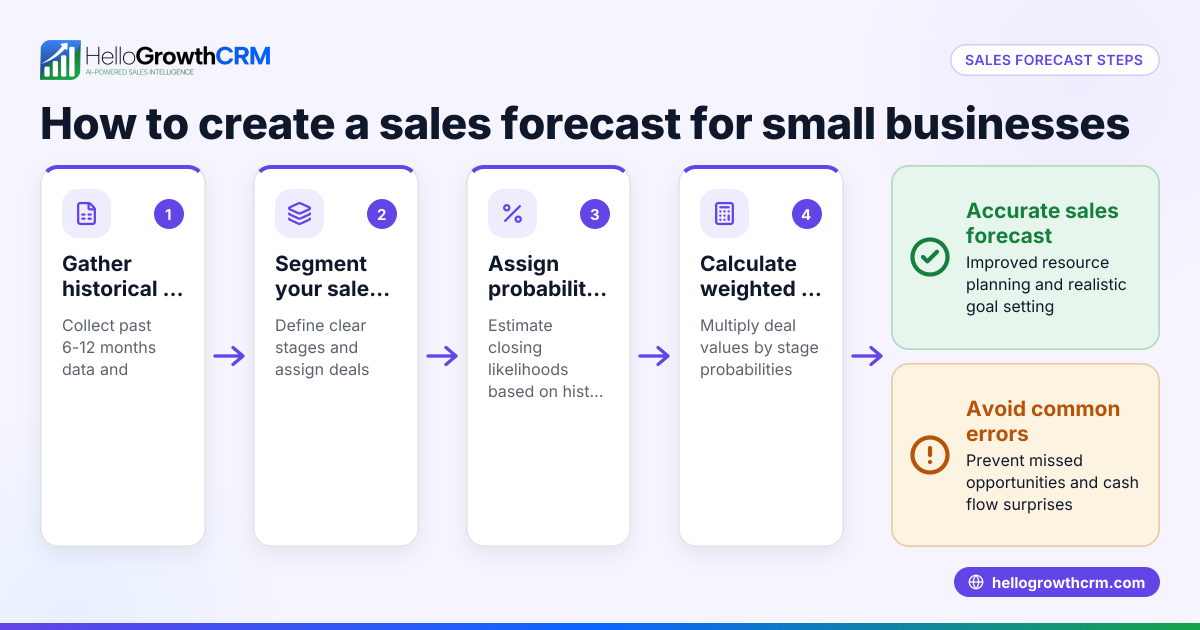
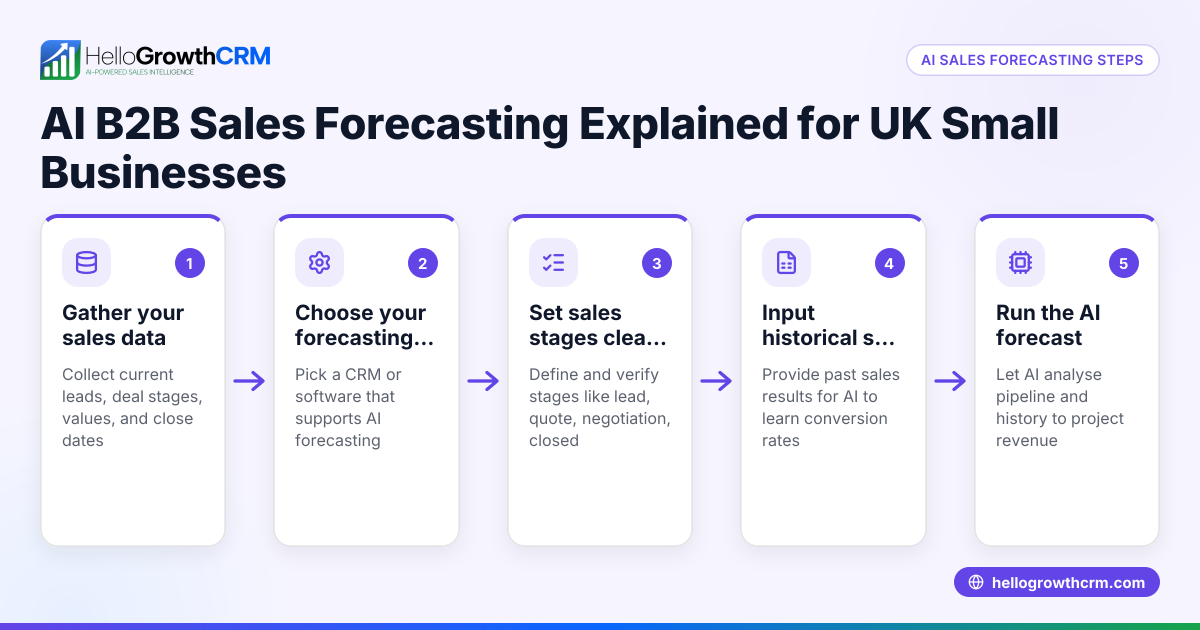
HelloGrowthCRM offers pipeline forecast and AI insights that help you see which stage deals are stalling without building spreadsheets. This AI-assisted revenue forecasting projects expected close amounts based on your current pipeline stage, velocity, and historical conversion patterns. It also provides analysis of pipeline health and sales signals to help you adjust your demand plans quickly. Learn more about sales forecasting and how an AI CRM can support your business.
Frequently asked questions
What are the main types of demand forecasting methods? There are qualitative methods like expert opinion and market research, and quantitative methods such as time series analysis, causal models, and moving averages. Qualitative methods rely on judgment, while quantitative methods use historical data and mathematical models.
How often should I update my demand forecast? You should review and update forecasts regularly—monthly or quarterly—depending on how fast your market changes. Frequent updates help you respond to new trends, sales patterns, or external factors.
Can demand forecasting help with cash flow management? Yes. Accurate demand forecasting helps you plan inventory purchases, staffing, and marketing spend, which directly affects your cash flow by avoiding overstock or stockouts.
How is demand forecasting different from sales forecasting? Demand forecasting estimates customer demand for your products or services, often broader and focused on market needs. Sales forecasting predicts your actual sales revenue based on deals in progress and sales pipeline, which HelloGrowthCRM supports with AI insights.
What if I don’t have enough historical data? If data is limited, start with qualitative methods like expert opinion or customer surveys. As you collect more data, you can move to quantitative models for improved accuracy.
How can technology improve demand forecasting? Technology like AI CRM tools can analyze large datasets quickly, identify patterns, and provide real-time insights, making forecasts more accurate and easier to update.
Key takeaways
- Demand forecasting methods estimate future customer demand using qualitative or quantitative approaches.
- Collect accurate sales data and analyze trends before applying forecasting models.
- Regularly validate and update forecasts to maintain accuracy.
- Avoid common mistakes like ignoring seasonality or neglecting qualitative insights.
- HelloGrowthCRM’s pipeline forecast and AI insights help spot deal stalls and improve revenue predictions.
Start improving your demand forecasting today with HelloGrowthCRM. Start on the Free Forever plan (200 leads, no credit card) to see how pipeline forecasting can support your small business.
Ready to put this into practice?
Set up your pipeline, WhatsApp follow-ups, and AI lead scoring in minutes — free, no credit card.
Try HelloGrowthCRM freeGet CRM tips in your inbox
Join thousands of sales professionals who get weekly insights on CRM strategy, AI automation, and pipeline optimization.

The HelloGrowthCRM team publishes guides on CRM strategy, AI sales tools, and revenue operations for small business sales teams.