HelloGrowthCRM software
Built for real small-business sales teams
HelloGrowthCRM helps reps qualify faster, follow up on time, and close more deals—with practical automation in one place.
- AI lead scoring and pipeline visibility
- Built-in dialer, WhatsApp, and email automation
- Sales forecasting and RevOps-ready reporting
Inventory forecasting methods help small businesses predict how much inventory to keep on hand to meet customer demand without overstocking or running out. These methods use past sales data, seasonal trends, and market conditions to estimate future stock needs. This article covers why inventory forecasting is important, detailed steps to create forecasts, a worked example with US dollar figures, common mistakes to avoid, and how pipeline forecast and AI insights can assist your planning.
Why this comes up / what goes wrong
Small business owners often face challenges managing inventory effectively. Ordering too much inventory ties up cash and storage space, while ordering too little leads to missed sales and dissatisfied customers. Without reliable forecasting methods, owners may rely on guesswork or outdated spreadsheets, resulting in poor purchasing decisions, increased costs, and lost revenue. Understanding inventory forecasting methods helps owners plan stock levels accurately, improve cash flow, and maintain customer satisfaction.
Step-by-step
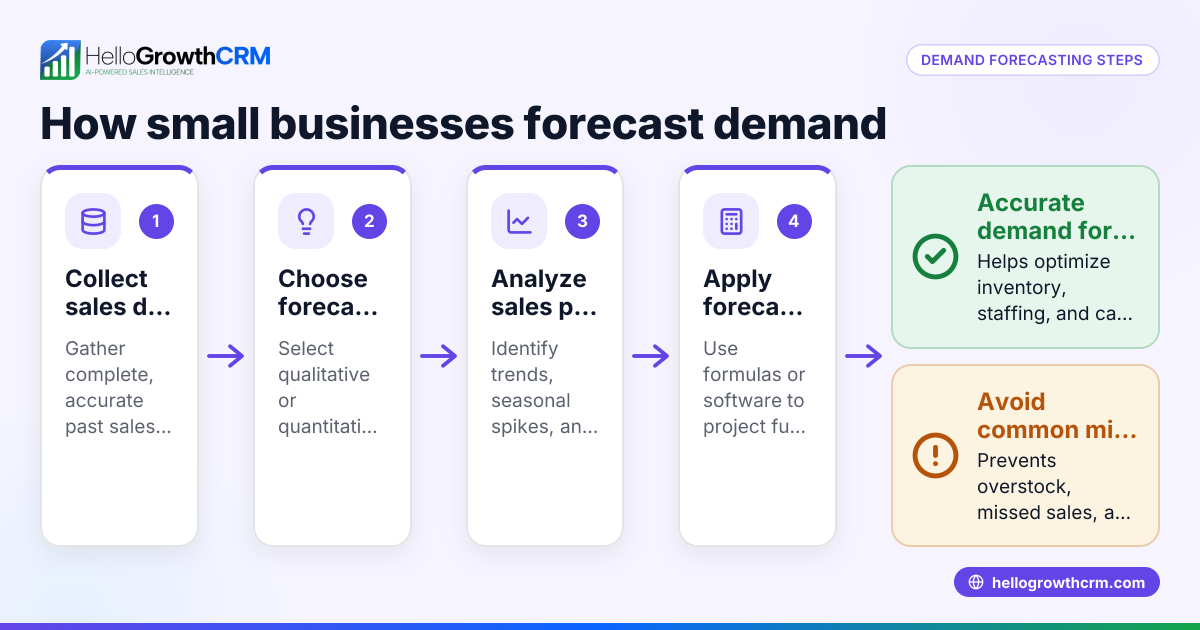
- Collect historical sales data: Gather 6 to 12 months of sales records to identify demand patterns.
- Select a forecasting method: Choose a method suitable for your product type and business size, such as moving averages, exponential smoothing, or causal models.
- Calculate forecasted demand: Apply the chosen method to estimate future sales quantities for each product.
- Adjust for seasonality and trends: Incorporate known seasonal variations, promotions, or market changes into your forecast.
- Determine safety stock levels: Add a buffer quantity to cover unexpected demand spikes or supply delays.
- Set reorder points and quantities: Define inventory levels that trigger new orders and decide how much to reorder.
- Review and update forecasts regularly: Compare actual sales with forecasts monthly and adjust assumptions as needed.
- Monitor inventory turnover: Ensure stock moves efficiently to avoid excess or obsolete inventory.
For insights on forecasting revenue and pipeline health that impact inventory needs, see sales forecasting.
Example (fictional figures)
A two-location dental practice in Columbus, Ohio, sells dental care products. They want to forecast inventory needs for a popular toothpaste brand for July 2026.
- Historical monthly sales (units): January 500, February 520, March 480, April 550, May 600, June 580
- Calculate 3-month moving average for July forecast:
- (April + May + June) / 3 = (550 + 600 + 580) / 3
- 1,730 / 3 = 576.67 units (rounded to 577 units)
- Adjust for July seasonality (assumed 10% increase):
- 577 × 1.10 = 634.7 units (rounded to 635 units)
- Safety stock (assumed 90 units based on past variability)
- Total inventory needed:
- 635 + 90 = 725 units
If each unit costs $4.50, total inventory value:
- 725 × $4.50 = $3,262.50
They should plan to have 725 units, valued at $3,262.50, available for July to meet expected demand and buffer.
Common mistakes
- Ignoring seasonality: Prevent this by analyzing sales patterns monthly or quarterly and adjusting forecasts accordingly.
- Using outdated or incomplete data: Prevent by regularly updating sales data and including recent market trends.
- Not accounting for supplier lead times: Prevent by factoring delivery times into reorder points.
- Relying on a single forecasting method: Prevent by testing different methods and combining approaches when appropriate.
- Failing to monitor forecast accuracy: Prevent by comparing forecasts with actual sales monthly and refining your methods.
- Neglecting safety stock: Prevent by calculating and maintaining buffer stock to avoid stockouts.
For help identifying sales stages that may affect inventory demand, explore pipeline forecast and AI insights in AI CRM.
Doing this in HelloGrowthCRM
HelloGrowthCRM offers pipeline forecast and AI insights that help small business owners identify which sales stages are stalling without building spreadsheets. This AI-assisted revenue forecasting projects expected close amounts based on your current pipeline stage, velocity, and historical conversion patterns. Understanding your sales pipeline health helps anticipate inventory needs linked to upcoming deals and customer orders. Learn more at HelloGrowthCRM for the United States.
Frequently asked questions
What is the easiest inventory forecasting method for small businesses? The moving average method is simple and effective. It averages sales over a recent period to predict future demand and works well when demand is stable without strong seasonal changes.
How often should I update my inventory forecasts? Monthly updates are recommended to capture recent sales trends, seasonality, and market changes. Regular reviews help adjust purchasing plans and avoid stock issues.
Can inventory forecasting help reduce costs? Yes. Accurate forecasting reduces excess inventory holding costs and prevents lost sales from stockouts. It improves cash flow by aligning purchases with actual demand.
How does sales forecasting relate to inventory forecasting? Sales forecasting predicts future revenue and order volume, which directly impacts inventory needs. Using sales forecasts ensures you stock the right amount of products to meet expected sales.
Do I need software to do inventory forecasting? Basic forecasting can be done with spreadsheets, but software with AI insights and pipeline forecasting can improve accuracy and connect sales data with inventory planning.
Key takeaways
- Inventory forecasting methods estimate future stock needs using sales data and trends.
- Follow clear steps: collect data, choose a method, adjust for seasonality, add safety stock, and review regularly.
- Common mistakes include ignoring seasonality, using outdated data, and not monitoring forecast accuracy.
- Pipeline forecast and AI insights help link sales pipeline health to inventory planning.
- Regular updates improve purchasing decisions and reduce costs.
Start managing your inventory more effectively by starting on the Free Forever plan (200 leads, no credit card).
Ready to put this into practice?
Set up your pipeline, WhatsApp follow-ups, and AI lead scoring in minutes — free, no credit card.
Try HelloGrowthCRM freeGet CRM tips in your inbox
Join thousands of sales professionals who get weekly insights on CRM strategy, AI automation, and pipeline optimization.

The HelloGrowthCRM team publishes guides on CRM strategy, AI sales tools, and revenue operations for small business sales teams.