HelloGrowthCRM software
Built for real small-business sales teams
HelloGrowthCRM helps reps qualify faster, follow up on time, and close more deals—with practical automation in one place.
- AI lead scoring and pipeline visibility
- Built-in dialer, WhatsApp, and email automation
- Sales forecasting and RevOps-ready reporting
Different types of customers include new customers, repeat buyers, loyal customers, discount seekers, and potential leads. Each type behaves differently and requires tailored approaches for sales and service to improve engagement and retention. This article explains why recognising these types matters, provides step-by-step guidance to identify and manage them, a practical example, common mistakes to avoid, and how HelloGrowthCRM supports managing customers after the sale.
Why this comes up / what goes wrong
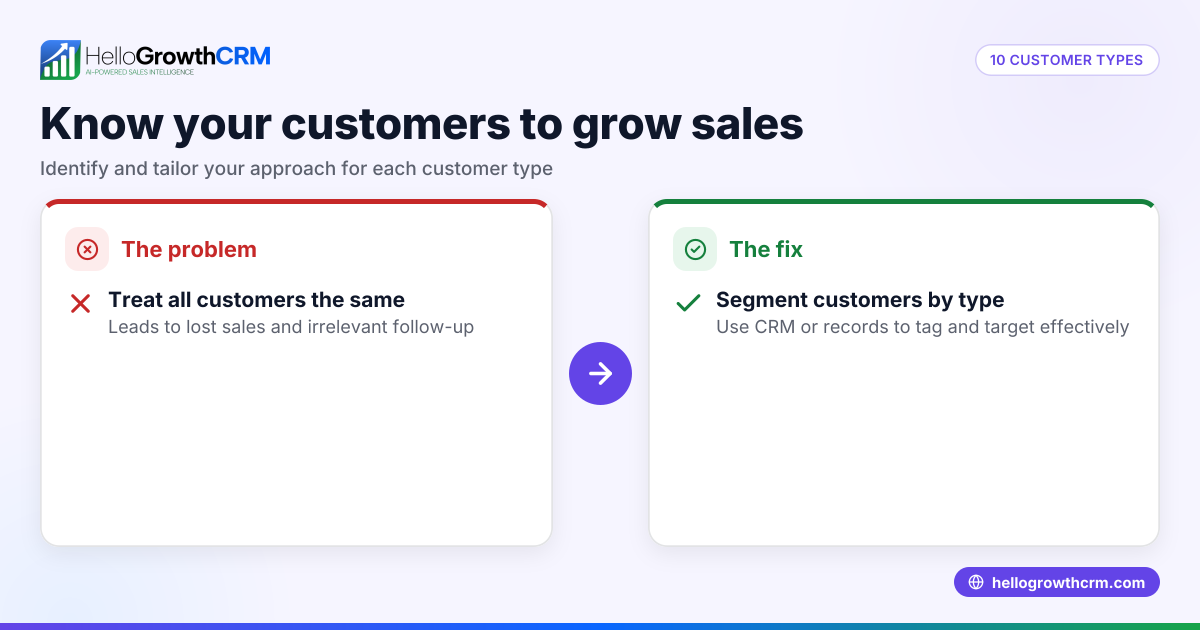
Small business owners in the UK often struggle because they treat all customers the same. This can lead to slow follow-up, missed sales opportunities, and poor customer retention. For example, a loyal customer might want personalised offers and quick support, while a discount seeker only buys when prices drop. Without understanding these differences, sales teams waste time and resources on ineffective communication.
Additionally, many businesses manage customer data across WhatsApp, email, and spreadsheets, which makes it harder to track interactions and service requests efficiently. This scattered approach can cause leads to be lost or service requests to be overlooked, further damaging customer relationships.
Step-by-step
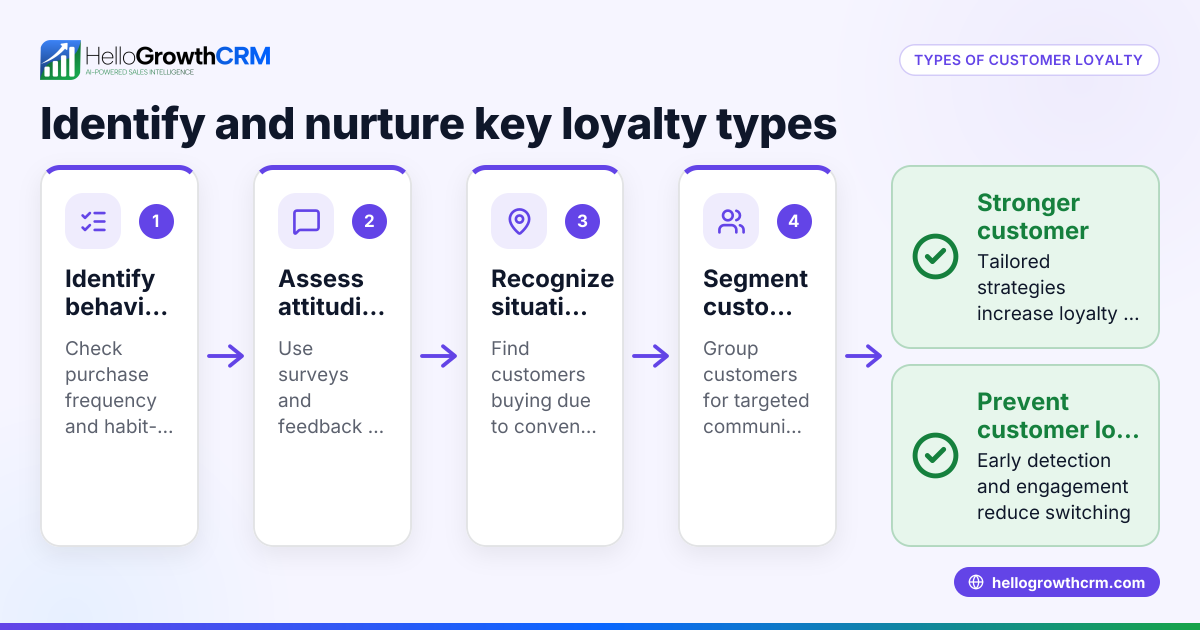
- Identify customer types by behaviour: Review your sales records and communication history. Look at purchase frequency, order size, and how customers interact with your business. Determine if a customer is new, returning, loyal, or primarily seeking discounts.
- Segment your customers: Group customers into categories such as new, repeat, loyal, discount seekers, and potential leads. This segmentation helps you tailor your sales and marketing efforts appropriately.
- Check customer value: Calculate the revenue each customer generates over time. Prioritise high-value customers who contribute most to your business.
- Track communication preferences: Note if customers prefer WhatsApp, email, or SMS. Engaging customers through their preferred channel improves response rates and satisfaction.
- Monitor customer health score: Use metrics like purchase frequency, response time, and satisfaction to assess customer engagement and predict churn. See customer health score for more details.
- Use a CRM to centralise data: Avoid juggling spreadsheets and scattered messages by keeping all customer information and interactions in one place.
- Follow up promptly: Quick responses increase conversion chances, especially for new and potential customers.
- Review and update segments regularly: Customer behaviour changes over time. Update your customer categories every few months to keep your approach relevant.
Example (fictional figures)
An accountancy practice in Birmingham wants to classify its customers as new, repeat, or loyal to improve follow-up and tailor offers.
- Total customers: 300
- New customers this year: 50
- Repeat customers (2-4 visits/year): 150
- Loyal customers (5+ visits/year): 100
Average revenue per customer type:
- New customers average spend: £500
- Repeat customers average spend: £1,500
- Loyal customers average spend: £3,000
Calculate revenue per group:
New customers: 50 × £500 = £25,000 Repeat customers: 150 × £1,500 = £225,000 Loyal customers: 100 × £3,000 = £300,000
Total revenue = £25,000 + £225,000 + £300,000 = £550,000
This shows loyal customers provide the highest revenue. The practice decides to prioritise personalised service and referral incentives for loyal customers and quick follow-up for new customers. They also plan to use WhatsApp and SMS for timely communication, knowing many clients prefer these channels.
Common mistakes
- Treating all customers the same: This wastes resources and misses opportunities. Prevent by segmenting customers and personalising communication.
- Ignoring communication preferences: Customers may prefer WhatsApp or SMS over email. Prevent by noting and using preferred channels to improve engagement. See WhatsApp and SMS CRM.
- Relying on spreadsheets and scattered messages: This leads to lost information and slow follow-up. Prevent by centralising data in a CRM.
- Neglecting after-sale service requests: Service issues can erode loyalty if not tracked properly. Prevent by using a system that keeps tickets and service needs on the same customer record.
- Failing to update customer segments: Customer behaviour changes; outdated segments reduce effectiveness. Prevent by reviewing segments regularly.
- Delaying follow-up: Slow responses lose leads and frustrate customers. Prevent by setting reminders and using task boards.
Doing this in HelloGrowthCRM
HelloGrowthCRM supports managing different customer types with its customer portal, referrals, tickets, and knowledge base. After the sale, service requests stay on the same customer record as the deal, making it easier to track ongoing needs and improve customer satisfaction. This centralised approach reduces lost leads and slow follow-up. Learn more about HelloGrowthCRM for the United Kingdom here.
Frequently asked questions
What are the main types of customers small businesses should know? The main types include new customers, repeat buyers, loyal customers, discount seekers, and potential leads. Each type has different needs and buying behaviours.
How can I identify different customer types? Track purchase frequency, order size, and communication preferences. Use a CRM to organise this data and segment customers effectively.
Why is customer segmentation important? It allows you to tailor your marketing and sales efforts, improving conversion rates and customer retention.
Can I use WhatsApp to manage customer relationships? Yes, WhatsApp is a preferred channel for many customers. Using a CRM with WhatsApp and SMS integration helps keep conversations organised and timely. See WhatsApp and SMS CRM.
How do I keep track of after-sale service requests? Use a CRM that supports tickets and keeps service requests on the same customer record as the deal to maintain a complete view.
How often should I review customer segments? Review your customer segments every few months to reflect changes in behaviour and preferences. This keeps your sales and marketing efforts effective.
Key takeaways
- Different customer types require different sales and service approaches.
- Segment customers by behaviour, value, and communication preferences.
- Use a CRM to centralise customer data and interactions.
- Regularly review customer segments to stay relevant.
- Track after-sale service requests on the same customer record.
- Follow up promptly using preferred communication channels.
Start managing your customers better today. Start on the Free Forever plan (200 leads, no credit card).
Ready to put this into practice?
Set up your pipeline, WhatsApp follow-ups, and AI lead scoring in minutes — free, no credit card.
Try HelloGrowthCRM freeGet CRM tips in your inbox
Join thousands of sales professionals who get weekly insights on CRM strategy, AI automation, and pipeline optimization.

The HelloGrowthCRM team publishes guides on CRM strategy, AI sales tools, and revenue operations for small business sales teams.