HelloGrowthCRM software
Built for real small-business sales teams
HelloGrowthCRM helps reps qualify faster, follow up on time, and close more deals—with practical automation in one place.
- AI lead scoring and pipeline visibility
- Built-in dialer, WhatsApp, and email automation
- Sales forecasting and RevOps-ready reporting
An email marketing framework is a structured approach to planning, creating, sending, and measuring email campaigns that engage your audience and drive sales. This article explains what an email marketing framework is, why small businesses need one, step-by-step instructions to build your own, a practical example, common mistakes to avoid, and how HelloGrowthCRM can help streamline your email marketing efforts.
Why this comes up / what goes wrong
Many small-business owners rely on sporadic or manual email outreach using personal inboxes or spreadsheets. This often leads to inconsistent follow-up, missed leads, and poor engagement. Without a clear framework, emails may lack focus or timing, resulting in low open and response rates. Business owners struggle with managing replies, segmenting contacts, and tracking campaign success, which wastes time and opportunities.
Step-by-step
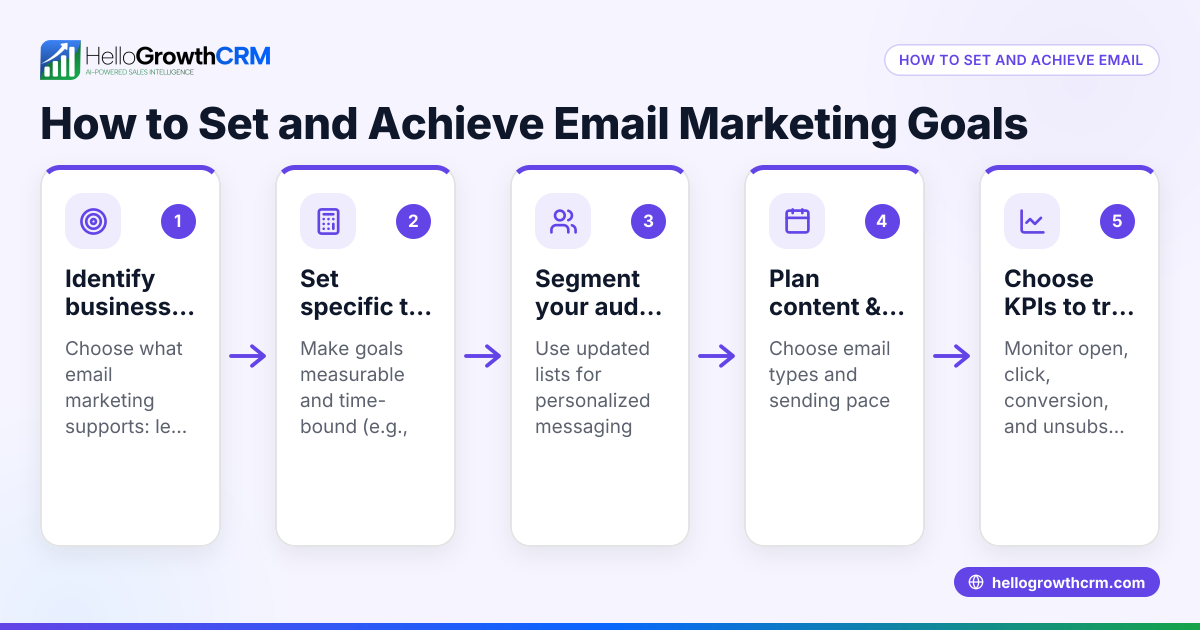
- Define your goals and audience
- Decide what you want to achieve: lead nurturing, sales, event promotion, or customer retention.
- Identify your target audience segments based on demographics, behavior, or purchase history.
- Build your email list legally and ethically
- Use web forms, lead magnets, or integrations to capture emails with explicit consent.
- Regularly clean your list to remove inactive or invalid contacts.
- Plan your content and sequence
- Outline the types of emails: welcome messages, product updates, educational content, promotions.
- Decide the frequency and timing for sending emails to avoid spamming.
- Create email templates and personalize
- Design clear, mobile-friendly templates with a recognizable sender name.
- Personalize subject lines and content to increase engagement.
- Set up automation and follow-up
- Use sequences to automate multi-step campaigns that send emails at set intervals.
- Ensure the sequence stops when a prospect replies to avoid over-contacting.
- Test and optimize
- A/B test subject lines, content, and sending times.
- Monitor open rates, click-throughs, and conversions to adjust your strategy.
- Track replies and team collaboration
- Use a shared inbox so your team can see incoming replies and respond promptly.
For more on automating email workflows, see email automation and sequences.
Example (fictional figures)
A two-location dental practice in Columbus, Ohio wants to increase new patient bookings through email marketing. They start on 07/01/2025 with a list of 1,000 contacts.
- Goal: Book 20 new patients in 3 months.
- Sequence: 5-step follow-up over 2 weeks.
Assuming a 20% open rate and 5% conversion from email to booking:
Contacts = 1,000 Open rate = 1,000 × 20% = 200 Conversions = 200 × 5% = 10 new bookings
They improve subject lines and timing, increasing open rate to 30%:
Open rate improved = 1,000 × 30% = 300 Conversions = 300 × 5% = 15 new bookings
They add SMS follow-up and get a 7% conversion from opened emails:
Conversions improved = 300 × 7% = 21 new bookings
This meets their goal of 20 new patients.
Common mistakes
- Not segmenting the email list
- Prevent by grouping contacts based on interests or behavior to send relevant content.
- Sending emails too frequently or infrequently
- Prevent by testing and setting a consistent schedule that respects subscribers’ preferences.
- Ignoring replies and follow-up
- Prevent by using a shared inbox so the team can manage responses together.
- Lack of automation
- Prevent by setting up sequences to save time and keep prospects engaged automatically.
- Not measuring results
- Prevent by tracking open rates, clicks, and conversions to improve future campaigns.
For details on managing replies and sequences, see WhatsApp and SMS CRM.
Doing this in HelloGrowthCRM
HelloGrowthCRM offers a shared inbox called HelloMail where your team can manage inbound email from leads and customers without switching to a separate email client. Replies to a quotation email are visible to the whole team on the deal, improving collaboration. You can also set up sequences and campaigns: automated five-step follow-ups over two weeks run on their own and stop immediately when a prospect replies. This helps keep your outreach timely and efficient. Learn more about these features at email automation and sequences.
Frequently asked questions
What is an email marketing framework? An email marketing framework is a structured plan that guides how you build, send, and manage email campaigns to engage your audience effectively. It includes defining goals, segmenting contacts, creating content, automating follow-ups, and measuring results.
How often should I send marketing emails? The frequency depends on your audience and goals but generally ranges from once a week to once a month. Too many emails can annoy subscribers, while too few may reduce engagement. Testing different schedules helps find the right balance.
How do I get started with email automation? Start by choosing an email tool that supports sequences or workflows. Create a series of emails that send automatically at intervals, and set triggers to stop follow-up when a prospect replies. HelloGrowthCRM offers sequences and campaign automation to simplify this process.
Can I use email marketing for lead follow-up and sales? Yes, email marketing is effective for lead nurturing and converting prospects into customers. Using sequences and personalized content helps keep leads engaged until they are ready to buy.
What common mistakes should I avoid in email marketing? Avoid not segmenting your list, sending emails too often or rarely, ignoring replies, lacking automation, and failing to measure results. Each mistake reduces the effectiveness of your campaigns.
For more on sequences and campaigns, visit email automation and sequences.
Key takeaways
- An email marketing framework organizes your outreach to engage leads and customers effectively.
- Define goals, segment your audience, plan content, and automate follow-up sequences.
- Use a shared inbox to manage replies and improve team collaboration.
- Test frequency, subject lines, and timing to optimize results.
- Avoid common mistakes like poor segmentation and ignoring replies.
Start building your email marketing framework today with HelloGrowthCRM’s shared inbox and automated sequences. Start on the Free Forever plan (200 leads, no credit card).
Ready to put this into practice?
Set up your pipeline, WhatsApp follow-ups, and AI lead scoring in minutes — free, no credit card.
Try HelloGrowthCRM freeGet CRM tips in your inbox
Join thousands of sales professionals who get weekly insights on CRM strategy, AI automation, and pipeline optimization.

The HelloGrowthCRM team publishes guides on CRM strategy, AI sales tools, and revenue operations for small business sales teams.