HelloGrowthCRM software
Built for real small-business sales teams
HelloGrowthCRM helps reps qualify faster, follow up on time, and close more deals—with practical automation in one place.
- AI lead scoring and pipeline visibility
- Built-in dialer, WhatsApp, and email automation
- Sales forecasting and RevOps-ready reporting
A customer success framework is a structured approach designed to help your customers achieve their goals with your product or service. It involves proactive engagement, ongoing support, and measuring customer health to prevent churn and encourage growth. This article covers why small businesses need such a framework, how to create one step-by-step, a practical example, common mistakes to avoid, and how HelloGrowthCRM can support your efforts.
Why this comes up / what goes wrong
Small business owners often struggle to keep customers satisfied and loyal because they lack a clear system to manage ongoing customer relationships after the sale. Without a customer success framework, follow-up can be inconsistent, service requests may get lost, and opportunities for referrals or upselling are missed. This leads to lost revenue and wasted marketing spend. For businesses running sales and support on multiple channels like text, email, and spreadsheets, the complexity grows, making it harder to track customer health or provide timely help.
Step-by-step
- Define Customer Success Goals
- Identify what success looks like for your customers using your product or service.
- Check that these goals align with your business objectives.
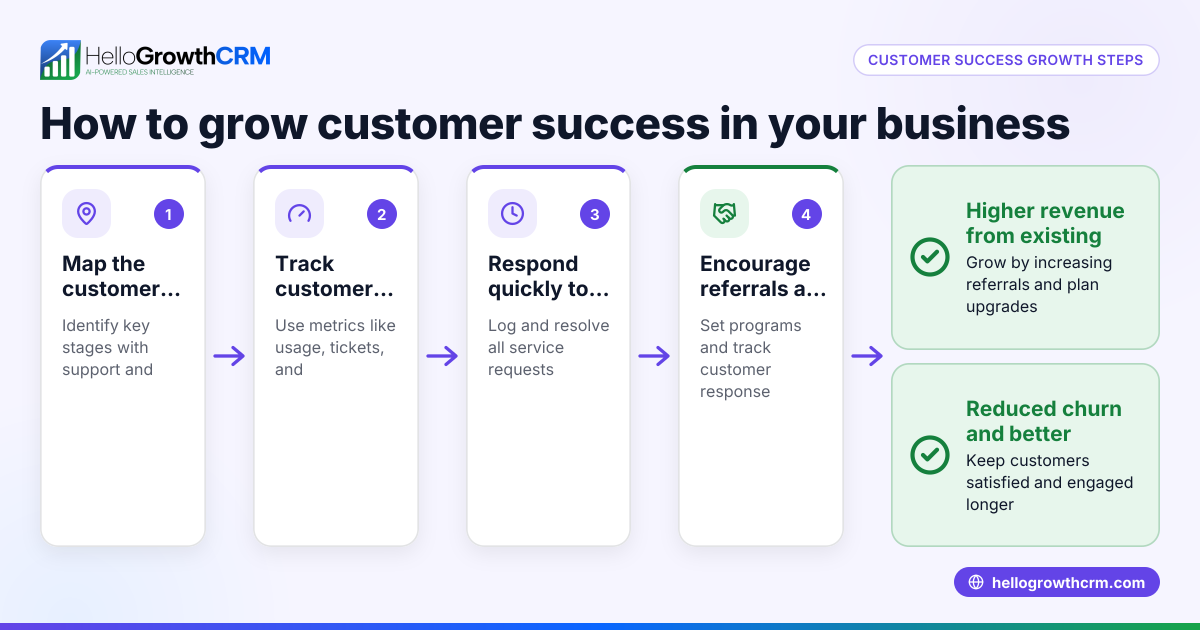
- Map the Customer Journey
- Outline key stages from onboarding to renewal.
- Check for touchpoints where you can engage or assist customers.
- Assign Customer Success Roles
- Designate team members responsible for customer follow-up, support, and advocacy.
- Check that responsibilities are clear to avoid gaps.
- Implement Tools to Track Customer Health
- Use metrics like usage frequency, support tickets, or satisfaction scores.
- Check regularly to identify at-risk customers early.
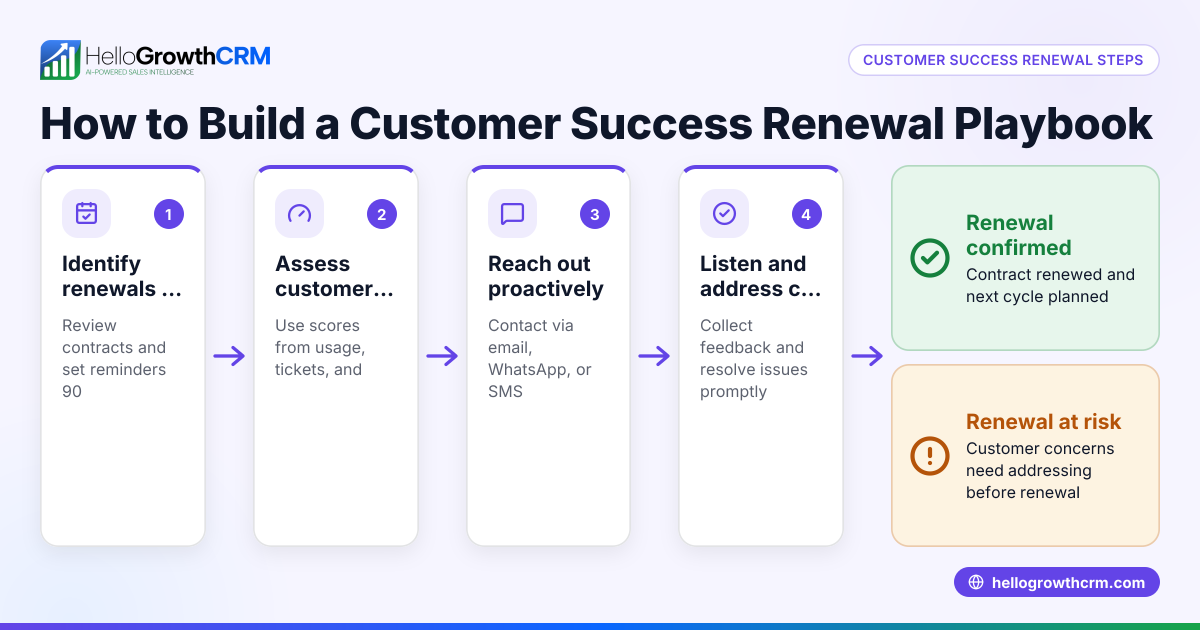
- Create a Support and Communication Plan
- Develop processes for timely responses to inquiries and proactive outreach.
- Check that communication channels are convenient for customers (e.g., WhatsApp, SMS).
- Establish a Referral and Feedback System
- Encourage satisfied customers to refer others and provide feedback.
- Check that referral tracking is in place to reward advocates.
- Review and Optimize Regularly
- Analyze customer success data and adjust your framework.
- Check for improvements in retention and customer satisfaction.
For more on tracking customer health, see customer health score.
Example (fictional figures)
Imagine a B2B software reseller in Denver, Colorado, named "Rocky Mountain Tech Solutions." They sell a cloud-based inventory system and want to reduce churn by implementing a customer success framework starting 01/15/2026.
- They define success as customers using the system daily and renewing annually.
- They map the journey: onboarding (month 1), usage check-in (month 3), renewal (month 12).
- They assign a customer success manager to 100 clients.
- They track customer health using login frequency and support tickets.
- They plan monthly WhatsApp check-ins and a referral program.
Results after 6 months:
- 80 customers log in daily.
- 10 customers had unresolved issues; manager followed up within 24 hours.
- 5 customers referred new leads.
Calculations:
Assuming an average annual contract value (ACV) of $12,000:
Current revenue = 100 customers × $12,000 = $1,200,000
If churn drops from 15% to 10%, retained customers increase by 5:
Additional revenue = 5 × $12,000 = $60,000
Referral leads convert at 20%, adding 1 new customer:
New revenue = 1 × $12,000 = $12,000
Total revenue increase = $60,000 + $12,000 = $72,000
This example shows how a customer success framework can boost revenue by reducing churn and gaining referrals.
Common mistakes
- Ignoring customer feedback: Prevent by actively soliciting and acting on feedback.
- Lack of clear roles: Prevent by assigning specific team members to customer success tasks.
- Inconsistent communication: Prevent by scheduling regular check-ins and using preferred channels like WhatsApp or SMS (WhatsApp and SMS CRM).
- Not tracking customer health: Prevent by implementing metrics and reviewing them frequently.
- Overcomplicating processes: Prevent by keeping steps simple and scalable.
Doing this in HelloGrowthCRM
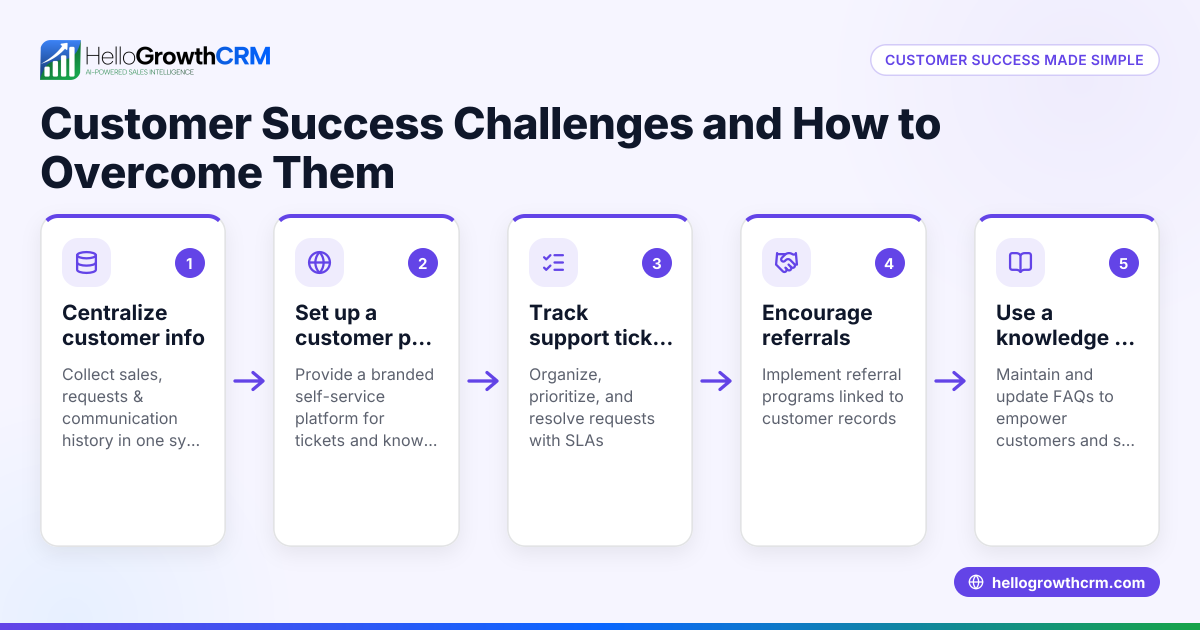
HelloGrowthCRM supports your customer success framework with a branded self-service customer portal, referral program tracking, support tickets, and a knowledge base. After the sale, all service requests stay linked to the same customer record as the deal, making it easier to track and manage ongoing customer needs in one place. Learn more at HelloGrowthCRM for the United States.
Frequently asked questions
What is the difference between customer success and customer support? Customer success is proactive and focused on helping customers achieve their goals to prevent problems and grow the relationship. Customer support is reactive, handling specific issues when customers ask for help.
How do I measure customer success? Common metrics include customer health scores, product usage rates, renewal rates, and customer satisfaction surveys. These help identify customers needing attention and opportunities for growth. See customer health score for more.
Can small businesses implement a customer success framework? Yes, small businesses can start with simple steps like defining success goals, mapping the customer journey, and using tools to track and communicate with customers effectively.
How does HelloGrowthCRM help with customer success? It offers a customer portal, referral tracking, tickets, and a knowledge base, keeping service requests linked to customer records for streamlined management.
Key takeaways
- A customer success framework ensures customers achieve their goals, reducing churn and increasing referrals.
- Define clear success goals and map the customer journey to identify engagement points.
- Assign roles and use metrics to track customer health regularly.
- Use consistent communication channels customers prefer, like WhatsApp and SMS.
- Avoid common mistakes by simplifying processes and actively managing feedback.
- HelloGrowthCRM supports customer success with integrated tools for customer portals, referrals, and support tickets.
Start your customer success framework with confidence. Start on the Free Forever plan (200 leads, no credit card) to manage your customers effectively today.
Ready to put this into practice?
Set up your pipeline, WhatsApp follow-ups, and AI lead scoring in minutes — free, no credit card.
Try HelloGrowthCRM freeGet CRM tips in your inbox
Join thousands of sales professionals who get weekly insights on CRM strategy, AI automation, and pipeline optimization.

The HelloGrowthCRM team publishes guides on CRM strategy, AI sales tools, and revenue operations for small business sales teams.