HelloGrowthCRM software
Built for real small-business sales teams
HelloGrowthCRM helps reps qualify faster, follow up on time, and close more deals—with practical automation in one place.
- AI lead scoring and pipeline visibility
- Built-in dialer, WhatsApp, and email automation
- Sales forecasting and RevOps-ready reporting
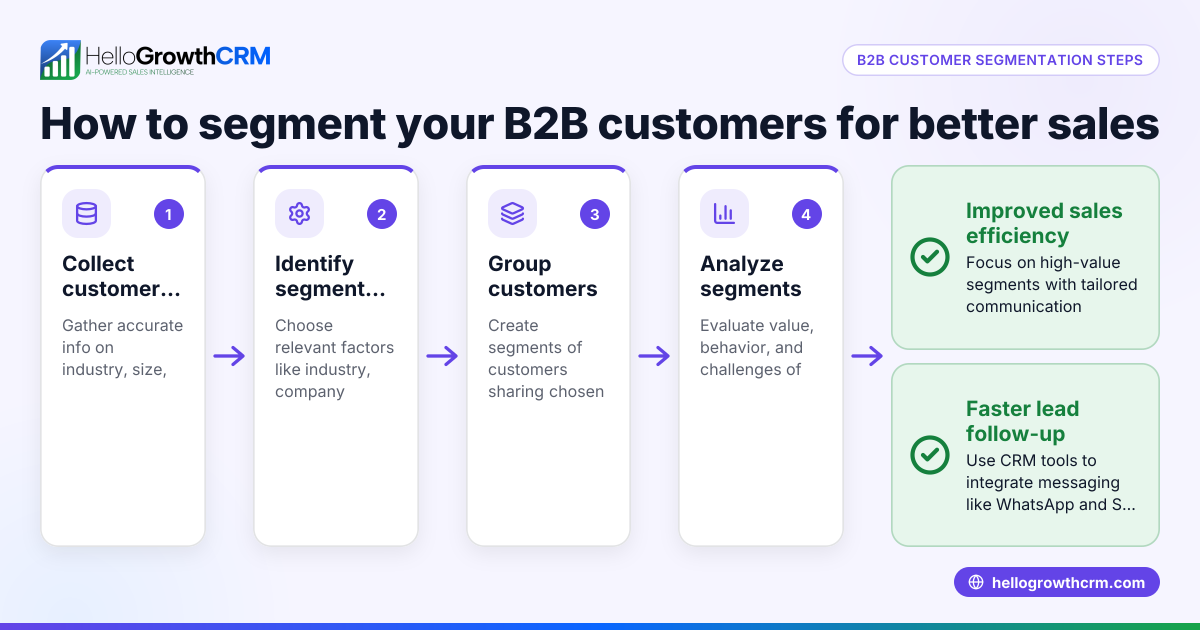
Email segmentation strategies involve dividing your email list into smaller groups based on shared characteristics, such as demographics, behavior, or purchase history. This helps you send relevant, personalized messages that increase engagement and conversion rates. This article covers why segmentation matters, step-by-step instructions to implement it, a practical example, common mistakes to avoid, and how HelloGrowthCRM supports email segmentation with automation.
Why this comes up / what goes wrong
Many small-business owners struggle with email marketing because they send the same message to everyone on their list. This one-size-fits-all approach leads to lower open rates, fewer clicks, and lost sales opportunities. For example, a small retail business might have customers interested in different product categories or at different stages of the buying journey. Without segmentation, the message is either too broad or irrelevant, causing recipients to ignore or unsubscribe from emails. Slow follow-up and managing contacts on spreadsheets or text messages make it harder to segment effectively and track results.
Step-by-step
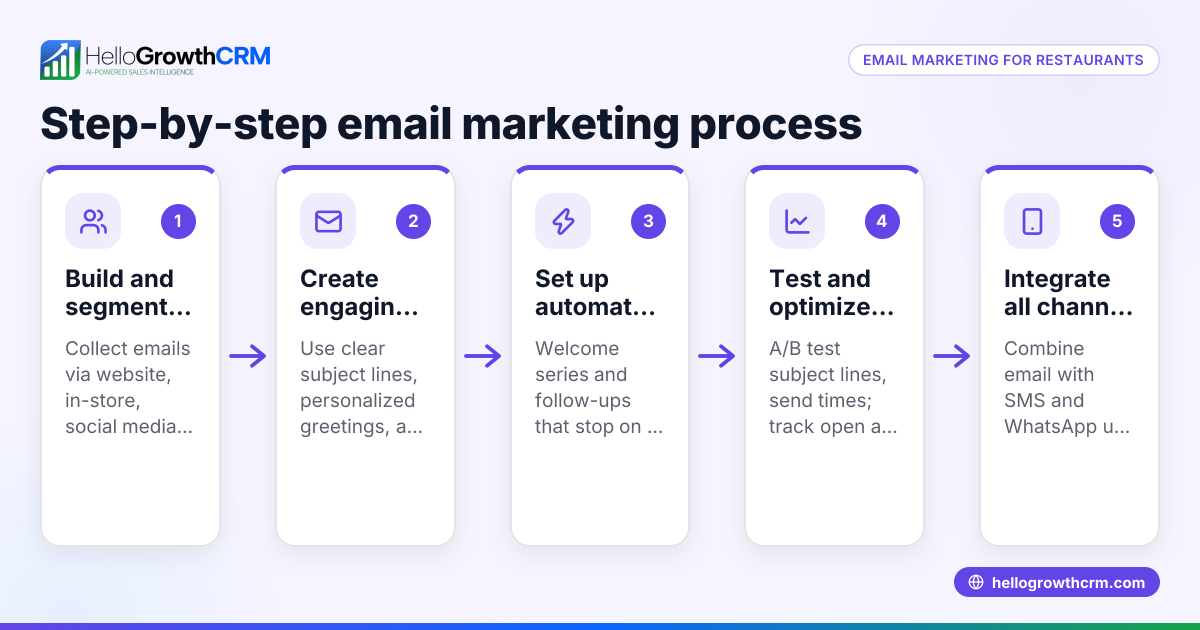
- Collect relevant data: Gather information about your contacts such as location, purchase history, engagement level, job role, or industry. Check that your data is accurate and updated.
- Define segments: Decide on meaningful groups based on your business goals. For instance, segment by new vs. returning customers, or by product interest. Check that each segment is large enough to justify targeted messaging.
- Create tailored content: Develop email messages that speak directly to each segment’s needs or interests. Check that the content matches the segment profile and addresses their pain points.
- Set up automation: Use email automation tools to send the right message to each segment at the right time. Check that sequences and campaigns are properly configured to stop when a prospect replies, avoiding over-contacting.
- Test and analyze: Monitor open rates, click-throughs, and conversions for each segment. Adjust your segmentation criteria and messaging based on performance data.
For managing these processes efficiently, consider solutions like email automation and sequences and WhatsApp and SMS CRM to reach your audience across channels.
Example (fictional figures)
A plumbing company in Austin, Texas, has 5,000 email contacts. They want to increase their service bookings by targeting customers with specific plumbing needs.
- They collect data and find 1,500 contacts interested in water heater services and 3,500 in drain cleaning.
- They define two segments: Water Heater segment (1,500) and Drain Cleaning segment (3,500).
- They create tailored emails: one promoting water heater maintenance specials, the other offering drain cleaning discounts.
- They set up a five-step follow-up sequence over two weeks for each segment, stopping when the customer replies.
- After the campaign, the Water Heater segment generated $48,000 in bookings, and the Drain Cleaning segment generated $72,000.
Calculations: $48,000 + $72,000 = $120,000 total revenue from segmented campaigns
This targeted approach helped the company increase bookings by focusing on customer interests.
Common mistakes
- Not segmenting at all: Sending the same email to everyone reduces relevance. Prevent by starting with basic segmentation like new vs. returning customers.
- Over-segmenting: Creating too many tiny groups can complicate management and dilute impact. Prevent by keeping segments actionable and sizable.
- Ignoring data quality: Outdated or incorrect data leads to wrong targeting. Prevent by regularly cleaning and updating your contact list.
- Using generic content: Sending bland messages misses the opportunity for engagement. Prevent by tailoring content to each segment’s needs.
- Not automating follow-up: Manual follow-up slows response time. Prevent by using automated sequences that stop on reply, as supported by HelloGrowthCRM.
Doing this in HelloGrowthCRM
HelloGrowthCRM offers a HelloMail shared inbox where team members can see replies to quotation emails, ensuring coordinated follow-up. Its Sequences and campaigns feature automates multi-step outreach workflows that run over two weeks and stop immediately when a prospect replies, helping your team maintain timely and relevant contact with each segment without manual effort.
Frequently asked questions
What is the best way to segment an email list? Start by using simple criteria like customer location, purchase history, or engagement level. These factors are easy to track and provide meaningful ways to personalize your campaigns.
How often should I update my email segments? Regularly review and update segments at least quarterly or whenever you acquire new data. Keeping segments current ensures your messages stay relevant.
Can I automate segmentation and follow-up? Yes, many CRM tools, including HelloGrowthCRM, support automated sequences that send targeted messages based on segment criteria and stop when a prospect replies, saving time and improving responsiveness.
What if my segments are too small? If a segment is too small, consider combining it with a similar group to maintain efficiency while still providing some personalization.
How do I measure the success of segmentation? Track metrics like open rates, click-through rates, and conversion rates for each segment. Compare these to your overall averages to see if segmentation improves engagement.
Key takeaways
- Segment your email list based on relevant data like behavior or demographics.
- Create tailored content that addresses each segment’s specific needs.
- Use automation to send sequences that stop when a prospect replies.
- Avoid over-segmentation and keep data clean and updated.
- Monitor campaign performance and adjust segments accordingly.
- HelloGrowthCRM supports segmentation with shared inboxes and automated sequences.
Start improving your email marketing by applying these segmentation strategies. To get started with a CRM that supports email automation and segmentation, Start on the Free Forever plan (200 leads, no credit card).
Ready to put this into practice?
Set up your pipeline, WhatsApp follow-ups, and AI lead scoring in minutes — free, no credit card.
Try HelloGrowthCRM freeGet CRM tips in your inbox
Join thousands of sales professionals who get weekly insights on CRM strategy, AI automation, and pipeline optimization.

The HelloGrowthCRM team publishes guides on CRM strategy, AI sales tools, and revenue operations for small business sales teams.