HelloGrowthCRM software
Built for real small-business sales teams
HelloGrowthCRM helps reps qualify faster, follow up on time, and close more deals—with practical automation in one place.
- AI lead scoring and pipeline visibility
- Built-in dialer, WhatsApp, and email automation
- Sales forecasting and RevOps-ready reporting
Escalation management means handling problems or customer enquiries that frontline staff cannot solve by passing them on to more experienced team members or managers. This process ensures that issues get resolved quickly, preventing delays that can cause lost leads or unhappy customers. For small businesses in Australia, where every lead counts, having a clear escalation process is vital to maintain sales momentum and customer trust.
Why this comes up / what goes wrong
Small business owners often manage sales and customer service with limited staff using informal tools like text messages, emails, or spreadsheets. Without a clear escalation process, issues can be overlooked or delayed because no one knows when or how to escalate them. For example, a salesperson might get stuck answering a complex pricing question but doesn’t escalate it, so the lead loses interest. Or, a customer complaint might not reach the right person quickly, causing frustration. These gaps lead to lost sales, wasted time, and damage to reputation.
Step-by-step
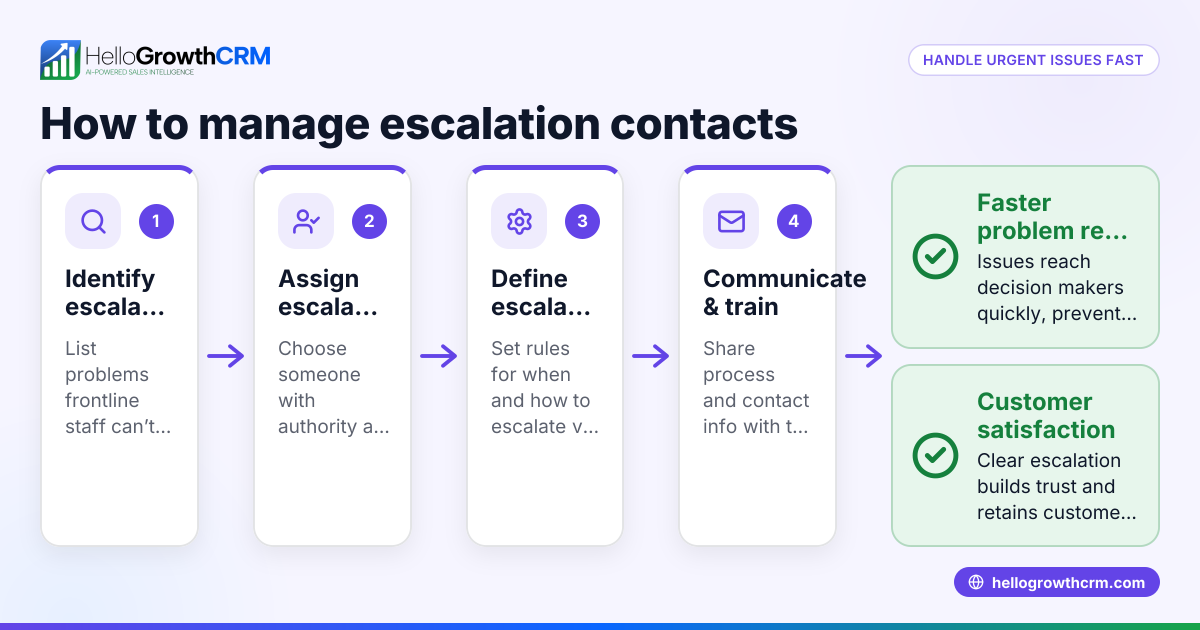
- Define escalation triggers: Decide what types of issues require escalation. These can include unanswered enquiries after a set time (e.g., 24 hours), technical questions beyond frontline knowledge, or urgent customer complaints.
- Assign escalation roles: Identify who in your team will handle escalations. This could be a sales manager, product expert, or customer service lead.
- Set clear timelines: Establish how quickly escalations must be acknowledged and resolved to keep leads engaged and customers satisfied.
- Document escalation paths: Create a simple guide showing who to contact for each issue type and how to escalate (phone call, email, CRM task).
- Train your team: Ensure everyone understands when and how to escalate issues and why it matters to the business.
- Track escalations: Use a system to log escalations, monitor their resolution times, and spot recurring problems.
- Review and improve: Regularly review escalation outcomes and update your process to fix any gaps.
Using a CRM like HelloGrowthCRM can help with steps 6 and 7 by keeping leads and tasks organised and visible.
Example (fictional figures)
A registered training organisation in Adelaide receives an enquiry about course fees on 10/04/2026. The frontline sales officer cannot answer a complex funding eligibility question.
- Enquiry received: 10/04/2026
- Escalation trigger: Question unresolved after 6 hours
- Sales manager assigned to escalation
- Sales officer logs escalation in CRM with next step "Manager follow-up by 11/04/2026"
Costs:
- Sales officer hourly rate: A$40
- Sales manager hourly rate: A$60
Time spent:
- Sales officer initial response: 1 hour = A$40 × 1 = A$40
- Sales officer follow-up attempt: 0.5 hour = A$40 × 0.5 = A$20
- Sales manager investigation: 1 hour = A$60 × 1 = A$60
Total labour cost to resolve escalation = A$40 + A$20 + A$60 = A$120
This clear escalation process prevents lead loss and ensures the enquiry is handled professionally within 24 hours.
Common mistakes
- No clear escalation criteria: Teams delay or skip escalation when triggers are undefined. Prevent this by documenting specific conditions that require escalation.
- Unclear roles and responsibilities: If staff don’t know who handles escalations, leads stall. Prevent this by assigning and communicating escalation owners clearly.
- Ignoring timelines: Slow responses cause leads to go cold. Prevent this by setting deadlines and monitoring adherence.
- Poor tracking of escalations: Without logging escalations, issues repeat unnoticed. Prevent this by using a CRM to track and report on escalations.
- Lack of training: Teams unsure about escalation fail to act promptly. Prevent this by regular training and refresher sessions.
- Overcomplicating the process: Complex escalation paths confuse staff and slow responses. Prevent this by keeping escalation steps simple and clear.
Doing this in HelloGrowthCRM
HelloGrowthCRM helps with escalation management by ensuring every enquiry from a form, call or WhatsApp lands as a lead with an owner and a next step, instead of in a notebook. This means no lead gets lost or forgotten, and team members know exactly when to escalate issues to managers or specialists. You can organise leads efficiently, assign owners, and track follow-ups all in one place, making escalation clear and manageable. Learn more about HelloGrowthCRM for Australia and its WhatsApp and SMS CRM capabilities, including the built-in CRM dialer that supports quick escalations by phone.
Frequently asked questions
What is escalation management in sales? Escalation management in sales is the process of forwarding customer issues or sales leads that frontline staff cannot resolve to higher authority or experts. This ensures problems are solved quickly and leads stay engaged.
Why is escalation management important for small businesses? Small businesses often have limited staff and resources, so efficient escalation management prevents lost leads and customer dissatisfaction by ensuring timely problem resolution.
How do I set up an escalation process for my team? Start by defining what issues require escalation, assign responsible team members, set timelines, document the process, and train your staff. Use tools like HelloGrowthCRM to track and manage escalations.
Can a CRM help with escalation management? Yes, a CRM like HelloGrowthCRM helps capture every lead with an owner and next step, so escalations are visible and managed without falling through the cracks.
What happens if I don’t manage escalations properly? Poor escalation management leads to delayed responses, lost sales opportunities, unhappy customers, and inefficiency.
How can I keep my team accountable for escalations? Use a CRM to assign ownership and deadlines for each lead or issue. Regularly review escalation reports and hold team meetings to discuss unresolved cases.
Key takeaways
- Escalation management ensures unresolved issues move quickly to the right person.
- Define clear triggers, roles, and timelines for escalation.
- Track escalations to prevent repeated problems and lost leads.
- Train your team on escalation procedures to ensure prompt action.
- Keep the escalation process simple and well documented.
- HelloGrowthCRM helps by capturing leads with owners and next steps, supporting smooth escalation.
Start managing your leads and escalations better today. Start on the Free Forever plan (200 leads, no credit card).
Ready to put this into practice?
Set up your pipeline, WhatsApp follow-ups, and AI lead scoring in minutes — free, no credit card.
Try HelloGrowthCRM freeGet CRM tips in your inbox
Join thousands of sales professionals who get weekly insights on CRM strategy, AI automation, and pipeline optimization.

The HelloGrowthCRM team publishes guides on CRM strategy, AI sales tools, and revenue operations for small business sales teams.