HelloGrowthCRM software
Built for real small-business sales teams
HelloGrowthCRM helps reps qualify faster, follow up on time, and close more deals—with practical automation in one place.
- AI lead scoring and pipeline visibility
- Built-in dialer, WhatsApp, and email automation
- Sales forecasting and RevOps-ready reporting
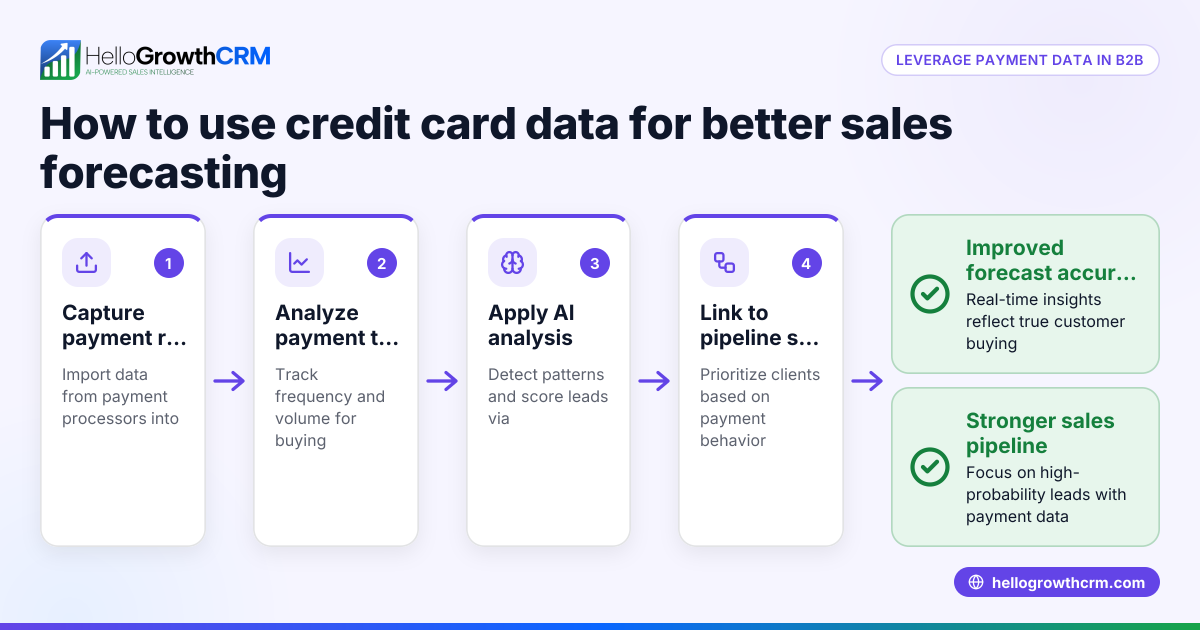
AI credit layers combine artificial intelligence with financial and credit data to improve how B2B companies score leads and forecast sales. These AI-powered tools analyze payer behavior, creditworthiness, and payment histories automatically, enabling more accurate lead qualification and reliable revenue predictions.
Key takeaways
- AI credit layers use AI-powered data analysis to evaluate a company’s financial strength and payment trends.
- They enhance B2B lead scoring by identifying prospects with strong credit profiles and purchasing potential.
- Automated with AI, these tools improve sales forecasting accuracy by incorporating real-time credit signals.
- AI software can integrate credit layers into CRM pipelines to prioritize leads and set realistic sales targets.
- US B2B sellers benefit from compliance-friendly credit data sources aligned with federal regulations.
- AI credit layers help reduce risk by spotting leads more likely to convert and can pay on time.
What is an AI credit layer in B2B sales?
An AI credit layer is an AI-powered data system that pulls together and analyzes a company’s credit and payment information to improve lead qualification. It adds financial health indicators to traditional lead data, helping sales teams assess a prospect’s ability to pay reliably.
These AI tools use machine learning to process credit scores, payment histories, and trade experiences from multiple sources. Integrated within CRM pipelines, the AI credit layer dynamically updates risk scores as new data arrives, helping prioritize leads based on actual financial strength.
How does AI credit layering improve B2B lead scoring?
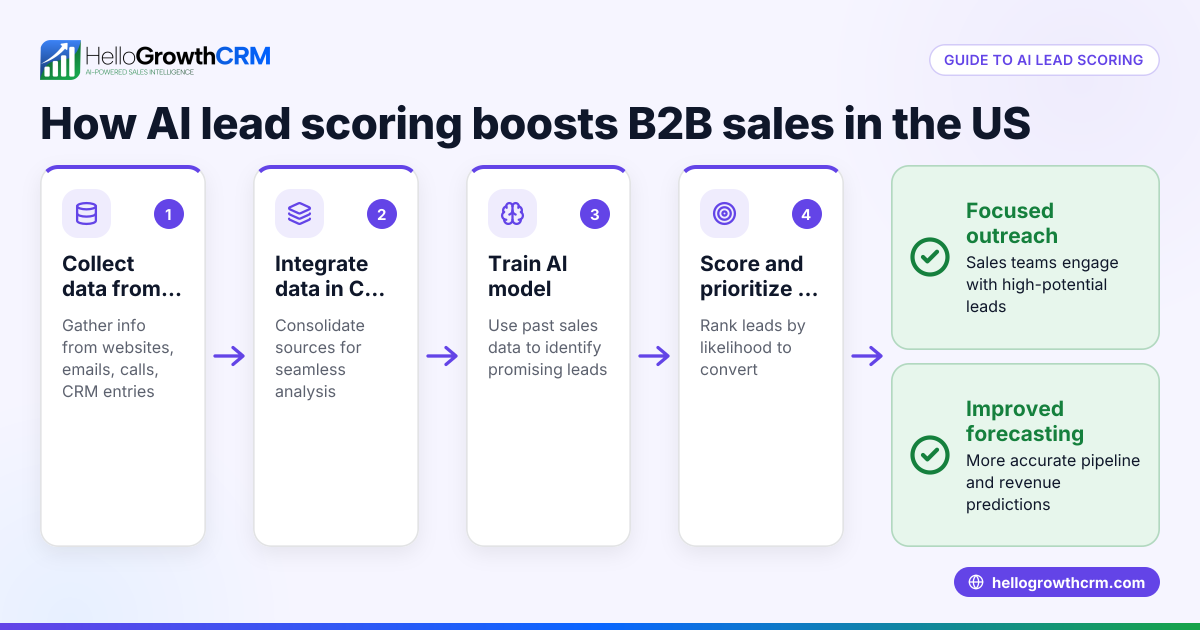
AI-powered credit layers offer more precise lead scoring by incorporating financial risk data with traditional criteria.
Here’s how the AI software enhances lead evaluation:
- Deeper risk profiles: It analyzes payment timeliness, credit limits, and debts to create a comprehensive risk score.
- Prioritized follow-up: Sales reps focus on leads with strong creditworthiness and real buying power.
- Better resource allocation: Sales automation routes leads based on financial scores, increasing conversion rates.
- Continuous updates: Automated with AI, credit scores adjust in real time to reflect changing financial conditions.
For US sellers, understanding credit profiles before extending payment terms reduces bad debts and collection issues, making AI credit layers essential for accurate lead scoring and forecast reliability.
How does AI-powered lead scoring differ from traditional methods?
AI-powered lead scoring adds financial insights beyond demographic and engagement data.
Automated with AI, this scoring model learns from payment patterns and credit histories, adjusting scores dynamically. Traditional scoring looks mainly at firmographics and activity. AI tools add a creditworthiness dimension to predict who can actually pay, not just who is interested.
This results in higher-quality lead prioritization, shorter sales cycles, and more dependable revenue forecasts.
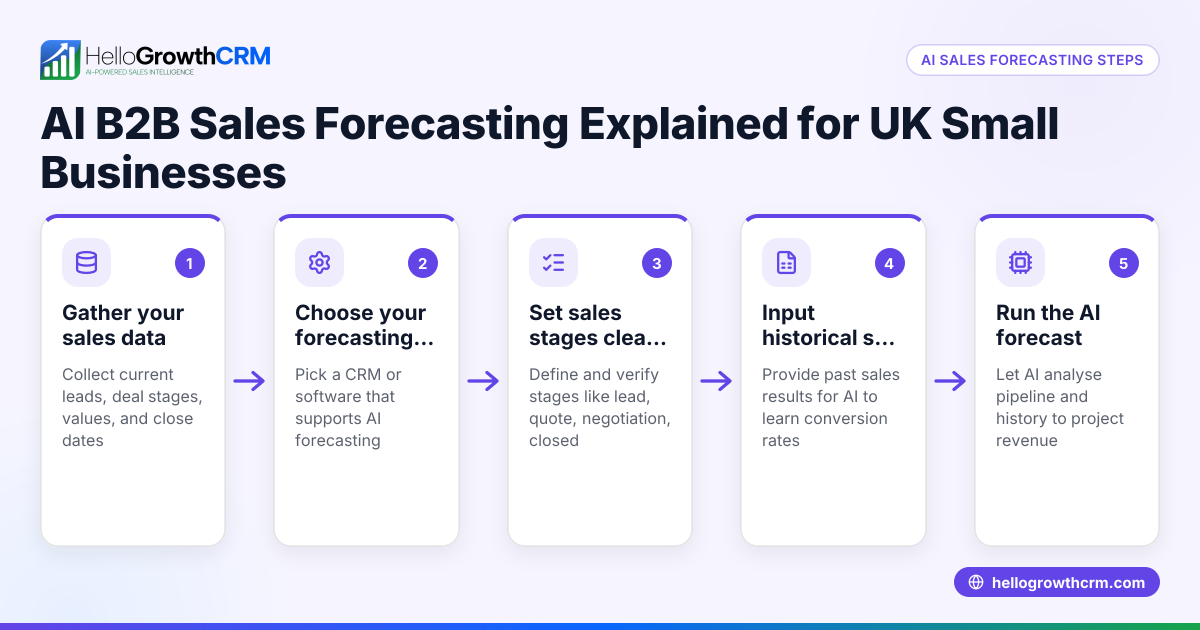
What role does automated AI play in sales forecasting?
Automated with AI, sales forecasting uses live credit data to improve revenue and pipeline predictions.
AI credit layers feed forecasting models by integrating financial stress signals and historical payment data. This approach refines deal closure probabilities and cash flow timelines. Forecast teams in US companies benefit from smarter scenario planning and early warnings about credit risk shifts.
Combining AI automation with traditional sales data delivers a clearer and more reliable revenue outlook.
How can AI credit layers be integrated into existing CRM systems?
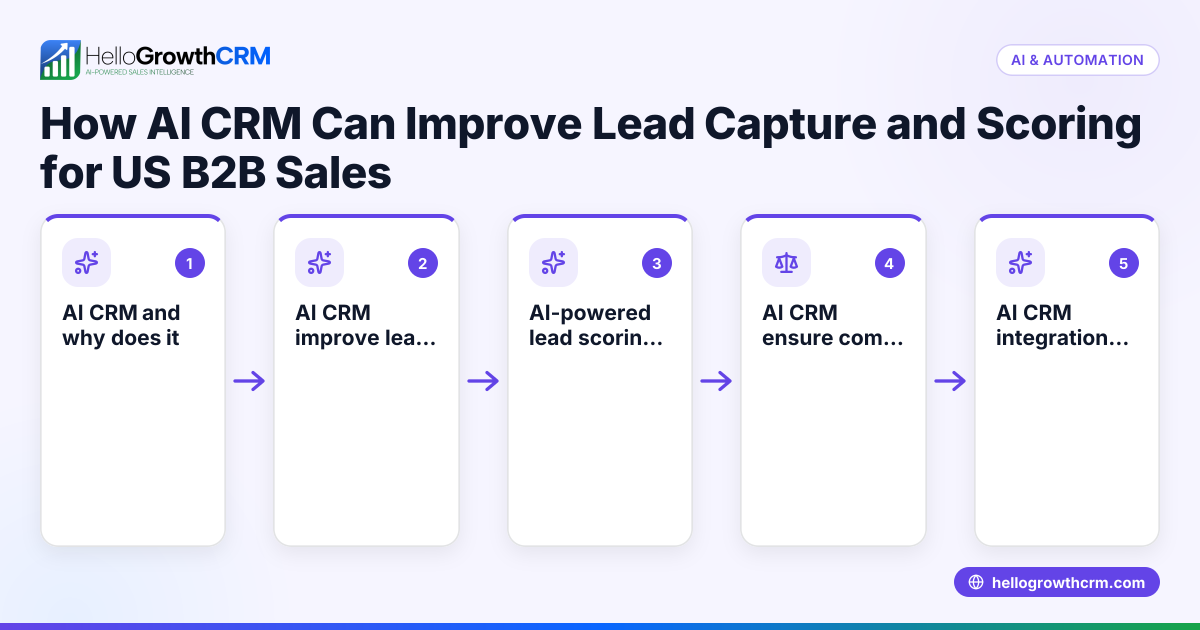
Integrating AI credit layers into a CRM involves:
- Connecting the CRM to authorized US credit data providers.
- Enabling AI automation to update credit scores and financial metrics within account records.
- Applying customized rules that factor credit information into lead scoring and pipeline stages.
- Automating alerts based on credit risk changes.
- Syncing credit insights with sales forecasting modules for real-time revenue adjustments.
AI-powered CRM platforms like HelloGrowthCRM offer native support for credit data, minimizing tool switching and improving lead prioritization via AI lead scoring.
What are compliance considerations for using AI credit layers in the US?
AI credit layers must comply with US regulations such as the Fair Credit Reporting Act (FCRA) and data privacy standards like SOC 2.
Using authorized credit data vendors is essential for legal compliance. In outreach, respecting CAN-SPAM for emails and TCPA for calls is mandatory. Maintaining audit trails supports internal and external reviews.
Partnering with an AI software provider and managed RevOps service can help ensure all compliance measures are met and reduce legal risks.
What benefits do US B2B companies gain from AI credit layers?
US companies using AI credit layers enjoy:
- Improved sales efficiency by focusing on creditworthy leads.
- Reduced bad debt and lower collection costs.
- More accurate revenue forecasts that help with budgeting.
- Smarter sales strategies informed by financial insights.
- Competitive advantage in US markets like Chicago, Houston, and Detroit.
AI-powered credit layers drive growth by lowering risks and increasing sales confidence.
What challenges might businesses face when adopting AI credit layers?
Challenges include:
- Technical hurdles in integrating credit data with CRM systems.
- Ensuring credit data accuracy to avoid misleading scores.
- Training sales teams to understand and use credit insights.
- Managing costs of credit data subscriptions and AI software.
- Keeping up with evolving regulatory requirements.
Working with a provider who offers managed RevOps can help mitigate these challenges and streamline adoption.
How can US companies start using AI credit layers today?
To begin:
- Review your current lead scoring and sales forecasting gaps.
- Select credit data vendors focused on US business credit.
- Evaluate AI-powered CRM platforms like HelloGrowthCRM with AI lead scoring and sales forecasting.
- Plan integration with financial tools like QuickBooks or ERP systems.
- Consider leveraging managed RevOps to simplify launch and training.
- Educate your sales teams on how to use credit data effectively.
- Monitor and fine-tune AI models for ongoing accuracy.
This phased approach unlocks growth through automated and intelligent credit risk analysis.
Start improving your lead scoring and sales forecasting with AI credit layers today. Get started with a free trial of HelloGrowthCRM or book a demo to see how AI-powered credit data can transform your sales pipeline management.
Frequently asked questions
What types of credit data do AI credit layers use?
They use US business credit scores, payment histories, trade references, outstanding debts, and sometimes public financial filings from authorized credit bureaus and payment processors.
Can AI credit layers predict deal closure timing?
Yes. AI software analyzes credit health and payment patterns to estimate when a buyer will close and pay, improving cash flow forecasts.
Do AI credit layers work with QuickBooks and ERP systems?
Many AI credit layers integrate with US accounting and ERP systems to sync financial and sales data, making scoring and forecasting seamless.
How do AI credit layers help with compliance?
They rely on FCRA-compliant credit data and maintain audit trails. When combined with outreach automation, they ensure adherence to CAN-SPAM and TCPA rules.
Is AI credit layer technology suitable for small businesses?
Yes. Growing SMBs benefit from automated credit scoring and forecasting to manage financial risk while scaling sales efforts.
How often is credit data updated in AI credit layers?
Credit data is generally updated daily or weekly by US providers, ensuring fresh, actionable signals for lead scoring and forecasting.
Read next
This article covers one part of a bigger topic. For the complete picture, read our guide to ai credit layer.
Frequently Asked Questions
Ready to put this into practice?
Set up your pipeline, WhatsApp follow-ups, and AI lead scoring in minutes — free, no credit card.
Try HelloGrowthCRM freeGet CRM tips in your inbox
Join thousands of sales professionals who get weekly insights on CRM strategy, AI automation, and pipeline optimization.

The HelloGrowthCRM team publishes guides on CRM strategy, AI sales tools, and revenue operations for small business sales teams.