HelloGrowthCRM software
Built for real small-business sales teams
HelloGrowthCRM helps reps qualify faster, follow up on time, and close more deals—with practical automation in one place.
- AI lead scoring and pipeline visibility
- Built-in dialer, WhatsApp, and email automation
- Sales forecasting and RevOps-ready reporting
Forecasting monthly sales revenue is essential for UAE small and mid-sized businesses to manage cash flow, allocate resources, and set achievable targets. Many business owners struggle with forecasting because they rely on guesswork, scattered data from WhatsApp, calls, and spreadsheets, or lack a clear method. This guide provides a step-by-step process to create a reliable monthly sales forecast you can update regularly.
Why this comes up / what goes wrong
Small business owners in the UAE often run sales through informal channels like WhatsApp and phone calls, tracking opportunities in spreadsheets or notes. This scattered approach causes slow follow-up, lost leads, and inaccurate revenue predictions. Without a structured sales forecast, businesses risk cash shortfalls, missed targets, or overestimating their capacity to grow. Common issues include ignoring deal stages, not applying realistic probabilities, failing to adjust for seasonal factors, and overlooking the need to update forecasts regularly.
Step-by-step
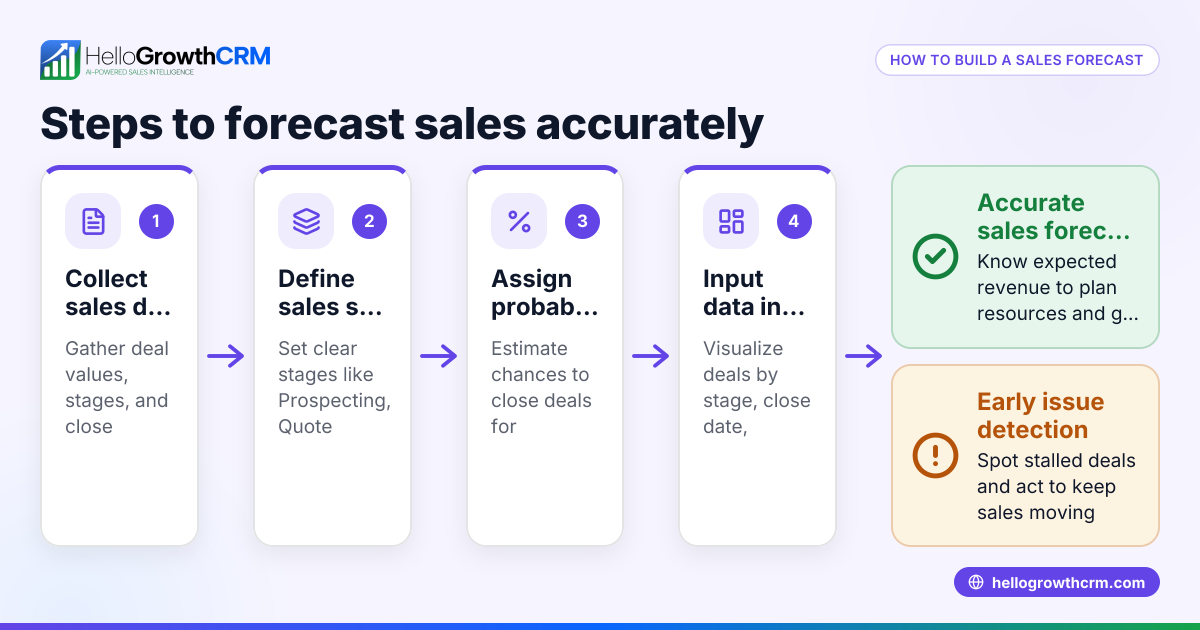
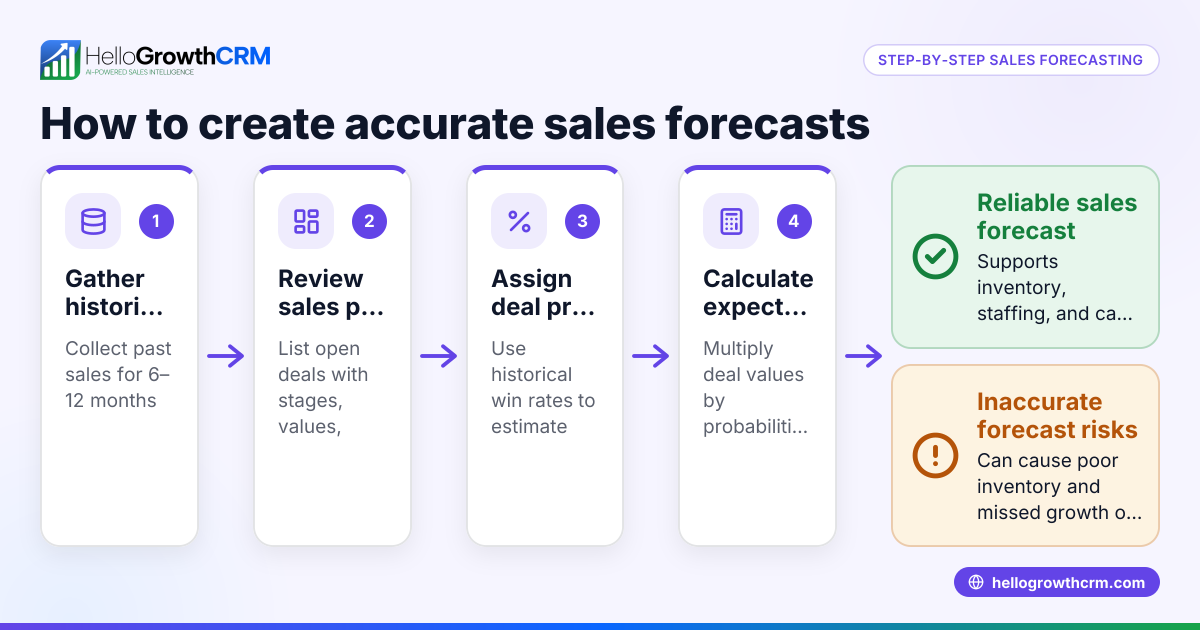
- Collect historical sales data: Gather your sales records for the past 6 to 12 months, including deal amounts, close dates, and the stages deals passed through. Verify the data is complete and accurate.
- List current open deals: Identify all active sales opportunities and their current stages, such as prospecting, quote sent, negotiation, or closing. Confirm each deal’s estimated value and expected close date.
- Assign probabilities to each stage: Based on your past conversion rates, estimate the likelihood of closing deals at each stage. For example, you might assign 20% probability to prospecting, 50% to quote sent, and 80% to negotiation.
- Calculate expected revenue per deal: Multiply each deal’s value by its assigned probability to get the expected revenue.
- Sum expected revenues for the target month: Add together the expected revenue from all deals likely to close within the month.
- Adjust for seasonality or market trends: Apply a factor to increase or decrease the forecast if you expect sales to change due to events, holidays, or economic conditions.
- Review and update monthly: Track actual sales against your forecast and refine your probabilities, deal values, and assumptions accordingly.
Before finalising, check your forecast for missing deals, outdated values, or unrealistic assumptions.
For more detailed insights, explore sales forecasting.
Example (fictional figures)
A car rental company in Abu Dhabi wants to forecast sales revenue for May 2024.
- Deal 1: AED 150,000, stage "quote sent", probability 50%, expected close 15/05/2024
- Deal 2: AED 80,000, stage "negotiation", probability 80%, expected close 20/05/2024
- Deal 3: AED 100,000, stage "prospecting", probability 20%, expected close 30/05/2024
Calculate expected revenue for each deal:
Deal 1: AED 150,000 × 50% = AED 75,000 Deal 2: AED 80,000 × 80% = AED 64,000 Deal 3: AED 100,000 × 20% = AED 20,000
Sum expected revenue: AED 75,000 + AED 64,000 + AED 20,000 = AED 159,000
Adjust for a 10% seasonal increase (Ramadan period): AED 159,000 × 110% = AED 174,900
Forecasted sales revenue for May 2024 = AED 174,900
Common mistakes
- Ignoring deal stages: Treating all deals as equally likely leads to overestimating revenue. Prevent this by assigning realistic probabilities to each stage.
- Not updating forecasts: Using outdated data causes inaccuracies. Prevent this by reviewing and updating your forecast monthly.
- Forgetting external factors: Omitting seasonality or market changes skews results. Prevent this by applying adjustment factors based on known events or trends.
- Overlooking follow-ups: Deals stall without timely action. Prevent this by tracking deal stages and follow-up dates in your CRM.
- Using inconsistent or incomplete data: Mixing outdated or partial figures causes errors. Prevent this by maintaining accurate and up-to-date sales records.
Learn more about AI CRM to keep your sales data organised and actionable.
Doing this in HelloGrowthCRM
HelloGrowthCRM helps you forecast monthly sales revenue with pipeline forecast and AI insights. It projects expected close amounts based on deal stage, sales velocity, and historical conversion patterns, so you see which deals are stalling without building spreadsheets. Its deals (pipeline) feature tracks opportunities from first contact through close, showing stage movement, probability, and expected value. For example, a quotation sent last week appears as a deal at the "quote sent" stage with a follow-up date, ensuring no deal is forgotten. Field teams can log visits from their phones, and managers can view daily routes and commissions, aiding sales forecasting and territory management. Learn more about HelloGrowthCRM for the United Arab Emirates.
Frequently asked questions
How often should I update my sales forecast? Update your sales forecast monthly or whenever there is a significant change in your pipeline. Regular updates keep your forecast accurate and actionable.
What if I don’t have historical sales data? Start by estimating deal values and probabilities based on your current pipeline and market knowledge. As you gather data over time, refine your forecasts for greater accuracy.
Can I include sales from different channels in one forecast? Yes. Combine deals from all sales channels but segment them if needed to see which channels perform best. This helps with resource allocation and strategy.
How does AI help in sales forecasting? AI analyses your pipeline health, sales rep performance, and revenue signals to project expected sales and highlight stalled deals, reducing manual work and improving accuracy.
Is forecasting useful for small sales teams? Absolutely. Even small teams benefit from forecasting to plan cash flow, set realistic targets, and prioritise timely follow-ups.
Key takeaways
- Collect accurate past sales data and list current deals with stages.
- Assign realistic probabilities to each sales stage based on past conversions.
- Calculate expected revenue by multiplying deal value by probability.
- Adjust forecasts for seasonality and market trends.
- Review and update forecasts monthly for accuracy.
- Use tools like HelloGrowthCRM for pipeline visibility, AI insights, and better follow-up.
Start forecasting your sales revenue today to improve your business planning and cash flow management.
Start on the Free Forever plan (200 leads, no credit card) at HelloGrowthCRM.
Ready to put this into practice?
Set up your pipeline, WhatsApp follow-ups, and AI lead scoring in minutes — free, no credit card.
Try HelloGrowthCRM freeGet CRM tips in your inbox
Join thousands of sales professionals who get weekly insights on CRM strategy, AI automation, and pipeline optimization.

The HelloGrowthCRM team publishes guides on CRM strategy, AI sales tools, and revenue operations for small business sales teams.