HelloGrowthCRM software
Built for real small-business sales teams
HelloGrowthCRM helps reps qualify faster, follow up on time, and close more deals—with practical automation in one place.
- AI lead scoring and pipeline visibility
- Built-in dialer, WhatsApp, and email automation
- Sales forecasting and RevOps-ready reporting
To issue a credit note in Canada, you must prepare a document that refers to the original invoice and specifies the amount credited back to the customer. The credit note should include the original invoice number, a unique credit note number, the date issued, the reason for the credit (such as returned goods, pricing error, or discount), the customer's name and contact details, and the credited amount. Issuing a credit note helps you keep your sales records and customer accounts accurate and supports proper tax reporting.
Why this comes up / what goes wrong
Small-business owners often need to issue credit notes when something goes wrong with an invoice. Common situations include billing errors where the amount charged was too high, goods or services returned by the customer, or discounts applied after the invoice was sent. For example, you might invoice a client for C$3,000 but later find out that one product was damaged and returned, requiring a credit. Without issuing a credit note, your accounting records will show incorrect revenue and accounts receivable balances, which can confuse your customers and complicate tax filings.
Step-by-step
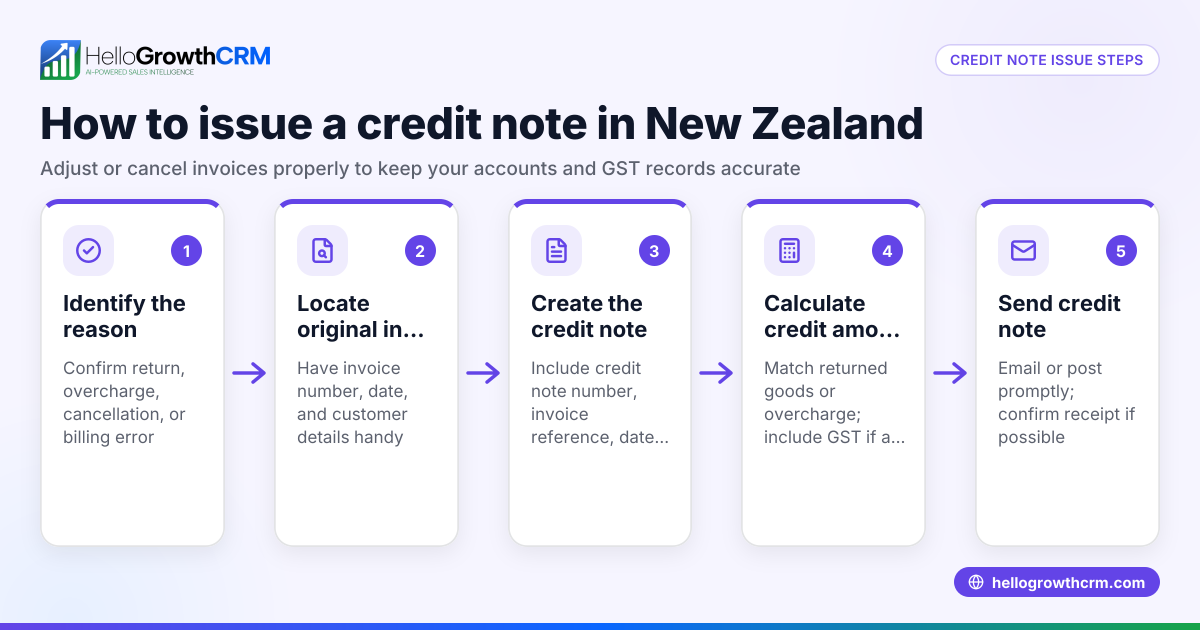
- Identify the need for a credit note: Confirm the invoice requires adjustment due to overcharge, return, or post-invoice discount.
- Gather original invoice details: Locate the original invoice number, date, customer name, and contact information.
- Create the credit note document:
- Reference the original invoice number.
- Assign a unique credit note number (different from invoice numbers).
- Include the date the credit note is issued.
- State the reason for the credit clearly (e.g., product return, pricing error, discount).
- Specify the credit amount, itemized if multiple items are involved.
- Send the credit note to the customer: Deliver the credit note by email or mail, and ask the customer to acknowledge receipt to avoid disputes.
- Adjust your accounting records: Record the credit note in your accounting system to reduce accounts receivable and sales revenue accordingly.
- Keep copies for tax and audit purposes: Store the credit note linked to the original invoice for your records.
- Review your sales process: Investigate how the error or return happened and put measures in place to prevent similar issues.
Example (fictional figures)
A staffing agency in Halifax, Nova Scotia, invoiced a client C$5,000 on 2024-05-10 for temporary staff services. Later, the client returned services valued at C$1,500 due to scheduling conflicts.
- Original invoice amount = C$5,000
- Credit amount = C$1,500
The credit note issued on 2024-05-20 would include:
- Reference invoice: #INV-2024-1001
- Credit note number: CN-2024-050
- Date: 2024-05-20
- Reason: Partial service return
- Credit amount: C$1,500
Accounting adjustment:
C$5,000 - C$1,500 = C$3,500
The client’s outstanding balance is reduced to C$3,500.
Common mistakes
- Not referencing the original invoice: Without linking the credit note to the original invoice, your records become confusing. Always include the invoice number.
- Missing unique credit note numbers: Using non-unique or no numbers makes tracking difficult. Use a clear, separate numbering system like "CN-YYYY-XXX".
- Failing to specify the reason for the credit: This causes misunderstandings with customers and accountants. Always state why the credit was issued.
- Not updating accounting records promptly: Delayed recording leads to inaccurate financial statements. Enter credits as soon as possible.
- Ignoring customer acknowledgement: Not confirming the customer received the credit note can lead to disputes. Request confirmation.
- Mixing credit notes with refunds: Credit notes adjust invoices; refunds are cash or payment returns. Keep these processes distinct.
- Overlooking electronic record-keeping: If you issue credit notes by email, keep clear digital copies and ensure they are stored securely.
Using tools like HelloGrowthCRM for Canada can help manage customer communications and keep your sales process organised. For teams using messaging, the WhatsApp and SMS CRM and built-in CRM dialer support faster follow-up and accurate record-keeping.
Frequently asked questions
What is the difference between a credit note and a refund? A credit note is a document that adjusts an invoice amount, reducing the customer’s balance owed. A refund is a payment returned to the customer as cash or other means. Credit notes affect accounts receivable, while refunds involve actual money movement.
Do I need to issue a credit note for every returned product? Yes, issuing a credit note for returned products ensures your sales and customer accounts reflect the return accurately. It also helps maintain proper tax and audit records.
Can I issue a credit note after filing my GST/HST return? You can issue credit notes after filing, but you must adjust your next GST/HST return to reflect the change in taxable sales. Keep careful records to support these adjustments. NEEDS EXPERT REVIEW
How should I number credit notes? Use a sequential and unique numbering system separate from invoices to avoid confusion. For example, prefix credit notes with "CN-" followed by the year and a sequence number.
Is a credit note required for discounts given after invoicing? Yes, if you grant a discount after invoicing, issuing a credit note documents the adjustment officially.
Can I issue a credit note electronically? Yes, electronic credit notes sent by email are acceptable, provided you keep clear records and ensure the customer receives them.
Key takeaways
- Always reference the original invoice when issuing a credit note.
- Include a unique credit note number, date, and reason for the credit.
- Send the credit note to the customer and confirm receipt.
- Update your accounting records promptly to reflect the credit.
- Use credit notes to document returns, discounts, and billing corrections.
- Keep credit notes organised for tax and audit purposes.
To keep your sales process smooth and avoid losing leads due to slow follow-up, start on the Free Forever plan (200 leads, no credit card).
Ready to put this into practice?
Set up your pipeline, WhatsApp follow-ups, and AI lead scoring in minutes — free, no credit card.
Try HelloGrowthCRM freeGet CRM tips in your inbox
Join thousands of sales professionals who get weekly insights on CRM strategy, AI automation, and pipeline optimization.

The HelloGrowthCRM team publishes guides on CRM strategy, AI sales tools, and revenue operations for small business sales teams.