HelloGrowthCRM software
Built for real small-business sales teams
HelloGrowthCRM helps reps qualify faster, follow up on time, and close more deals—with practical automation in one place.
- AI lead scoring and pipeline visibility
- Built-in dialer, WhatsApp, and email automation
- Sales forecasting and RevOps-ready reporting
Measuring customer sentiment means understanding how your customers feel about your products, services, or brand. You do this by gathering feedback, analyzing it for positive, neutral, or negative feelings, and using that insight to improve your business.
Why this comes up / what goes wrong
Small-business owners often struggle to know if their customers are happy or frustrated because feedback is scattered across emails, social media, phone calls, WhatsApp, SMS messages, and support tickets. Without a clear, organized process, important signs of dissatisfaction or praise can be missed. This leads to lost sales, poor customer retention, and missed chances to improve customer experience. Many owners rely on spreadsheets or disconnected tools, making it hard to track sentiment trends or respond quickly.
Step-by-step
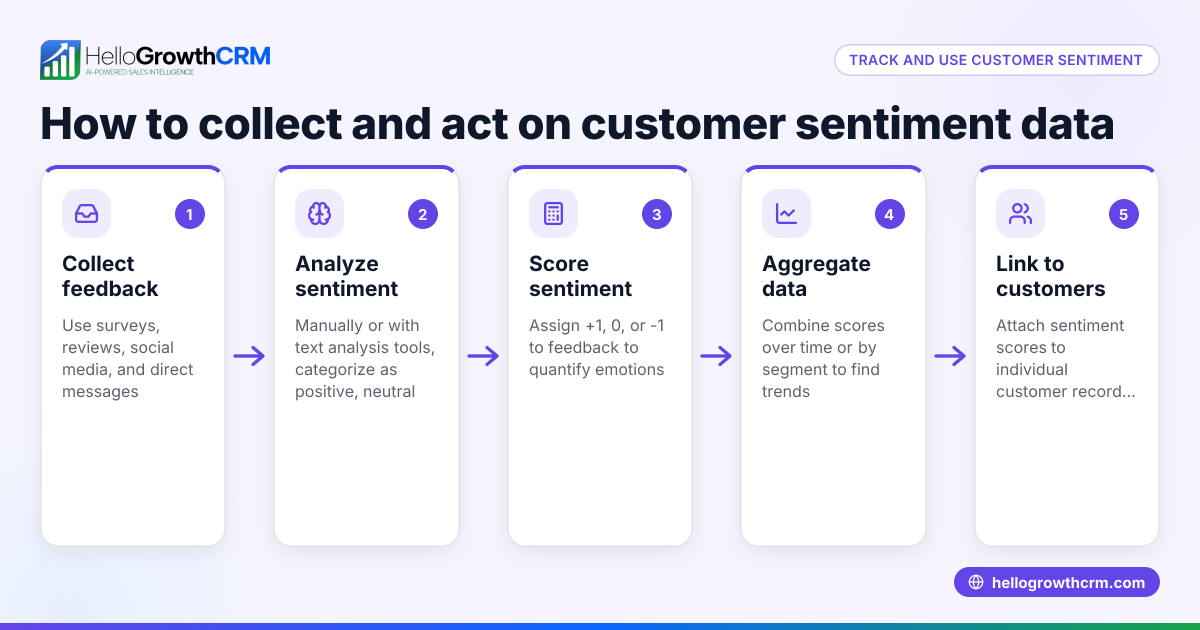
- Collect customer feedback: Gather data from multiple channels such as customer surveys, online reviews, social media comments, WhatsApp and SMS messages, and support tickets. Check you have enough responses for a meaningful sample.
- Choose a sentiment measurement method: Select a method like numeric rating scales (1–5 stars), simple positive/neutral/negative tagging, or AI-based text sentiment analysis. Confirm your method fits your data type.
- Aggregate and clean data: Group feedback into positive, neutral, and negative categories. Remove duplicates or irrelevant entries to ensure accuracy.
- Calculate sentiment scores: For rating scales, calculate the average score. For text feedback, assign values (+1 for positive, 0 for neutral, -1 for negative) and find the overall average.
- Analyze trends over time: Track sentiment scores weekly or monthly to spot improvements or declines. Check if changes relate to business events like promotions or product updates.
- Act on insights: Identify common complaints or praise and prioritize changes or marketing messages. Make sure your team understands the sentiment findings and follows up where needed.
Example (fictional figures)
A landscaping contractor in Charlotte, North Carolina, wants to measure customer sentiment for April 2026.
- They collected 100 customer survey responses with ratings from 1 (very unhappy) to 5 (very happy).
- The total sum of all ratings is 420.
- Calculate average rating: 420 ÷ 100 = 4.2
- Sentiment interpretation: An average of 4.2 indicates generally positive customer sentiment.
- They also categorized 100 online reviews: 70 positive, 20 neutral, 10 negative.
- Calculate sentiment score: (70 × +1) + (20 × 0) + (10 × -1) = 70 + 0 - 10 = 60 60 ÷ 100 = 0.6
- A score of 0.6 on a scale from -1 to +1 confirms positive sentiment.
Tracking these scores monthly helps the contractor spot shifts in customer feelings and respond quickly.
Common mistakes
- Relying on too few responses: Prevent this by collecting a representative sample size to ensure accuracy.
- Ignoring neutral feedback: Prevent this by including neutral as a category to understand indifferent customers.
- Mixing different feedback types without normalization: Prevent this by standardizing data before analysis.
- Not following up on negative sentiment: Prevent this by setting alerts for negative feedback and assigning support tickets promptly.
- Overlooking trends over time: Prevent this by regularly reviewing sentiment scores to catch changes early.
- Using sentiment data without context: Prevent this by combining sentiment with customer health score and sales data for a fuller picture (customer health score).
Doing this in HelloGrowthCRM
HelloGrowthCRM helps you measure and manage customer sentiment by keeping all service requests, referrals, and support tickets linked to the same customer record after the sale. This unified view lets you track feedback over time and respond quickly to issues. Explore how HelloGrowthCRM supports customer interactions and sentiment tracking in the US market (HelloGrowthCRM for the United States).
Frequently asked questions
What is customer sentiment analysis? Customer sentiment analysis is the process of interpreting customer feedback to determine their feelings toward your business, typically classified as positive, neutral, or negative. It helps businesses improve products and services.
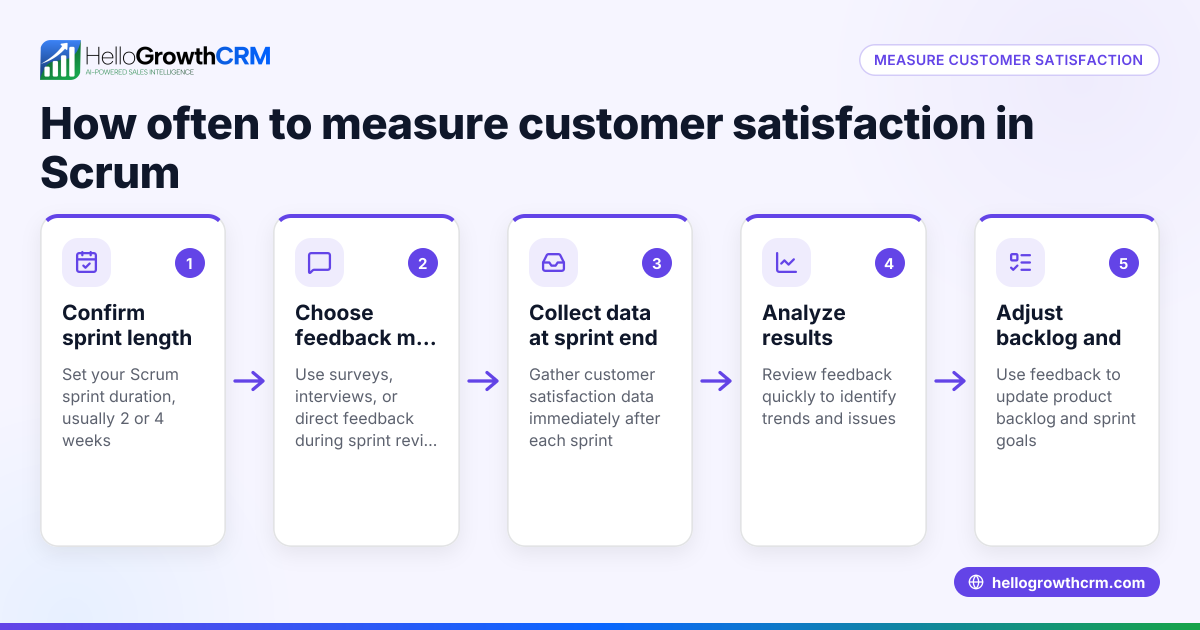
How often should I measure customer sentiment? It's best to measure sentiment regularly—monthly or quarterly—to track changes and respond to trends. Frequent measurement helps catch issues early and monitor the impact of improvements.
Can I measure sentiment from text messages and WhatsApp? Yes, you can analyze customer messages on platforms like WhatsApp and SMS for sentiment. Using a CRM that supports these channels, like HelloGrowthCRM (WhatsApp and SMS CRM), makes collecting and analyzing this data easier.
How do I handle negative sentiment effectively? Respond quickly to negative feedback by creating support tickets and following up with the customer to resolve issues. This can turn unhappy customers into loyal ones.
Is sentiment measurement the same as customer satisfaction? Sentiment measures feelings expressed in feedback, which can be broader than satisfaction scores that usually come from specific survey questions. Both are useful but focus on different aspects.
Key takeaways
- Collect diverse customer feedback from surveys, reviews, social media, WhatsApp, SMS, and support tickets.
- Use clear methods like rating scales or sentiment scoring to analyze customer feelings.
- Track sentiment trends over time to detect changes and act promptly.
- Avoid common mistakes like small samples, ignoring neutral feedback, and mixing data types.
- Use tools like HelloGrowthCRM to unify customer service records and improve sentiment management.
Measuring customer sentiment helps you understand your customers better and improve your business. Start measuring today with the steps above and manage customer feedback efficiently with HelloGrowthCRM. Start on the Free Forever plan (200 leads, no credit card).
Ready to put this into practice?
Set up your pipeline, WhatsApp follow-ups, and AI lead scoring in minutes — free, no credit card.
Try HelloGrowthCRM freeGet CRM tips in your inbox
Join thousands of sales professionals who get weekly insights on CRM strategy, AI automation, and pipeline optimization.

The HelloGrowthCRM team publishes guides on CRM strategy, AI sales tools, and revenue operations for small business sales teams.