HelloGrowthCRM software
Built for real small-business sales teams
HelloGrowthCRM helps reps qualify faster, follow up on time, and close more deals—with practical automation in one place.
- AI lead scoring and pipeline visibility
- Built-in dialer, WhatsApp, and email automation
- Sales forecasting and RevOps-ready reporting
Organising customer requests from multiple channels is crucial for small New Zealand businesses to avoid missed leads and slow responses. The key is to centralise all requests into one system where you can track, prioritise, and respond efficiently. This article covers why this problem arises, step-by-step instructions to set up a system, a worked example with NZD figures, common mistakes to avoid, and how HelloGrowthCRM supports this process.
Why this comes up / what goes wrong
Many small businesses in New Zealand receive customer requests from various channels such as email, phone calls, WhatsApp, SMS, and website forms. Without a single system to manage these, requests often get lost or delayed. For example, a customer might send a WhatsApp message that goes unnoticed while the team focuses on emails. Businesses sometimes rely on spreadsheets, notes, or separate apps for each channel, which causes confusion, slow follow-up, and lost sales opportunities.
Step-by-step
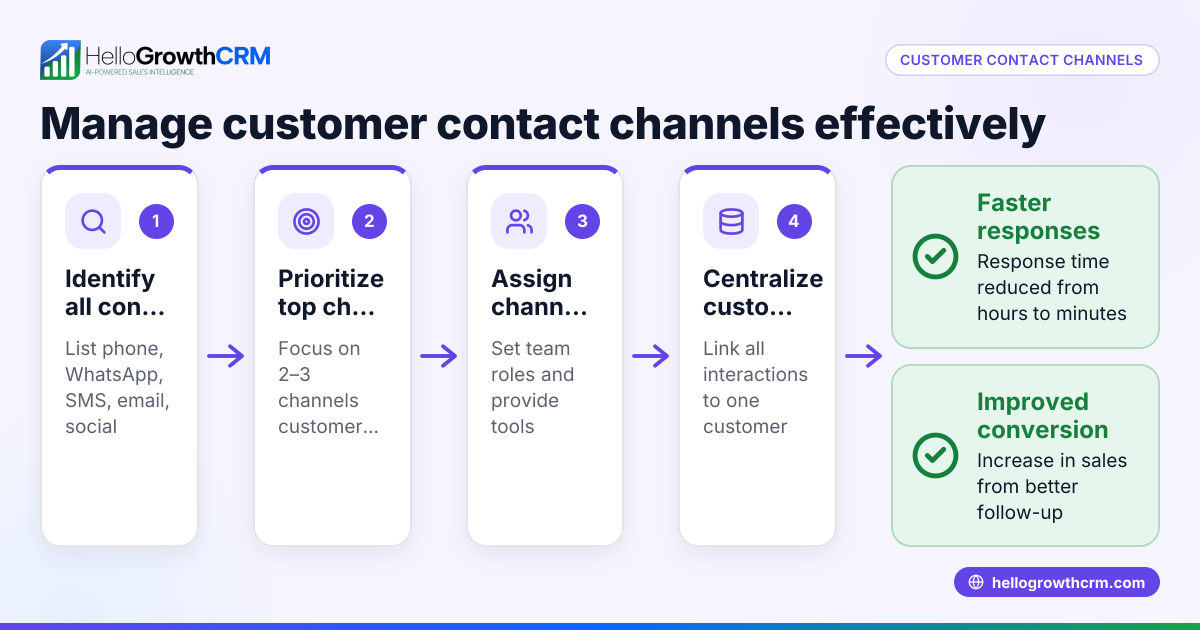
- Identify all customer request channels
- List every channel customers use to contact you: email, phone, WhatsApp, SMS, web forms, social media.
- Check regularly to add any new channels.
- Choose a single place to collect requests
- Use a CRM or ticketing system that can capture requests from all channels in one place.
- If you don’t have software, create one master spreadsheet or document to record every request.
- Standardise what information to capture
- For each request, record: customer name, contact details, channel, date/time, request details, and urgency.
- Use a simple form or template to keep data consistent and easy to follow.
- Assign requests to team members for follow-up
- Decide who handles which requests or customers.
- Track the status of each request: new, in progress, resolved.
- Prioritise requests and set deadlines
- Sort requests by urgency or business value.
- Set clear deadlines to respond or resolve each request.
- Follow up and update request status regularly
- Communicate with customers promptly.
- Update the request status as progress is made.
- Review and report weekly
- Check how many requests were received, pending, or overdue.
- Use this to improve response times and customer satisfaction.
Example (fictional figures)
Kiwi Adventures, a Queenstown tourism operator, receives customer requests via email, WhatsApp, phone, and their website.
On 10/04/2024, they received:
- 5 emails
- 3 WhatsApp messages
- 2 phone calls
- 4 web form submissions
They record each request in a spreadsheet:
| Request | Channel | Customer Name | Date | Details | Assigned To | Status | Priority |
|---|---|---|---|---|---|---|---|
| 1 | Sarah Jones | 10/04/2024 | Booking enquiry | Alice | New | High | |
| 2 | Mike Turner | 10/04/2024 | Equipment hire | Bob | In progress | Medium | |
| 3 | Phone call | Emma Wilson | 10/04/2024 | Cancellation request | Alice | New | High |
| 4 | Web form | John Smith | 10/04/2024 | Tour information | Carol | Resolved | Low |
They prioritise cancellation and booking enquiries as High priority, aiming to respond within 4 hours. Equipment hire is Medium priority with a 24-hour response target, and general information requests are Low priority.
The total number of requests is:
5 (emails) + 3 (WhatsApp) + 2 (phone calls) + 4 (web forms) = 14 requests
Kiwi Adventures assigns team members to each request and tracks progress daily, ensuring no request is missed or delayed.
Common mistakes
- Not centralising requests: Requests scattered across apps and notes get lost. Prevent by consolidating all requests into one system.
- Inconsistent data capture: Missing key information delays responses. Use a standard template for every request.
- Ignoring some channels: Overlooking WhatsApp or social media messages causes lost leads. Regularly review all channels.
- No assignment or follow-up: Requests remain unassigned and forgotten. Assign owners and track progress.
- No prioritisation: Treating all requests equally wastes time. Sort by urgency and value.
- Failing to review performance: Without tracking response times, no improvements happen. Review weekly and adjust.
See more about managing customer engagement with a customer health score.
Doing this in HelloGrowthCRM
HelloGrowthCRM helps by providing a customer portal, referrals, tickets, and a knowledge base to keep service requests organised. After a sale, all service requests stay on the same customer record as the deal, which simplifies follow-up. The ticket system and knowledge base help your team track and resolve requests from multiple channels including WhatsApp and email. Learn more about HelloGrowthCRM for New Zealand businesses at HelloGrowthCRM for New Zealand.
Frequently asked questions
How can I track customer requests from WhatsApp and SMS? You can use a CRM that integrates WhatsApp and SMS messages into one inbox to track requests. This prevents messages from getting lost and allows you to respond quickly. HelloGrowthCRM supports WhatsApp and SMS CRM features to manage these channels efficiently. See WhatsApp and SMS CRM.
What is the best way to prioritise customer requests? Prioritise requests based on urgency and potential business value. For example, booking cancellations or new sales enquiries should get faster responses than general questions. Use a simple priority system like High, Medium, Low and set deadlines accordingly.
How often should I review my customer request process? Review your process weekly or monthly to identify bottlenecks or delays. Tracking metrics like average response time and number of unresolved tickets helps improve your system. Consider using a customer health score to monitor customer engagement.
Can I handle referrals and customer requests in the same system? Yes, managing referrals alongside customer requests in one CRM keeps all customer interactions in one place. HelloGrowthCRM includes referral programme tracking integrated with customer records.
Key takeaways
- Centralise all customer requests from email, phone, WhatsApp, SMS, and web forms into one system.
- Standardise information captured for each request to ensure consistent follow-up.
- Assign requests to team members and prioritise by urgency and value.
- Regularly review and report on request status to improve response times.
- Avoid common mistakes like scattered data and no prioritisation.
- Use HelloGrowthCRM’s customer portal and ticket system to keep all requests linked to customer records.
Start organising your customer requests today to improve response times and customer satisfaction. Start on the Free Forever plan (200 leads, no credit card).
Ready to put this into practice?
Set up your pipeline, WhatsApp follow-ups, and AI lead scoring in minutes — free, no credit card.
Try HelloGrowthCRM freeGet CRM tips in your inbox
Join thousands of sales professionals who get weekly insights on CRM strategy, AI automation, and pipeline optimization.

The HelloGrowthCRM team publishes guides on CRM strategy, AI sales tools, and revenue operations for small business sales teams.