HelloGrowthCRM software
Built for real small-business sales teams
HelloGrowthCRM helps reps qualify faster, follow up on time, and close more deals—with practical automation in one place.
- AI lead scoring and pipeline visibility
- Built-in dialer, WhatsApp, and email automation
- Sales forecasting and RevOps-ready reporting
To qualify a sales lead in the USA, you must quickly determine whether the lead is a good fit for your product or service and worth pursuing. This involves checking if the lead matches your target customer profile, has the budget, authority, need, and timeline to buy. This article explains why qualifying leads is essential, lays out the steps to qualify leads clearly, provides a practical example with US dollar figures, outlines common mistakes, and shows how HelloGrowthCRM can help streamline the process.
Why this comes up / what goes wrong
Small and mid-sized businesses in the US often receive many inquiries from potential customers through various channels like web forms, calls, or WhatsApp messages. Without a clear method to qualify these leads, sales teams waste time chasing prospects who are unlikely to buy. This slows down follow-up, causes lost sales, and makes forecasting unreliable. Many businesses try to track leads with spreadsheets or notes, leading to disorganization and missed opportunities. A step-by-step qualification process helps prioritize leads that are most likely to convert and focus sales efforts efficiently.
Step-by-step
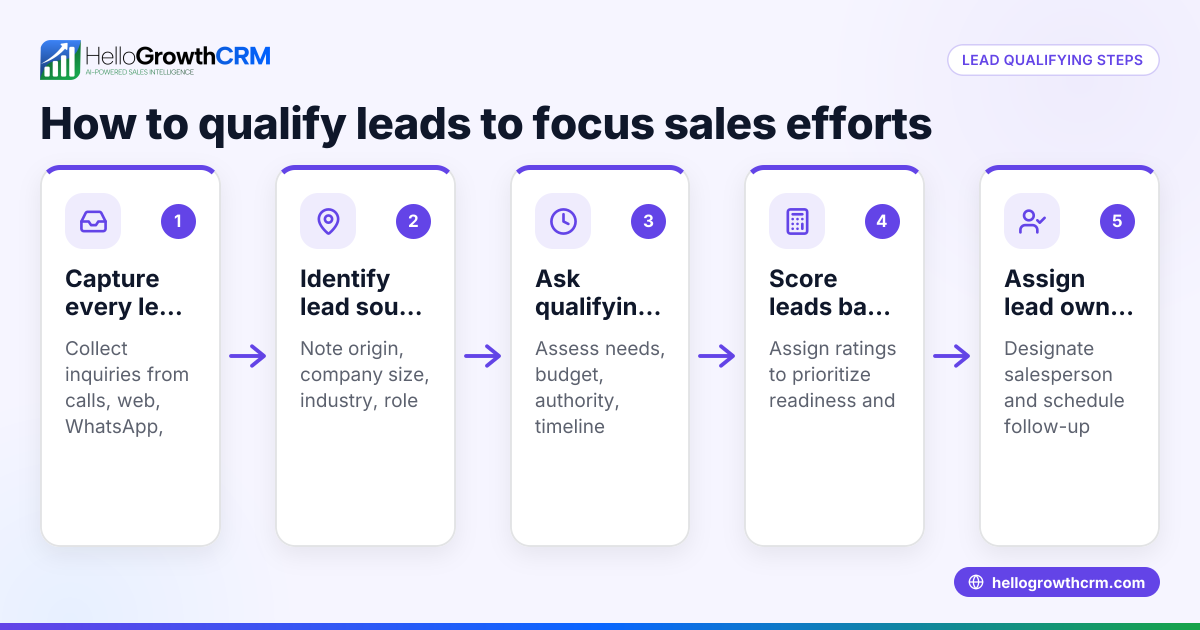
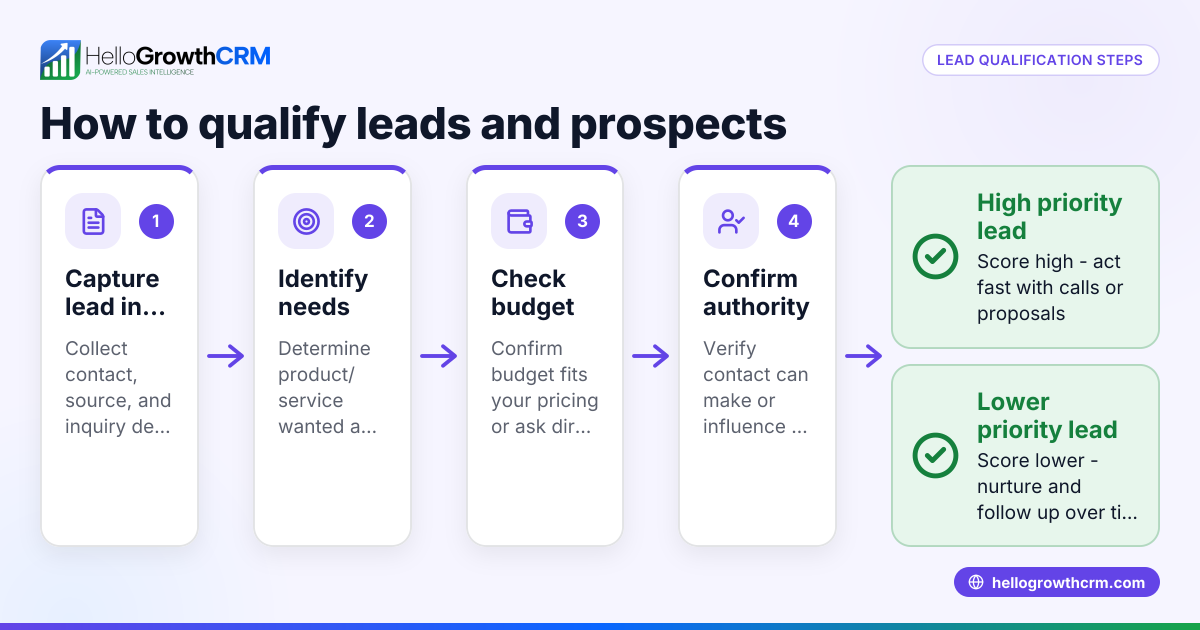
- Identify the lead source and capture details: Record where the lead came from (web form, call, WhatsApp) and collect contact information. This ensures no lead is lost and starts the qualification process.
- Check if the lead fits your target market: Confirm if the lead’s industry, location, company size, or other criteria match your ideal customer profile. If not, deprioritize or disqualify.
- Determine budget availability: Ask or infer if the lead has a budget allocated for your product or service. Leads without budget should be flagged for nurturing or disqualified.
- Confirm decision-making authority: Verify if the contact person can make or influence purchasing decisions. Leads without authority may need to be escalated or deprioritized.
- Assess the lead’s needs: Understand the problem the lead wants to solve and whether your offerings meet those needs.
- Establish the buying timeline: Find out when the lead plans to purchase. Leads with immediate or near-term timelines are higher priority.
- Score the lead: Assign a score based on the above factors to rank leads by conversion likelihood. This helps prioritize follow-up.
- Assign the lead and set next steps: Allocate the lead to a sales team member with clear next actions and follow-up dates.
- Track progress through stages: Move the lead through pipeline stages such as 'new', 'contacted', 'qualified', 'proposal sent', and 'closed' to monitor status.
Following these steps ensures your sales team focuses on leads that are ready and able to buy, improving conversion rates and sales efficiency. For managing this process, tools like sales task boards help visualize and organize next steps and priorities. See sales task boards for details.
Example (fictional figures)
Phoenix Residential Real Estate Team receives an inquiry on 06/10/2024 from a potential client, John Smith, interested in buying a home.
- Lead source: Website form
- Target market fit: John is looking in Phoenix, Arizona, within the team's service area — fits.
- Budget: John states he has $500,000 saved for a down payment.
- Authority: John is the buyer, full decision-maker.
- Needs: Wants a 3-bedroom house near schools.
- Timeline: Plans to buy within 3 months.
Lead score calculation (illustrative):
- Target market fit: 30 points
- Budget available: 25 points
- Decision authority: 20 points
- Needs match: 15 points
- Buying timeline: 10 points
Total score = 30 + 25 + 20 + 15 + 10 = 100 points
Since John scores 100 points, he is a high-priority lead. The sales rep assigns John a next step to schedule a property viewing within 2 days.
Common mistakes
- Not verifying decision authority: Contacting someone without buying power wastes time. Always confirm authority early.
- Ignoring budget constraints: Pursuing leads without budget leads to dead ends. Ask about budget upfront.
- Failing to track leads systematically: Using notebooks or spreadsheets causes lost leads. Use a lead management system.
- Delaying follow-up: Slow responses lose leads to competitors. Prioritize leads with AI lead scoring to call the best first. Learn more about AI lead scoring.
- Skipping needs assessment: Offering irrelevant solutions frustrates leads. Understand their needs before proposing.
- Not setting clear next steps: Leads stall without assigned owners or follow-up dates. Use sales task boards to keep on track.
Doing this in HelloGrowthCRM
HelloGrowthCRM helps small and mid-sized US businesses qualify and manage leads efficiently. Every enquiry from a form, call, or WhatsApp lands as a lead with an owner and a next step, preventing leads from getting lost in notebooks or spreadsheets. AI lead scoring prioritizes leads so telecallers call those most likely to convert first. Deals (pipeline) track quotations and follow-ups at each stage, like 'quote sent', ensuring no opportunity is forgotten. Explore how HelloGrowthCRM supports your sales process at HelloGrowthCRM for the United States.
Frequently asked questions
How do I follow up with sales leads in the USA? Follow up promptly, ideally within 24 hours. Use a clear next step like scheduling a call or meeting. Personalize communication based on the lead’s needs and buying timeline. Automate reminders and sequences with tools like email automation and sequences to maintain consistent contact.
What criteria should I use to qualify a sales lead? Use criteria like target market fit, budget, decision authority, needs, and buying timeline. These factors help determine if the lead is worth pursuing now or needs nurturing.
How often should I review and update lead qualification? Regularly review leads as new information comes in or as timelines change. Update scores and pipeline stages to reflect the current status and maintain focus on the most promising leads.
Can AI help with lead qualification? Yes, AI lead scoring can analyze lead data to rank leads by likelihood to convert, helping sales teams prioritize calls and follow-ups effectively.
What is the best way to organize leads for a small sales team? Use a CRM with lead capture, qualification, and pipeline features. Assign owners and next steps clearly. Visual tools like sales task boards help track progress and deadlines.
Key takeaways
- Qualify leads by checking target market fit, budget, authority, needs, and timeline.
- Score leads to prioritize follow-up and focus sales efforts.
- Use a system to capture, assign, and track leads instead of notebooks or spreadsheets.
- Avoid common mistakes like ignoring budget or delaying follow-up.
- Tools like AI lead scoring and sales task boards improve lead management efficiency.
- HelloGrowthCRM supports lead capture, qualification, and pipeline tracking for US businesses.
Start qualifying your leads today with a clear process and tools that keep your sales organized. Start on the Free Forever plan (200 leads, no credit card).
Ready to put this into practice?
Set up your pipeline, WhatsApp follow-ups, and AI lead scoring in minutes — free, no credit card.
Try HelloGrowthCRM freeGet CRM tips in your inbox
Join thousands of sales professionals who get weekly insights on CRM strategy, AI automation, and pipeline optimization.

The HelloGrowthCRM team publishes guides on CRM strategy, AI sales tools, and revenue operations for small business sales teams.