HelloGrowthCRM software
Built for real small-business sales teams
HelloGrowthCRM helps reps qualify faster, follow up on time, and close more deals—with practical automation in one place.
- AI lead scoring and pipeline visibility
- Built-in dialer, WhatsApp, and email automation
- Sales forecasting and RevOps-ready reporting
To quote tree removal accurately, you need to evaluate the job thoroughly and calculate all associated costs clearly. This includes measuring the tree, considering access difficulties, estimating labor and equipment needs, disposal fees, and any permits required. Then add your profit margin and contingencies. This guide walks you through each step, offers a realistic example with numbers, points out common quoting errors, and explains how HelloGrowthCRM can streamline your quoting process.
Why this comes up / what goes wrong
Small business owners offering tree removal often struggle to provide clear, accurate quotes quickly. Customers expect transparent pricing but tree removal costs vary widely based on tree size, location, and complexity. Without a structured method, quotes can be too low (leading to lost profit) or too high (losing the job). Manually tracking quotes, follow-ups, and payments across text messages, emails, and spreadsheets wastes time and risks errors. This leads to lost leads and frustrated customers who may turn to competitors.
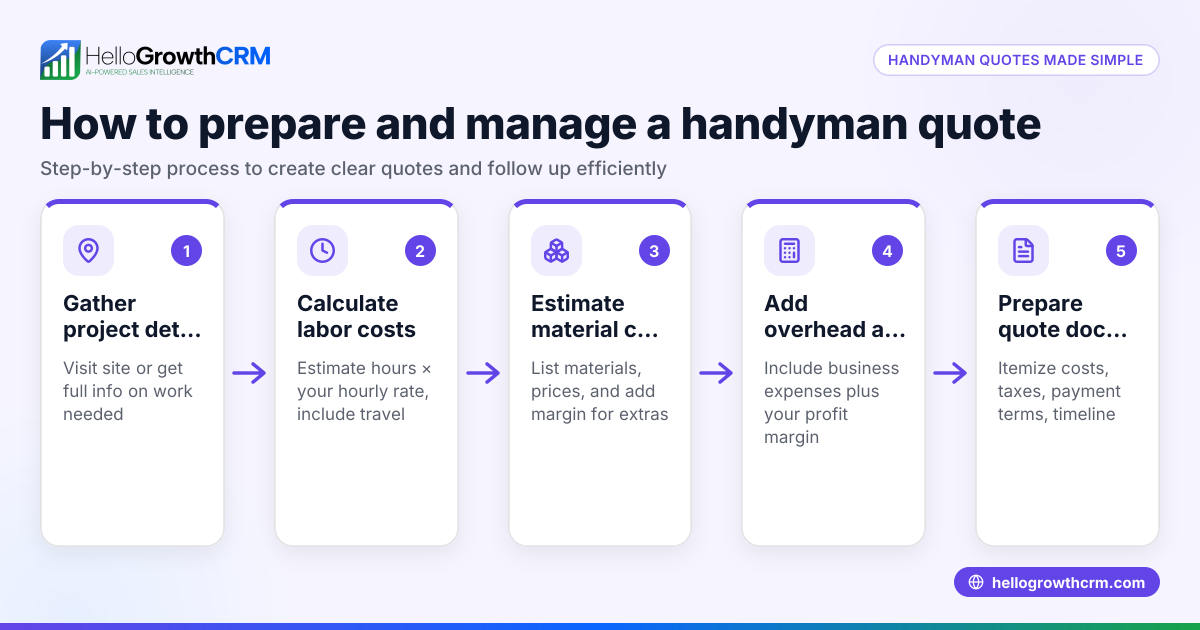
Step-by-step
- Inspect the Tree and Site: Measure the tree height and trunk diameter. Note the species if it affects difficulty. Check access for equipment and disposal trucks. Take photos for your records.
- Assess Hazards and Complexity: Identify power lines, structures, slopes, or other obstacles near the tree. These increase risk and labor requirements, so factor them into your estimate.
- Estimate Labor Hours: Based on the tree size and site hazards, estimate total crew hours needed for cutting, removal, and cleanup. Include time for stump grinding if part of the job.
- Calculate Equipment Costs: Include rental or depreciation for chainsaws, cranes, stump grinders, trucks, and safety gear. Also account for fuel and maintenance costs.
- Estimate Disposal Fees: Contact local landfill or green waste facilities to find fees per ton or cubic yard. Estimate the volume or weight of debris for disposal cost.
- Check Permit Requirements: Some cities or counties require permits for tree removal. Confirm local regulations and include permit fees and time to obtain them.
- Add Contingency: Add a percentage of the subtotal to cover unexpected issues like hidden roots, difficult weather, or extra cleanup. A typical range is 10% to 15%, but adjust based on job complexity.
- Calculate Profit Margin: Add your desired profit margin (usually 20% to 30%) on top of the total cost including contingency.
- Prepare the Quote Document: Itemize costs clearly: labor, equipment, disposal, permits, contingency, and profit. Use clear language and include terms and conditions.
- Send and Track the Quote: Use a CRM or quoting tool to send the quote. Monitor whether the customer views it and schedule follow-ups to close the deal.
Example (fictional figures)
A Denver, Colorado tree removal company quotes a 60-foot pine tree removal on 06/15/2026.
- Labor: 3 crew members × 8 hours × $30/hour = $720
- Equipment rental: Chainsaw + stump grinder for 1 day = $200
- Fuel and maintenance: estimated = $50
- Disposal: 2 tons at $40/ton = $80
- Permit fee: $75
- Subtotal = $720 + $200 + $50 + $80 + $75 = $1,125
- Contingency (12%): $1,125 × 0.12 = $135
- Total cost = $1,125 + $135 = $1,260
- Profit margin (25%): $1,260 × 0.25 = $315
- Final quote = $1,260 + $315 = $1,575
Quote presented to customer: $1,575 (rounded)
Common mistakes
- Underestimating site hazards: Always inspect for power lines, structures, or slopes to avoid surprises. Prevent by thorough site visits and photos.
- Ignoring disposal costs: Disposal fees vary by location and volume. Confirm local rates before quoting to avoid losing money.
- Not including permits: Check local regulations for permit requirements. Exclude them and you risk fines or delays.
- Skipping contingency: Unexpected problems arise often. Add a contingency buffer to protect your profit.
- Poor follow-up on quotes: Leads go cold without timely follow-up. Use a CRM to track quote status and schedule reminders.
- Using multiple tools for quotes and communication: Managing quotes via text, email, and spreadsheets causes confusion. Consolidate quoting and follow-up in one system like HelloGrowthCRM to stay organized.
Doing this in HelloGrowthCRM
HelloGrowthCRM lets you build, send, and track quotes directly from the deal record. You can see the quote status—sent, viewed, or accepted—on the same screen as your follow-up task. This keeps your sales process organized and speeds up closing. Learn more about HelloGrowthCRM’s built-in CRM dialer and WhatsApp and SMS CRM features to communicate efficiently with leads and customers.
Frequently asked questions
How do I estimate labor costs for tree removal? Estimate the number of crew members and hours needed based on tree size and site difficulty. Multiply crew hours by hourly wages including benefits and overhead.
What equipment costs should I include? Include rental or depreciation of chainsaws, cranes, stump grinders, trucks, plus fuel and maintenance costs.
Do I need permits for tree removal? Permit requirements vary by city or county. Check local regulations and include any fees or time delays in your quote.
How do I handle disposal fees? Contact local landfill or green waste facilities to get per-ton or per-cubic-yard fees. Include these in your cost estimate.
Can I send and track quotes digitally? Yes, using a CRM like HelloGrowthCRM, you can create quotes, send them via email or WhatsApp, and track if the customer viewed or accepted them.
What if a customer wants to negotiate the quote? Be prepared with a clear breakdown of costs and explain why each item is necessary. Use your CRM to update and resend revised quotes quickly.
Key takeaways
- Inspect the tree and site carefully to assess size, hazards, and access.
- Calculate labor, equipment, disposal, permits, contingency, and profit separately.
- Add a contingency buffer for unexpected costs, commonly around 10-15%.
- Use a CRM to send, track, and follow up on quotes efficiently.
- Avoid common mistakes like ignoring permits or disposal fees.
- HelloGrowthCRM integrates quoting and follow-up tasks on one screen.
Start quoting tree removal jobs confidently today. Start on the Free Forever plan (200 leads, no credit card) with HelloGrowthCRM to manage your quotes and sales pipeline efficiently.
Ready to put this into practice?
Set up your pipeline, WhatsApp follow-ups, and AI lead scoring in minutes — free, no credit card.
Try HelloGrowthCRM freeGet CRM tips in your inbox
Join thousands of sales professionals who get weekly insights on CRM strategy, AI automation, and pipeline optimization.

The HelloGrowthCRM team publishes guides on CRM strategy, AI sales tools, and revenue operations for small business sales teams.