HelloGrowthCRM software
Built for real small-business sales teams
HelloGrowthCRM helps reps qualify faster, follow up on time, and close more deals—with practical automation in one place.
- AI lead scoring and pipeline visibility
- Built-in dialer, WhatsApp, and email automation
- Sales forecasting and RevOps-ready reporting
To send a formal email, begin by clearly stating your purpose, addressing the recipient with an appropriate salutation, and using professional language throughout. Make sure your subject line is concise and relevant, and close your email politely with your full name and contact details. This guide explains why formal emails are important for small UK businesses, walks you through each step, provides a worked example, highlights common errors, and shows how HelloGrowthCRM simplifies email follow-up.
Why this comes up / what goes wrong
Small business owners in the UK often need to send formal emails to clients, suppliers, or partners but may struggle with what to include, how to sound professional, or how to ensure their message is clear and timely. Many rely on informal tools like WhatsApp or spreadsheets, which can cause missed replies or inconsistent communication. Without a clear method, emails can be too casual, unclear, or even ignored, risking lost sales or damaged relationships.
Step-by-step
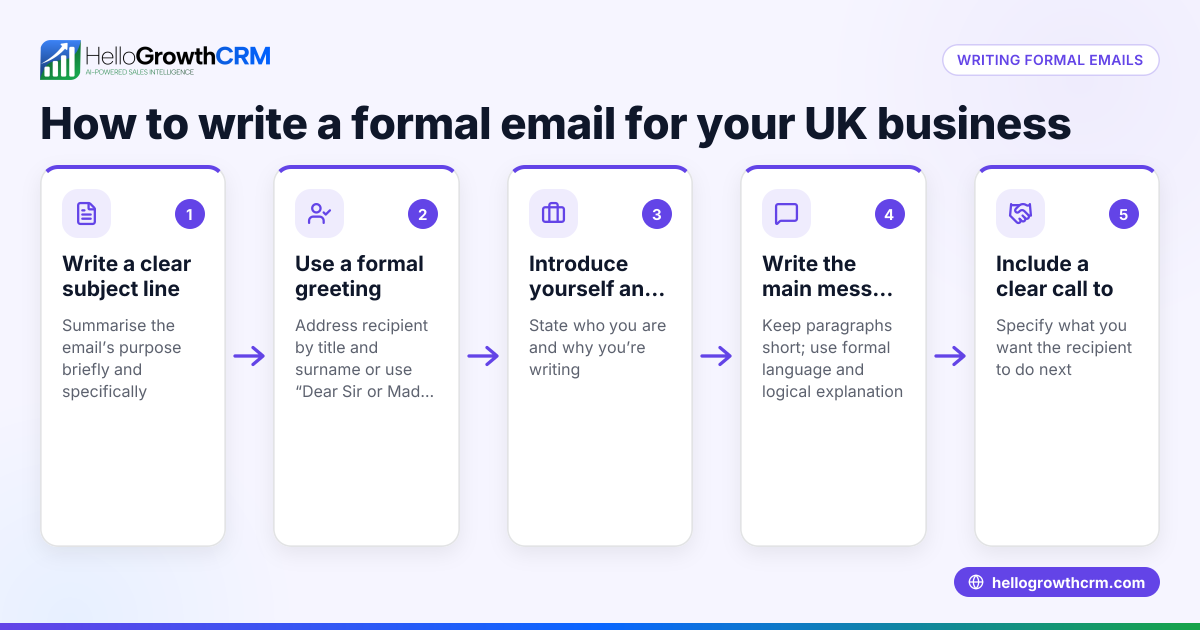
- Identify the recipient and purpose: Know who you are emailing and why. Check their correct email address.
- Write a clear subject line: Summarise the email’s purpose in a few words, e.g. "Quotation for Recruitment Services – Bristol Office".
- Start with a formal greeting: Use "Dear Mr Smith," or "Dear Ms Jones,". If unsure of the name, "Dear Sir or Madam," is acceptable.
- Introduce yourself briefly: State your name and company if the recipient may not know you.
- State the purpose early: In the first sentence or two, say why you are writing.
- Provide necessary details logically: Use short paragraphs or bullet points for clarity.
- Use polite and professional language: Avoid slang, contractions (use "do not" instead of "don’t"), and emoticons.
- Include a clear call to action: What do you want the recipient to do next?
- Close formally: Use "Kind regards," or "Yours sincerely," followed by your full name, job title, company, and contact details.
- Proofread before sending: Check spelling, grammar, and tone. Verify all names, dates, and figures.
Example (fictional figures)
A recruitment consultancy in Bristol wants to send a formal quotation email on 15/04/2026.
- Subject: "Quotation for Recruitment Services – Bristol Office"
- Email body: "Dear Ms Taylor,
I am John Roberts from Bristol Recruitment Ltd. Following our recent conversation, please find below our quotation for recruitment services.
Our fee is based on a percentage of the candidate’s first annual salary.
For example, for a candidate with a £40,000 salary: £40,000 × 10% = £4,000
This fee covers candidate sourcing, screening, and initial interviews.
Please let me know if you would like to proceed or have any questions.
Kind regards, John Roberts Bristol Recruitment Ltd john.roberts@bristolrecruitment.co.uk 0117 123 4567"
This example shows a clear subject, polite greeting, introduction, purpose, detailed calculation, call to action, and formal closing.
Common mistakes
- Using informal language: Avoid slang or casual phrases. Prevent by reading your email aloud and removing contractions.
- Forgetting to check recipient details: Double-check email addresses to avoid sending to the wrong person.
- Writing long, dense paragraphs: Break information into short paragraphs or bullet points for easy reading.
- Neglecting proofreading: Use spellcheck tools and review grammar before sending.
- Omitting a clear call to action: Always specify what you want the recipient to do next.
- Not including contact details: Make it easy for recipients to reply or call by adding your full contact info.
For more on managing email follow-up efficiently, see email automation and sequences.
Doing this in HelloGrowthCRM
HelloGrowthCRM includes a shared inbox called HelloMail, which helps your team manage replies to formal emails like quotations. Everyone on the deal can see replies without switching apps. You can also set up sequences and campaigns: a five-step follow-up over two weeks runs automatically and stops as soon as the prospect replies, ensuring timely and consistent communication. Learn more about these features at email automation and sequences.
Frequently asked questions
What is the best way to address someone in a formal email? Use "Dear" followed by the recipient’s title and surname, such as "Dear Mr Brown," or "Dear Dr Patel,". If the name is unknown, "Dear Sir or Madam," is acceptable.
How long should a formal email be? Keep it concise but complete. Aim for a few short paragraphs or bullet points that clearly explain your purpose without unnecessary detail.
Can I use contractions in formal emails? It is best to avoid contractions like "don’t" or "can’t" in formal emails. Use the full forms "do not" and "cannot" to maintain professionalism.
Should I include a signature in a formal email? Yes, always include your full name, job title, company name, and contact details to make it easy for the recipient to respond.
How can I follow up a formal email if I get no reply? Use polite follow-up emails or automated sequences like those in HelloGrowthCRM to remind recipients without seeming pushy. See WhatsApp and SMS CRM for multi-channel follow-up options.
Key takeaways
- Start with a clear subject and formal greeting.
- Use polite, professional language and structure your message logically.
- Include a clear call to action and full contact details.
- Proofread carefully to avoid errors.
- Use HelloGrowthCRM’s HelloMail shared inbox and automated sequences to manage replies and follow-ups efficiently.
Sending formal emails need not be difficult. With these steps and tools, you can communicate professionally and keep your business relationships on track.
Start on the Free Forever plan (200 leads, no credit card) at HelloGrowthCRM.
Ready to put this into practice?
Set up your pipeline, WhatsApp follow-ups, and AI lead scoring in minutes — free, no credit card.
Try HelloGrowthCRM freeGet CRM tips in your inbox
Join thousands of sales professionals who get weekly insights on CRM strategy, AI automation, and pipeline optimization.

The HelloGrowthCRM team publishes guides on CRM strategy, AI sales tools, and revenue operations for small business sales teams.