HelloGrowthCRM software
Built for real small-business sales teams
HelloGrowthCRM helps reps qualify faster, follow up on time, and close more deals—with practical automation in one place.
- AI lead scoring and pipeline visibility
- Built-in dialer, WhatsApp, and email automation
- Sales forecasting and RevOps-ready reporting
Writing a formal email is essential for small and mid-sized UK businesses aiming to communicate professionally with clients, suppliers, and partners. A formal email follows a clear structure: a polite greeting, a focused message, and a respectful closing. It helps convey credibility and ensures your message is understood as intended.
Why this comes up / what goes wrong
Small-business owners often need to write formal emails for quotations, appointments, complaints, or follow-ups. However, many struggle with unclear wording, informal tone, or missing key information. This can cause confusion or delay responses, which is costly when leads or clients lose confidence. Writing a formal email correctly improves clarity, professionalism, and response rates.
Step-by-step
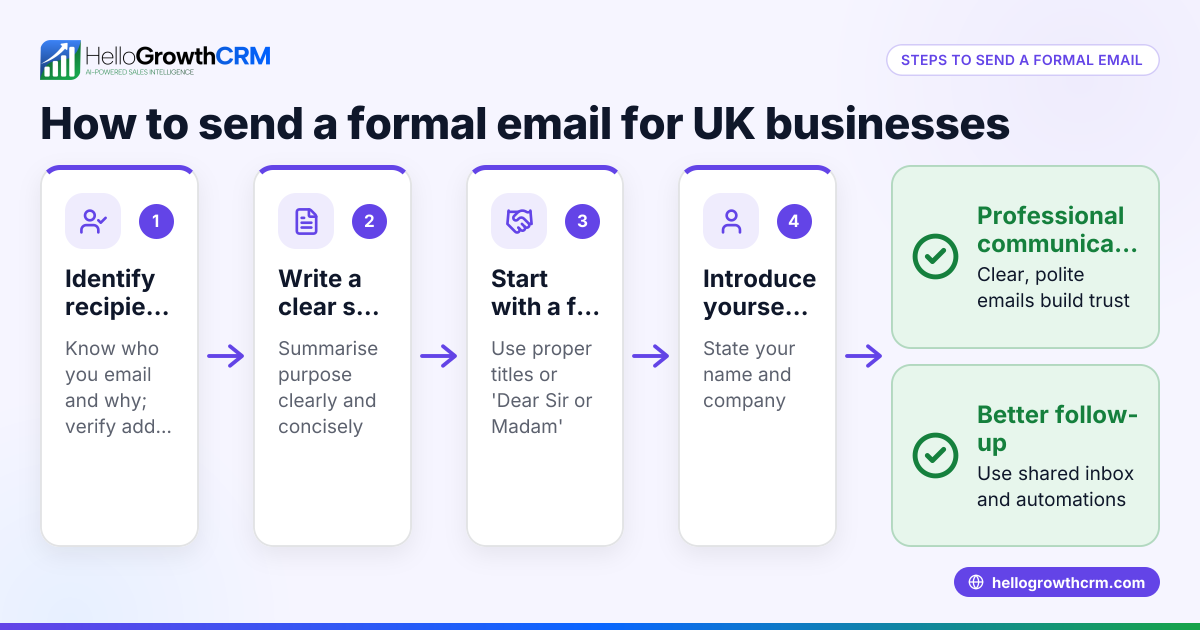
- Start with a clear subject line: Summarise the email’s purpose in a few words. Check it is relevant and specific, e.g. "Quotation for Solar Panel Installation – 15/07/2026".
- Use a formal greeting: Address the recipient by title and surname if known, e.g. "Dear Mr Smith," or "Dear Ms Jones,". If unknown, use "Dear Sir or Madam,".
- Introduce yourself and your business briefly: State who you are and why you are writing. This helps the recipient place your email in context.
- Write the main message clearly and politely: Keep paragraphs short. Use formal language and avoid slang or contractions (write "do not" instead of "don’t"). Explain your point logically, e.g. quotation details or meeting request.
- Include a clear call to action: Specify what you want the recipient to do next, such as "Please confirm your availability" or "Kindly review the attached quotation".
- Close politely with a formal sign-off: Use phrases like "Yours sincerely," if you know the name, or "Yours faithfully," if you do not. Add your full name, position, and contact details.
- Proofread before sending: Check spelling, grammar, and tone. Confirm attachments are included if referenced.
- Use a professional email signature: Include your company name, phone number, and website.
- Keep a copy and track replies: Save sent emails and note responses to follow up promptly.
Using a CRM like HelloGrowthCRM helps automate and organise follow-ups, so no lead or enquiry is missed. See more on email automation and sequences.
Example (fictional figures)
A Glasgow-based solar panel installer needs to send a quotation email dated 15/07/2026 to a potential client.
Subject: Quotation for Solar Panel Installation – 15/07/2026
Dear Mr Brown,
Thank you for your enquiry regarding solar panel installation at your property. We are pleased to provide the following quotation:
- Installation cost: £12,000
- Estimated completion time: 4 weeks
- Warranty: 10 years
Please review the attached document for full details. Kindly confirm if you would like to proceed by 22/07/2026.
Yours sincerely,
Jane Wilson Sales Manager SunPower Solutions Phone: 0141 555 1234 Email: jane.wilson@sunpower.co.uk
This email is clear, polite, and includes a call to action with a deadline.
Common mistakes
- Using informal language or slang: Prevent by sticking to formal phrases and avoiding contractions.
- Omitting a clear subject line: Always summarise the email purpose to help the recipient prioritise.
- Writing long, dense paragraphs: Break text into short paragraphs for readability.
- Forgetting to proofread: Always check spelling and grammar to maintain professionalism.
- Not including a call to action: Specify the next step to avoid confusion.
- Sending emails without tracking replies: Use tools like HelloGrowthCRM to monitor and follow up leads efficiently.
For more on managing follow-ups, see WhatsApp and SMS CRM.
Doing this in HelloGrowthCRM
HelloGrowthCRM offers a shared inbox called HelloMail, where your team can see all replies to quotation emails on each deal, avoiding missed messages. You can also set up sequences and campaigns that automate a five-step follow-up over two weeks, stopping as soon as the prospect replies. This keeps your communication timely without manual effort. Learn more about these features at email automation and sequences.
Frequently asked questions
What is the difference between a formal and informal email? A formal email uses polite language, full sentences, and a professional tone. Informal emails are casual and may use slang or contractions. Formal emails suit business communication to maintain respect and clarity.
How long should a formal email be? Keep it concise but complete. Usually, one to three short paragraphs are enough to convey your message clearly without overwhelming the reader.
Can I use contractions in a formal email? It is best to avoid contractions (e.g., use "do not" instead of "don’t") in formal emails to maintain professionalism.
Should I include attachments in a formal email? Yes, if relevant. Mention attachments clearly in the email body and double-check they are included before sending.
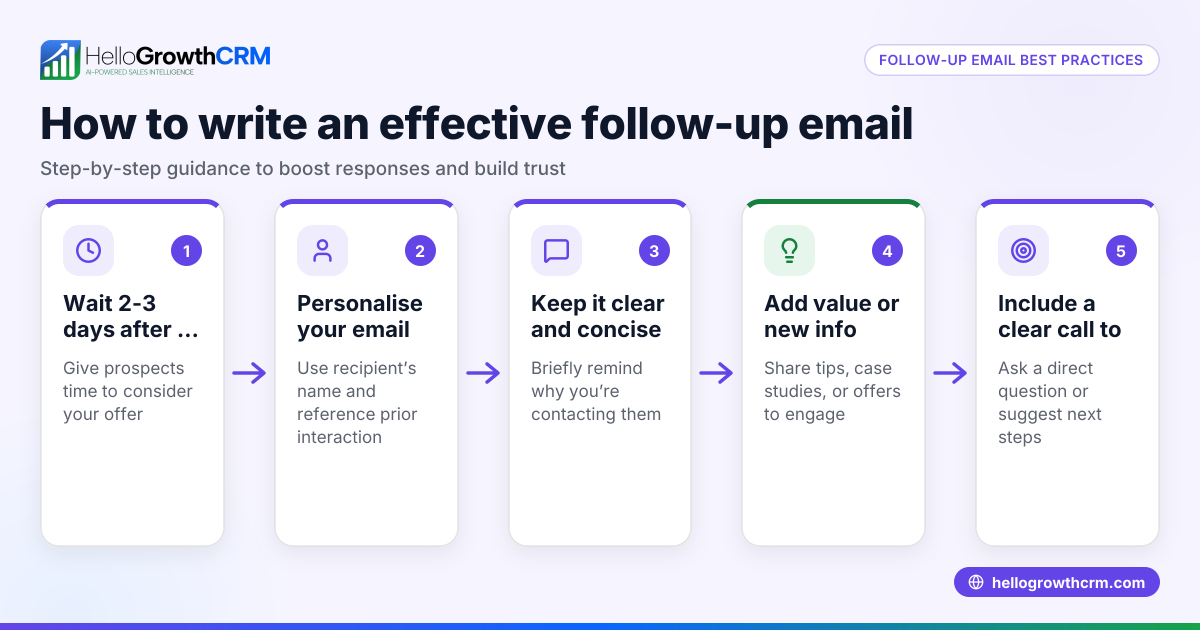
How do I follow up if I don’t get a reply? Send a polite follow-up email after a reasonable time, usually one week. You can automate this process with HelloGrowthCRM sequences to save time.
Key takeaways
- Use a clear subject line and formal greeting.
- Write concise, polite, and well-structured content.
- Include a clear call to action and professional sign-off.
- Proofread carefully and check attachments.
- Track replies and follow up promptly, using tools like HelloGrowthCRM.
Writing formal emails well improves your business image and response rates. Start improving your email communication today.
Start on the Free Forever plan (200 leads, no credit card) to organise your emails and leads efficiently.
Ready to put this into practice?
Set up your pipeline, WhatsApp follow-ups, and AI lead scoring in minutes — free, no credit card.
Try HelloGrowthCRM freeGet CRM tips in your inbox
Join thousands of sales professionals who get weekly insights on CRM strategy, AI automation, and pipeline optimization.

The HelloGrowthCRM team publishes guides on CRM strategy, AI sales tools, and revenue operations for small business sales teams.