HelloGrowthCRM software
Built for real small-business sales teams
HelloGrowthCRM helps reps qualify faster, follow up on time, and close more deals—with practical automation in one place.
- AI lead scoring and pipeline visibility
- Built-in dialer, WhatsApp, and email automation
- Sales forecasting and RevOps-ready reporting
Needs based selling is a sales technique that centers on understanding the buyer’s unique needs, challenges, or goals and then offering products or services that directly address those needs. Instead of delivering a generic sales pitch, you customize your conversation to solve the customer’s real problems.
Why this comes up / what goes wrong
Small business owners often face difficulty in closing sales because they focus on selling their product features rather than understanding the customer’s actual needs. For example, a business might highlight advanced features of its software without connecting those features to how they solve a prospect’s problems. This approach can cause leads to lose interest and sales opportunities to slip away.
Needs based selling arises as a solution because it shifts the focus from what the seller wants to sell to what the buyer truly needs. This method helps sales teams avoid wasting time on uninterested leads and builds trust by showing genuine concern for the customer’s challenges.
Step-by-step
- Research Your Prospect Before Contact
- Collect basic information about the prospect’s business and industry.
- Identify potential pain points or goals they might have.
- Check if they have interacted with your company before.
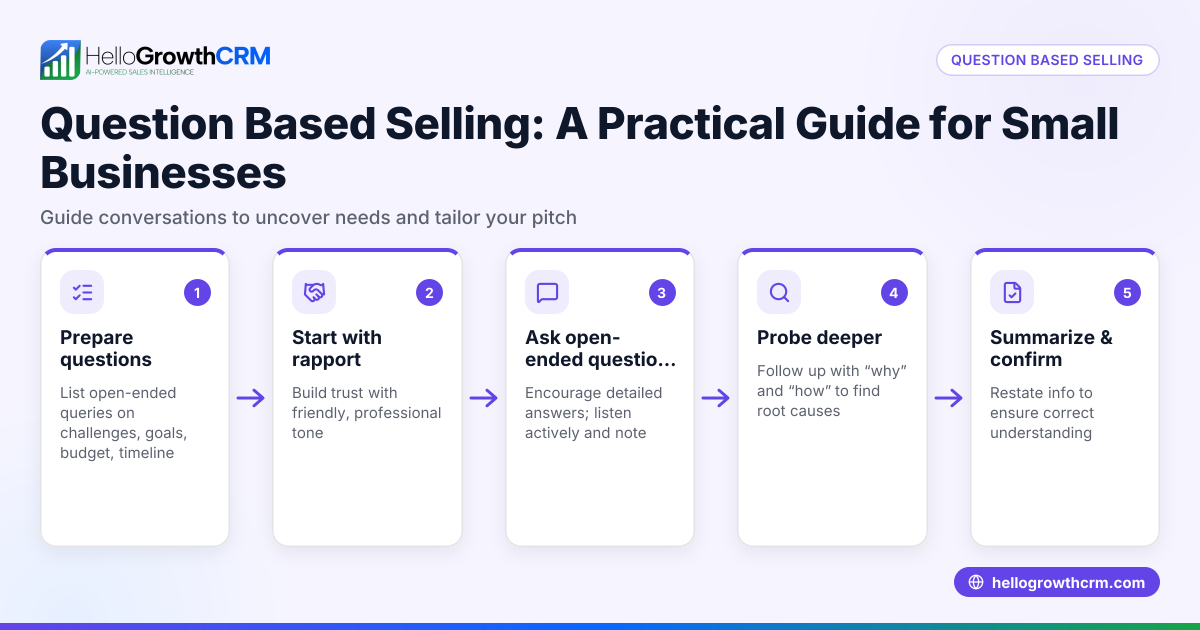
- Ask Open-Ended Questions to Discover Needs
- Begin with questions like, “What challenges are you facing in your current process?” or “What goals are you trying to achieve this quarter?”
- Listen carefully and take detailed notes.
- Confirm and Clarify Needs
- Summarize what you heard: “So, you want to reduce manual data entry and speed up your sales follow-up, is that right?”
- Ask for confirmation or additional details.
- Match Your Offering to Those Needs
- Present only the product or service features that solve the stated problems.
- Avoid mentioning unrelated features that do not address the customer’s needs.
- Handle Objections by Refocusing on Needs
- If the prospect raises concerns, relate your responses back to their needs.
- For example, “I understand cost is a concern, but since you want to improve follow-up speed, our solution can help you save time and reduce lost leads.”
- Agree on Next Steps Based on Their Priorities
- Set clear actions such as scheduling a demo, offering a trial, or arranging a follow-up call.
- Confirm timing and decision criteria.
- Track and Follow Up Promptly
- Use a system to remind you of follow-up tasks and deadlines.
- Quick responses demonstrate you value the customer’s needs.
Using a CRM with features like a built-in dialer and WhatsApp and SMS sequences can help keep your follow-up organized and timely. See built-in CRM dialer and WhatsApp and SMS CRM for tools that support these steps.
Example (fictional figures)
Imagine a B2B software reseller in Denver, Colorado, named "Mile High Software Solutions." They want to sell a CRM system to a local marketing agency struggling with lead follow-up.
- The marketing agency generates around 1,000 leads per year.
- Their average deal size is $2,500.
- They estimate they lose a portion of leads due to slow follow-up but have not quantified it precisely.
If Mile High Software Solutions offers a CRM that improves follow-up speed and helps recover some lost leads, they can explain the potential revenue impact like this:
Assuming they recover 20% of lost leads, and those leads convert at the average deal size:
Leads recovered = 1,000 × 20% = 200 leads
Potential revenue gained = 200 leads × $2,500 = $500,000
By focusing their sales pitch on how their CRM can help the agency improve lead follow-up and increase revenue by up to $500,000 annually, they align with the agency’s needs, making the sale more relevant and compelling.
Common mistakes
- Not Listening Enough
- Mistake: Talking too much about your product instead of understanding the customer’s needs.
- Prevention: Practice active listening and ask clarifying questions.
- Assuming Needs Without Asking
- Mistake: Guessing what the customer wants based on assumptions.
- Prevention: Always ask open-ended questions to confirm needs.
- Overloading with Features
- Mistake: Presenting every feature regardless of relevance.
- Prevention: Tailor your pitch only to the needs identified.
- Ignoring Follow-Up Timing
- Mistake: Delayed responses lose customer interest.
- Prevention: Use tools like built-in CRM dialer and WhatsApp and SMS CRM to automate reminders and quick contact.
- Failing to Align Solutions to Budget
- Mistake: Offering solutions that don’t fit the customer’s financial constraints.
- Prevention: Discuss budget early and propose options that meet their needs and price range.
Frequently asked questions
What is the main difference between needs based selling and traditional selling? Needs based selling focuses on understanding and solving the customer’s specific problems before presenting a solution. Traditional selling often emphasizes product features and benefits regardless of the buyer’s unique needs.
How do I find out what a customer really needs? Ask open-ended questions and listen carefully. Questions about their challenges, goals, and current solutions help uncover what matters most to them.
Can needs based selling work for all industries? Yes, it is effective across industries because every buyer has specific needs and problems. Tailoring your approach to those needs improves sales success.
How can technology support needs based selling? CRM tools with features like lead capture, follow-up task boards, and communication sequences via WhatsApp, SMS, or email help you track customer needs and maintain timely contact. See HelloGrowthCRM for the United States for examples.
What if a customer’s needs change during the sales process? Stay flexible and keep asking questions to update your understanding. Adjust your solution to match their evolving priorities.
Key takeaways
- Needs based selling starts by discovering the customer’s specific problems and goals.
- Asking open-ended questions and active listening are essential.
- Tailor your product pitch to directly address identified needs.
- Use timely follow-up to maintain trust and interest.
- Avoid overwhelming customers with irrelevant features.
- Technology like CRM systems with built-in dialers and messaging sequences can support this approach.
Start on the Free Forever plan (200 leads, no credit card) to organize your sales process and improve your follow-up speed with tools designed for small businesses.
Ready to put this into practice?
Set up your pipeline, WhatsApp follow-ups, and AI lead scoring in minutes — free, no credit card.
Try HelloGrowthCRM freeGet CRM tips in your inbox
Join thousands of sales professionals who get weekly insights on CRM strategy, AI automation, and pipeline optimization.

The HelloGrowthCRM team publishes guides on CRM strategy, AI sales tools, and revenue operations for small business sales teams.